Podcast: The Big Event

THE BIG EVENT
The BIG Event is the annual Stewardship Sunday held each Fall at LUCC. This year the celebration was focused on the ways that LUCC functions as a Base Camp: Mission Support. The BIG Event offered the opportunity to celebrate the many ways LUCC does this, a ministry that transforms lives and is worthy of support with time as well as money. Those present were given the opportunity to make a financial commitment to the church for the coming year and to indicate how they would like to contribute their time and talent to the ministry of the church.

THE SPEAKERS
At the BIG Event this year, three LUCC members shared how they experience the church as Base Camp: Mission Support.

From Colleen Coughenour

Good Morning, my name is Colleen Coughenour. When my husband, Mark and I first moved to St Pete in 1993, I’d all but given up looking for a spiritual base camp. As a young adult, I’d briefly been a part of two extraordinary church homes.

The first was when I was 19 years old. I was living in Boston for the summer and attended a Presbyterian/UCC church. It was here that I initially experienced the liberation of inclusive language – of God as a mother and a woman, and the inclusion of my gay brothers and sisters. It was life changing. The second, was a small progressive Mennonite community where Mark and I worshiped during our college years. The sense of community was safe, challenging and loving.

Both communities were an extension of the faith I’d been introduced to as a child – but unlike the churches of my youth, the base camps of my youth, where being female meant a smaller and separate tent – these churches offered a place to question and evaluate my faith, and for the first time gave me an equal place at the table and in the big tent.

In those days, and many after, so much of my energy was reconciling being a woman of faith yet not being included as a valued part of the body of Christ. Some of you have lived this as well. I knew these camps existed, but I couldn’t find one. It would be many year later – almost 15, before I would find another church that provided this kind of shelter, security, strength and call for service.

The years that followed involved relocating to Florida – and resulted in limited success at finding a church home. Fast forward to 1993, a move to St Pete with our two year old child; Mark and I decided it was time for another try. We visited several churches, but it was always difficult for me to get past the male oriented language. I just couldn’t go back to the tiny tent. I gave up, but fortunately for me, Mark kept looking. After reading an article quoting Pastor Kim – Mark urged me to go with him to visit Lakewood UCC. I was skeptical.

However, like many of you, that first visit left us feeling hopeful, like we finally found a home. Our base camp.

We were surrounded by a loving, welcoming community that although relatively small – reached out into the greater community in a powerful way. It didn’t take us long to know this is where we belonged; where we could explore, question and grow in our faith. A place where we too could recharge.

And not only did we recharge, but we proceeded to venture out into some of the most treacherous and exhilarating journeys of our lives. Emily, our oldest, was six when we decided to adopt our daughter Olivia, from China. It is unlikely this would have happened without the church. That journey took a lot of replenishing. It is here that our children were also raised. They had to the opportunity to grow up in a church where race, gender and sexual identity were not a test for entering the camp. They understood that welcome actually meant welcome.

We listened to the stories and observed the lives of those who were much older than us. People who had traversed these trails before, and warned us about the missteps and applauded us for making it through thorny ventures. These people, many of whom have passed on were instrumental in the camp. They were the sages, and the workers. The “old timers” who let us know that we were on the right trail. Their stories and support were essential and inspiring.

In many ways, I feel as though it has been a luxury to be a part of this congregation. The base camp is fully stocked and open to all. The inclusion and welcome for all people is a given. Here, we have formed lifetime friendships. Our two children have mostly moved on, but the lessons of the base camp live on. Olivia recently revealed to us her first (and Mark is hoping only) tattoo. It was a symbol of the UCC cross. We’ve witnessed and continue to witness faith in action through the lives of our brothers and sisters. We comfort and support each other in time of need, and celebrate the joy of living. All of our church community’s needs are met -and this , of course, allows us to venture out and express our faith in our greater community in a myriad of actions.

For us, the base camp has become a home. Others may stay for a time, re-charge and then move on. And we are grateful to have their energy, gifts and fellowship while they are here.

But here’s the catch. The base camp is always in need of attention. Someone needs to tend the fire, to gather the wood, cook the food, or build the shelter and of course, there’s always the need for someone to sing, play music and tell stories around the fire. It takes all of us.

So, today, I challenge you to think about what this basecamp means to you – and what part you can play to keep it running. I am so grateful for this community of faith, and look forward to giving of my time, talent and my financial support.

From Patti Cooksey

Over 20 years ago, I pulled into the parking lot of LUCC to respond to the church sign that read, office assistant needed. Within days I began serving as the part time LUCC office assistant, which was a perfect, safe base where I could find focus and make a few dollars while finishing my courses and senior thesis in the PEL program at Eckerd College. When I left LUCC about a year later, Pastor Kim gave me this apple paperweight with a beautiful note thanking me for my service and encouraging me to continue on in my studies, suggesting that I was a teacher. Nobody had ever told me that. I had always worked in the medical field. Her note seemed odd, but I kept reading it and still have that note–and this apple.

Today I am happy to say the apple has been on my bookshelf in my office at Eckerd College for over 16 years. I did continue my studies and have been blessed to serve Eckerd College as a teacher, an academic adviser, a consultant, a service learning coordinator, and a member of the spiritual life council. Mind you, I never applied for a job at EC; I was called to come back as an alum and serve as a writing tutor for students. My career blossomed from there. I think of Fredrick Buechner’s words as he spoke of vocation: “vocation is where your deep gladness meets the world’s deep need.” In reflecting on his words and the inspirational note from Kim, I can see that in listening and following, we can find our calling. This apple represents the day my journey to follow, to serve, began, and it has now become a symbol of my church home; my church family; my base camp.

Although I could write a book about the many joys that have come through teaching and sharing the successes of so many, I want to share some extraordinary circumstances from this past year that have helped me realize that the faith journey can become treacherous; grief, doubt, and confusion can obscure the path.

Facing the fallout of murders, violence, racism, bombings, and political divide in our society, my students and my classrooms, were becoming overcome with fear and anger. I found myself sometimes overwhelmed, uncertain, and drawing heavily on my faith to keep balance, openness, dialogue, and hope not only in the classroom but in my life as I shared their pain and sought answers. I saw racism; I heard the words and saw the expression and the body language of hate and mistrust. I had students who wept in my office after the shootings at The Pulse. Some of their families were dividing over social and political issues. They were having difficulty with their studies. I wept many nights on my way home, praying God could use me to help bring love, peace, and understanding into my classroom, and into the hearts of all who were suffering. This was not written into my course curriculum.

Along with prayer and blocking of any distractions that could keep me from my base camp, I climbed my way through any obstacle so I could reach LUCC base camp for renewal and refreshment through God’s word– and through my church family.

It has been a real struggle to stay on the path of light this year, but I can tell you that that light, warmth, love, and understanding have emerged. I have found renewal through the flickering firelights at the camp. I have been able to see students come back to me and share new understandings and a healing that occurred in the classroom. They have less anger and fear. I had a new energy as I stood with one student at the prayer vigil at City Hall as we prayed for the victims of the Pulse shootings. He found healing that night, a healing that went deeper than the shooting event. All of these blessings came from God and our church that unites us and leads us out to serve, to bring love, peace, and hope to those who suffer.

Today I continue to be nurtured and be given more love and understanding to carry forward. I may be a little wobbly in my hiking boots, but I know I can continue to serve not only those on the EC campus, but also the families in the Family Promise program, the neighbor on the ground suffering from a seizure, a brother grieving for his wife, a granddaughter abandoned by her wife. I also know I will find peace and guidance after recently losing my dear friend and now beginning to close out my position at EC. I have a firm foundation at base camp—a foundation of love, service and a unity that connects and strengthens me in my service.

While I have sadness as I am preparing to leave my office on the EC campus, I know I will carry forth many lives and many experiences as I go forward to wherever I am called. I will also have this apple to remind me to listen, to pull into base camp for the love, guidance, and peace that will lead me forward as I continue to serve LUCC. Thank you, Kim, for being the voice that led me to a vocation of joy and service, and thank you for being my camp leader. I now go forward on my journey with this apple, the love and mission of LUCC, and the words from this song in my heart:

Here I am Lord, Is it I Lord?
I have heard You calling in the night.
I will go Lord, if You lead me.
I will hold Your people in my heart.

From Victoria Long

This metaphor of mountain climbing, and the necessity of base camp speaks to me. Gary and I climb mountains, never Everest….but we did stand at the top of Kilimanjaro. I can speak with authenticity, when I say, I know what it feels like to wake up each morning, pull on my boots, step out of a tent and begin the day knowing…without the support of those around you…your goal…your hope… of summiting a looming formation that taunts your— every step….would never…could never…happen without those who sustain you at base camp.

And this is exactly what I discovered when I found myself adrift, almost three years ago….as I made my way through those doors and sat in your midst. You see, my GPS seemed to have gone astray. My vocation as an ordained minster had me traveling in a direction that I did not seem to have the necessary maps or the right equipment for. I had served a church as their associate minister, and I “thought” that was the adventure I had been called to. But a still small voice began to rise up, and I knew that place, in that time, was a mountain that had been navigated and now it was time to discover new elevations, new crevasses, cliffs and crags, and soaring slopes.

Mountain climbers are most often supported by a Sherpa. Sherpas are highly experienced mountaineers. They serve as guides at the extreme altitudes of the peaks and passes. These guides lend their knowledge and expertise to ones attempting to summit new ranges. Kim was the first of your Sherpas to throw me a rope, a cup of hot tea and a new compass. Yours is a base camp full of wise and seasoned travelers and much has been learned just sitting in your midst. I indeed took this sacred space and rested and reflected for awhile. I then was ready to be re-nourished, and finally feeling re-stored and renewed, I re-engaged!

Much has occurred over these past few years. Professionally, my path has had me traveling in places I never expected. As of September 26th, I am a full time Hospice Chaplain, with a team of my own and a redefined understanding of what my call had been all along. And if that were the only truth discovered, well that would have been worth the trip. But NO…there was more!

In this place of sanctuary….where we come to recover….we….you….decided…..we here at Lakewood would offer our Sherpa skills to others. To those who had found themselves homeless. We joined with Family Promise and Lakewood United Methodist to provide a base camp for families and their children and this base camp even came with tents! We became part of a network of camps that offered new trails/paths that sustains these folks as the climb out of poverty. Making a way out of no way, by being present to another and sharing what we have….what we have learned.

And that is what each of us are called to do…that is what Sherpas do You see…Sherpas cannot provide promises of expected or hoped for outcomes the individual climber may be holding within their hearts. They simply can companion with, offering support as needed. Because of their expertise, they can interpret the weather, the path, the crevasses better than those new to the journey. They can encourage and offer their wisdom gleaned from years of climbing, but ultimately it is up to the individual to make the accent. To journey with, for a while and then return to our own individual place and time. Possibly transformed by the experience, and able to share what we have learned with another.

That is what happens here…..Kim reminded us of that a few weeks ago…
Here, we listen for our calling.
Here we have our sense of mission confirmed.
Here we learn to work together, without the need for recognition, fame, or glory. We look out for each other and seek the highest good of the other. We find our calling to live for something beyond our personal satisfaction, comfort, and pleasure.
Here we identify resources, financial and human, to mobilize for mission.

It is in this place, each of us listen to our own “still small voice ” and respond to whatever mountain calls our name…..poverty, injustice in whatever form, children, the least of these….anyone the world treats “less than.”
Because… like another 21st century prophet has declared….we here at base camp Lakewood….respond.
And how do we respond?

When they go low…..we go high.!
Thanks be to God for this sacred space and place
Base camp….as sanctuary….LakeWood United Church of Christ!

THE HARVEST FORM
In addition to the speakers, there was the reporting of the results of the Harvest for 2016, read by Charles Lewis and Jim Andrews. Each year the church family is invited to fill out a form indicating the total amount of money donated in the past year and the total amount of time volunteered. In addition, there is the opportunity to list the organizations and activities that receive the time and money given. At The BIG Event, there is a reading of the list and a sharing of the total money and time donated. The information is astounding! Here is the full report.

REAPING THE HARVEST 2016

Total Hours: 5350
Total Dollars: $94,585
Total Sheets Handed In: 24

Organizations and Institutions:
Bread for the World
WUSF
Youngest Child
Humane Society
Bayfront Health
Gratefulness.org
Dali Museum
CropWalk
Family Promise
Sanderlin IB World School
Choir
Suncoast Hospice
LUCC office and book club
American Bible Society
Clearwater Central High School
Freefall Theatre
Harvard University
Metro Wellness
12 Step Programs
Bulow Charity
Operation Attack
Helping neighbor
PFLAG
SPC Community Chorus
Gulfport Senior Center Foundation
Library
Club Sports Kids
Political Groups
Tampa Bay Watch
Making Tote Bags
SAMS Episcopal Missionaries
Friends of the Depot
Daystar
Interfaith Association
Russian Heritage
Environmental Projects
SPIFFS
Sunday School
Eckerd College
Spiritual Counsel
Grinnell College
PDK
Avelos Scholarship Fund
Caregiver
Salvation Army
Geneva College
HEIFER Project
LUCC Roof
Making storage holders for walkers
CASA
Peninsula Rescue Mission
Jack and Jill
Union Theological Seminary
Macular Degeneration
Eden Theological Seminary
Sierra Club Solar Initiative
Suncoast Health Center
SPCA Tampa Bay
Pinellas County Schools
Smile Train
Easter Seals
University
Metropolitan Ministries
ECHO
Southeastern Fisheries Assoc.
Hillary Fund
Children’s Miracle Network
AARP
ASPEC at Eckerd College
WEDU
Shriners Hospital
Seafund
Maximo Elementary
Alzheimer’s Foundation
Westminster Suncoast Committees
Heart Association
Proliteracy
SOTENI
Putnam Co.
New College
American Association Of University Women
Friends of the South Branch Library
Monthly Journal at Westminster Suncoast
Methodist Children’s Home
LUCC Creation Justice Task Force
Red Cross
West Chester
SAGE
Wounded Warrior
Nature Conservancy
Florida Conference UCC
Shoe Fund
Westar Institute
Westminster Suncoast
Doctors Without Borders
Pet Pal Rescue
Habitat for Humanity
Equality Florida
International Rescue
Local Food Banks
Local Arts Community
National Public Radio
Children International
PBS
Emory University
American Diabetes Association
Americans for Responsible Solutions
Biloxi Mission
Southern Poverty Law Center
FINCA
Carter Center
Ghost Ranch
LUCC Communion Fund
Nepal Victims
Good Samaritan Church
Salvation Army
Heartbeat Scholarship
Good Will
Tampa Museum of Art
St Jude’s
Aylesworth Scholarship Foundation
WMNF
Samaritans Purse
Rincon UCC
First Church of Christ, Scientist
Terra Nova
Every Town for Gun Safety
Florida Orchestra
Sheriff’s Youth Ranch
Indiana University
Cancer Associations
University of Florida
St. Petersburg Free Clinic
Veterans for Peace
Parkinsons
Visiting long term care residents
LUCC Advisors
All Children’s Hospital
Visiting sick
Writing letters to inmates
CASA
Visiting hospital patients
Salesian Missions
Sea Level Rise Planning Network and Conferences
Floridians for Alternatives to the Death Penalty
Veterans Of Foreign Wars
Neighborhood Association
Center for Action and Contemplation
Suncoast Employee Appreciation Fund
First Presbyterian Church Festival Chorus
Amnesty International
Wellesley College
Syrian Refugee Crisis
Sing Out Tampa Bay
UMCOR
Piano Fund
Garden assistance
Refugees
Pass A Grille Beach Community Church
St. Anthony’s Hospital Foundation
Democratic Party
74th Street Elementary School
UCC Annual Fund
Internal Review Board, Bayfront Health
Family member with cancer
Suncoast Hospice Thrift Shop

SPECIAL MUSIC
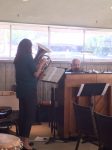
Special music for the celebration included Méditation from the opera Thaïs by Jules Massenet, performed by Katie Aucremann, solo euphonium, and Hilton Jones, piano and the Lakewood UCC Choir performing The Canticle of the Turning, featuring instrumentalists, the Rev. Mardie Chapman, piccolo, and Zach Blair-Andrews, guitar.

THE ALTAR
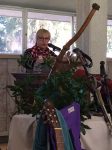
Colleen Coughenour prepared a beautiful installation for the altar that perfectly captured the theme: Base Camp: Mission Support.

PICTURE GALLERY

photos by Yoko Yogami

Click on any picture for a larger image and then again for a closeup. 
COMPLETE AUDIO PLAYLIST

Who Would Jesus Vote For?

Who could have foreseen what a bizarre, nasty, and divided election season this would be? Not only are we bombarded with constant trash about the candidates, here in Florida  there are also persistent lies about the amendments to the Florida State Constitution especially Amendment One relating to solar energy. And even if you try to avoid it all by ignoring the paper, the radio, and the newsfeed on the internet, they are dishing it up to you on your phone with incessant robo calls.

As Christians, much as this election season may disgust us, we know that it is an opportunity to vote our values and to express our faith in a way that matters and can make a difference. And so we suppress the urge to stay home and not even bother voting.

Let’s take a moment to examine how Jesus might vote if he were an American citizen today. Jesus was devoted to a God of love for all of Creation. He showed people a God of love and care for all with no prejudice based on religion, ethnicity, or sexual identity. With that God at his center, Jesus took action on a day to day basis. He showed us how to embody the universal love of God for all by acting with compassion and mercy for individual people. This exposed the injustices of the society of his day. Jesus disrupted the social, political, religious, and economic arrangements of his time because all of those systems were set up to protect some at the expense of others. It’s no wonder he was killed.

In thinking about how to make our voting decisions, we can think about Jesus taking into consideration the big picture: All of Creation is beloved by God. So, how will our vote affect all of Creation? How will our vote impact the besieged people of Aleppo? How will our vote make a difference to the melting polar ice caps and glaciers? How will our vote influence the child who is sent on to Middle School but still cannot read? What will our vote do for the people of all the nations of the world who are all made in God’s image and beloved? I think this is how Jesus would think about who to vote for.

In the Tampa Bay Times, there was a letter to the editor this morning in which the writer shares how he will decide who to vote for: “Both presidential candidates are flawed human beings. But we must vote for one. So, which might benefit us and our families the best?” That is how Leonard Mead of Apollo Beach will decide who to vote for. To me, this perspective is not consistent with the universal vision of Jesus. To limit our concern to “us and our families” in voting is not in keeping with Jesus’ concern for all of Creation. This is far too limited a perspective for someone committed to the way of Jesus.

In another letter to the editor today, R. B. Johnson of Indian Rocks Beach gives this advice for selecting who to vote for: “Instead of obsequiously marching in lockstep to the siren blandishments of party solidarity, we should be considering ourselves human beings first, Americans second, and members of political parties a distant third.” This perspective is much closer to the vision of Jesus. The writer is encouraging us to broader horizons, to consider the well-being of the whole human family, not just our own family. This is much more in keeping with the way of Jesus.

All of Creation is the self disclosure of God. All of life is sacred. Every person is created in God’s image. Judaism, Jesus, and Christianity are about a grand vision of the common good. And that is what should guide our voting as followers of Jesus.

Sermon Oct. 16, 2016 "Base Camp: Mission Support"

Date: October 16, 2016
Scripture Lesson: Matthew 14:13-36
Sermon: Base Camp: Mission Support
Pastor: Rev. Kim P. Wells

The challenges of climbing at high altitude are very much related to the thin air and its effects on the body. But there are other challenges as well. There is the terrain which is often rocky, uneven, steep, and perilous. But that’s not even the end of it. There is the danger of avalanche even in areas that may seem to be stable. It’s hard to know what may lead to just the right conditions for an avalanche to terrorize a mountain slope and anyone on it. And there is the weather. Snow. Clouds. White out. And wind; wind that is severe even to people from Florida used to tropical storms, hurricanes, and tornadoes. The wind in the mountains can be extreme because it is blowing the snow and the air pressure is so low.

A climber on one Everest expedition tells of being rocked by the wind at base camp: “I got back to camp about four-thirty or five and I just collapsed in my sleeping bag from exhaustion. . . I don’t think I had a molecule of energy left in me. Later [I] awoke or regained consciousness. . . and it was a terrifying experience for me. Actually, it was the wind that woke me up. It was just pushing me around inside of my tent. It was actually getting under the floor of the tent, picking me right up in my sleeping bag and slamming me back down and pushing me around. . .” [The Climb, Anatoli Boukreev and G. Weston DeWalt, p. 194] Winds of up to 200 miles per hour are known on Mount Everest. So, wind and weather definitely add to the hazards of high altitude climbing.

In addition, the altitude itself is a hazard. The air pressure is one-third the pressure at sea level, and this means the level of oxygen is one third what it is at sea level. The wind can further decrease the oxygen level by 14%. Experts predict that, “A sea-level dweller exposed to the atmospheric conditions at the altitude above 8,500 m (27,900 ft) without acclimatization would likely lose consciousness within 2 to 3 minutes.” [Wikipedia, “Mount Everest”] To avoid this kind of death, climbers acclimatize, a process that takes 40-60 days. They slowly move to higher altitudes helping the body become accustomed to the thinner air. But the low oxygen has many physical effects. The breathing rate increases from the typical 20-30 breaths per minute to 80-90 breaths. It’s like panting. The thin air leads to a constant state of exhaustion. It can cause dementia and brain damage. People experience a mental fog, they have difficulty making decisions, memory is poor, thought is slow, and even hallucinations can occur.

The atmospheric conditions slow down not only the brain but the body. It usually takes climbers 12 hours to climb about one mile on summit day on Everest. There is the constant danger of frost bite. And some people are afflicted with retinal hemorrhages which damage eyesight and can cause blindness.

With all of this, we may wonder why anyone wants to even attempt to climb Mount Everest or other peaks of such altitude! Yet, climb they do. This year, 456 people have summited Everest as of June. And, on case you are wondering, the oldest person to climb to the top of Everest was an 80 year old in 2013. The youngest was a thirteen year old in 2010.

Until the spring of 2014 when16 people were killed in an avalanche on Mount Everest, the climbing season of the spring of 1996 was one of the deadliest. Fifteen people died that year. A movie as well as several books and articles tell about the events of May 10 when several preventable problems, like too many people on the trail and an oxygen shortage, became deadly when the weather turned violent leaving 8 climbers dead. Apparently, the storm was awful. As one person tells is, “I mean, it was just like a hundred freight trains running on top of you, and I was screaming, but you know, a person five feet away couldn’t hear anything.” [The Climb, p. 194] The conditions were so extreme, that the support staff at the base camp did not feel they could venture out to help those who were in trouble.

Going down the mountain late in the day as it was getting dark with the storm making it impossible to see the way, a group of climbers that was close to base camp got lost. They formed a huddle trying to keep alive as they ran out of bottled oxygen and were in danger of freezing to death. One of those who was in the huddle described what it was like: “We did decide to huddle up. We got into a big dogpile with our backs to the wind. People laid on people’s laps. We screamed at each other. We beat on each other’s backs. We checked on each other. Everybody participated in a very heroic way to try to stay warm and to keep each other awake and warm. This continued for some period of time – I don’t know how long. Time is very warped, but it must have been awhile because I was extremely cold pretty shortly after that. We were checking fingers. We were checking each other’s consciousness. We just tried to keep moving. It was something of an experience that I’ve never really had before, being what I felt was so close to falling asleep and never waking up. I had rushes of warmth come up and down through my body – whether it was hypothermia or hypoxia I don’t know – a combination of both. I just remember screaming into the wind, all of us yelling, moving, kicking, trying to stay alive. I kept looking at my watch. . . hoping that the weather would clear.” [The Climb, p. 202] This huddle of climbers was about a 15 minute walk from camp, in good weather.

A guide for one of the expeditions, Anatoli Boukreev, had helped his clients to the summit earlier in the day. Then the expedition leader agreed that he should descend and be prepared to help the climbers as they returned to base camp. So, he went down, recovered himself, and prepared to help the other climbers as they got back. But the storm blew in and the others did not return. Finally two drifted in and told of the others, in the huddle, trying to stay alive. Boukreev went out into the raging storm and searched in the fierce wind and snow for the huddle. He could not find them. He returned to camp to warm up and regroup. He spoke with those who had returned. He went out again. This time, he found them. Some of the people could still walk and follow him back to camp, but some could not. Boukreev only had the strength to help one person at a time. He got one back to camp. Then he rested again. Restored himself. He tried to get others at base camp to help him go back to the huddle. They could not or would not help, feeling it was just too dangerous. Boukreev went out alone again and brought back another client. Again, he drank tea, rested, caught his breath, and tried to get others to help him. He went out alone a third time and brought back another climber. In all, he was able to save three of the five people who were lost in the huddle. He felt very guilty that he was not able to rescue them all.

After this awful tragedy, Boukreev was criticized by some, notably Jon Krakauer in his article and book, Into Thin Air, for going down the mountain ahead of his group and being at camp resting while the others ended up needing help on their way down. But the leader of the expedition had specifically agreed that Boukreev should be waiting at the camp so that he could go back up the mountain to help if needed.

In December of 1997, a year and a half after the tragedy, the American Alpine Club gave Anatoli Boukreev the David A. Sowles Memorial Award. This is one of the highest awards that a mountain climber can receive. It is given to those who have “distinguished themselves, with unselfish devotion, at personal risk, or at sacrifice of a major objective, in going to the assistance of fellow climbers.” Boukreev was a hero because he “repeated extraordinary efforts in searching for, then saving, the lives of three exhausted teammates trapped by a storm on the South Col of Mount Everest,” and made a “valiant attempt, at great personal risk, in going out into the renewed storm in one last-ditch effort to save his friend and expedition leader Scott Fischer.” [The Climb, pp. 292-293]

As a sidebar, Boukreev could not be at the ceremony to receive the award because he was back in the Himalaya mountains making a winter climb up Anapurna, a neighboring peak to Everest. Boukreev and one of his companions were killed in an avalanche on Annapurna on Christmas day.

In the story of the events on Everest in 1996, we see Boukreev keeping his strength in reserve so that he can help others. We see him going back to camp after each rescue to recover before his next effort. We see the rhythm of helping and recovering, helping and recovering. Without the recovery time at base camp, he would not have been able to save his companions.

We see this same kind of rhythm in the ministry of Jesus. He spends time staying centered and focussed and then he serves. Then, he recovers again and he is able to respond to the needs of the people. Then, he takes time away to connect with God, and he is restored so that he can respond to those around him once again. Jesus’ ministry begins this way. We are told that he is baptized but he does not immediately begin to teach and heal. He is baptized and then he goes into the wilderness centering and strengthening his heart. After that he returns to the people ready to teach and heal.

We saw this rhythm in motion in the scripture lesson that was read this morning. In the reading we are told that Jesus learns of the death of John the Baptizer, his cousin, who had prepared the way for him. John’s ministry of preparing is over. Jesus’ ministry can now come into its fullness. In this time of grief and transition, Jesus goes off to a deserted place by himself. He needs to recover and reflect. But when the crowds find out where he is, they follow. He has compassion on them and heals the sick. Then we have the story of the feeding of the 5,000. Serving. Meeting the needs of the world. Following that, we are told of Jesus sending the disciples off in a boat, dismissing the crowds, and going up by himself on a mountain to pray. Again, Jesus is recentering himself, restoring himself, so that he can serve. Then, we hear how the disciples in the boat get caught in a storm. They are afraid they will drown. Jesus comes to them and calms the storm. Then the boat gets to shore, we are told that the people come from all around bringing the sick to be healed.

In Jesus we see the wisdom of the rhythm of contemplation and action, prayer and serving, reflection and engagement. It is like Boukreev going back again to base camp to revive himself so that he could go back out to try to help others. For us, the church provides the setting for our contemplation, our restoration, our re-centering, our reflection, and our recovery. In the world, we are busy with trying to help others and be a healing presence. Then the church provides space for renewal. Here we find support and refreshment. Here we are nurtured. Here we are encouraged to think about our service and our calling and the needs around us so that we can figure out how to be an expression of love and compassion in the world. Here we sort things out and refocus. Here we assess the situation around us and within us and look to God for light. Buffeted, baffled, and blinded by the world around us, the church sustains us with the hopes and dreams of God. The ministry of Jesus gives us a lens for viewing our situation and the needs around us and within us.

The church provides the community that reminds us of the importance of the rhythm of engagement and reflection. Prayer and action. When we devote ourselves to serving without our grounding in the faith community, we may very well find ourselves burning out. Who should we serve? How should we serve? What are our gifts and skills for serving? The needs are so great. We may respond but then find ourselves spent, disillusioned, and without hope. We may be so overwhelmed we give up in defeat. The church as a community of support helps us to maintain our hope and our commitment to serve.

But prayer and worship and church without service also leads us into a condition that is not sustainable. The pretending and denying create a heavy burden. It’s hard to maintain a lie. We don’t find the wholeness and joy and peace promised by our faith without compassionate service. The book of James tells us faith without works is dead. Faith without works may also kill us.

For our faith to be vital, to find meaning, to be made whole, brought together from the fragments of our lives and the world, we look to Jesus, the mystic and the prophet. We see the way he paces his life to the rhythm of restoration, reconnection, and renewal balanced with healing, feeding, and teaching. In this way, his ministry is sustainable.

Next Sunday is The BIG Event, an annual celebration of the ministry of this church. This year, we will hear from several people in the congregation about how the church functions as base camp for them on their journey of discipleship. We will hear how the church grounds them in their service, nurtures them for responding to the needs of the world, and offers support when doing the right thing leaves us feeling sick and tired.

As part of The BIG Event, we will consider how we will support this church in its mission of sustaining the congregation in ministering to the world. The church is here for us as we seek direction and support for our lives. The church is here as a community of discernment and celebration to revive and refresh us. How will we offer our time, talent, and treasure to this community of faith which grounds us?

On that fateful day in May 1996 on Mount Everest, expedition leader Scott Fischer and guide Anatoli Boukreev had a conversation about the game plan for getting all of the clients down the mountain safely. Boukreev tells us about this conversation: “When I met Scott, my intuition was telling me that the most logical thing for me to do was to descend to Camp IV as quickly as possible, to stand by in case our descending climbers needed to be resupplied with oxygen, and also, to prepare hot tea and warm drinks. Again, I felt confident of my strength and knew that if I descended rapidly, I could do this if necessary. From Camp IV I would have a clear view of the climbing route to the South Col and could observe developing problems.

“This intuition I expressed to Scott, and he listened to my ideas. He saw our situation in the same way and we agreed that I should go down. Again, I surveyed the weather, and I saw no immediate cause for concern.” [The Climb, p. 178]

This was a very good plan. This provided the balance needed to support the climbers. Base camp was the setting for recovery and outreach. If Boukreev had not gone down and had been on the mountain with the others, it is likely that he himself would have died. Then he could not have helped the three people that he did save.

May the wisdom of Jesus lead and guide us as we think about how we are called to support this faith community which in turn sustains us. Amen.

In addition to The Climb, other sources for consulted include:
Into Thin Air, Jon Krakauer
Climbing High: A Woman’s Account of Surviving the Everest Tragedy, Lene Gammelgaard
High Exposure: An Enduring Passion for Everest and Unforgiving Places, David B. Breashears and Michael Gross
Left for Dead: My Journey Home from Everest, Beck Weathers and Stephen G. Michaud
A reasonable effort has been made to appropriately cite materials referenced in this sermon. For additional information, please contact Lakewood United Church of Christ.

Sermon Oct. 9, 2016 "The Mallory Mystery"

Date: Sunday Oct. 9, 2016
Scripture: 2 Timothy 2: 8-15 and quote from George Mallory
Sermon: The Mallory Mystery
Pastor: Rev. Kim P. Wells

Quote from George Mallory that was read after the scripture.

“Climbers who, like myself, take the high line have much to explain, and it is high time they set about it.  Notoriously they endanger their lives.  With what object?  If only for some physical pleasure, to enjoy physical movements of the body and to experience the zest of emulation, then it is not worth while. . . The only defence for mountaineering puts it on a higher plane than mere physical sensation.” [Because It’s There: The Life of George Mallory, Dudley Green, p. 64]

Why climb Mount Everest? The most famous answer came from George Mallory. “Because it’s there.” Mallory was part of three English expeditions to Mount Everest in 1921, 1922, and 1924. As an admired climber in Europe, Mallory was a likely candidate for these Everest expeditions. The first trip was for reconnaissance. There was much mapping, charting, and getting to know the area in order to scope out a possible route to the top.”

The second effort, the 1922 expedition, included several attempts to get to the top with no success. When asked to participate in the third expedition in 1924, Mallory at 37 years old, knew it would be his last chance. In the end, he and Andrew Irvine made the bid for the top and they headed up but never returned. Did they make it to the top? We don’t know. Mallory’s body was found on Everest in 1999. There was a fall and the two bones of his leg above the ankle were broken. Irvine has not been found. Neither has the camera that Mallory took with him. If they got to the top, surely he would have captured the moment on film. But that film has not yet been found and may well never be.

Whether or not Mallory reached the summit of Everest, we know that he lived out his dream. He wanted to be part of climbing the highest peak in the world. For Mallory, as we heard in the quote from the article read earlier, climbing was about much more than just the physical challenge. He was a teacher and a writer. He was very much concerned with culture, history, and human affairs. He had been part of World War 1, the war to end all wars. In the aftermath, it was a time of great optimism for humanity. There was prosperity and hope for lasting peace. Mallory supported the idea of the League of Nations. He saw himself very much as part of the whole human race. In a lecture at Charterhouse, where he was a teacher, he argued for a new kind of patriotism:

If the individual man is conscious of himself as belonging to various groups, to the family, the trade, the class, and many others, why should his group consciousness stop with the state? Why should not an Englishman become conscious of Europe as a group and then of the whole world; become, in fact, a citizen of the world? [Green, p. 83]

For Mallory, a gifted climber, being part of the Everest expeditions was about being a citizen of the world and advancing humanity as a species. Those involved felt that this was a step in the progress of humankind toward achieving its full potential. It was a symbol of human promise and capability. Climbing Everest in their eyes was a noble aim. A triumph for humanity as a whole.

This is a much different understanding than there seems to be today about climbing Mount Everest. Climbing the highest mountain in the world today has become much more about personal, individual achievement than about the betterment of humankind as a whole. It has also become big business. The heaps of garbage and the trails strewn with used oxygen canisters attest to this. Today, climbing Mount Everest is no longer thought of as a noble quest of the universal human spirit and a symbolic gesture of the potentiality of the human race as it was in Mallory’s day and the years following.

So Mallory and others left livelihood, home, family (Mallory had a wife and three children), and the comfort and safety of their lives in Europe to venture into the wilds of the Himalayas. They were gone for months slowly traversing sea and land. Gear was, to our sensibilities, primitive. There were none of the fancy new synthetic materials that are lightweight and warm. Tents were cotton canvas. Shoes were leather. Clothes were wool and tweed. Oxygen delivery was cumbersome, heavy, and unreliable. They were risking their lives for a greater good, in their eyes. A conquest for humanity.

And there was no promise of personal glory in the undertaking. These expeditions involved dozens of people, Europeans and local people from the Everest region. There were doctors, scientists, and a variety of climbers involved. There were camps established at regular intervals up the mountain supplying food, gear, and information. This supply chain made it possible to press ever upward toward the noble goal of doing something significant for the betterment of humanity. Lower camps could see weather issues from afar. And they had systems of communication – without satellite phones or walkie talkies. At one point there was a symbol system devised using two sleeping bags. Laying out the bags in a cross meant one thing. Laying them parallel meant another. And so on. In this way, they sent messages from camp to camp. When supplies were needed, there was contact with the camps below. Supplies were stowed along the way. It wasn’t until everything was in place, after weeks of setting up and putting out ropes, and identifying good camping locations, and acclimatizing for the altitude, that the actual summit bid could be made. There were many unknowns along the way including the physical condition of the climbers: Some got sick. Some couldn’t handle the altitude. Some were injured. And weather was a factor. They had to pick a day when the weather was just right. There were so many variables. So, who would actually make a summit bid was determined at the very end through an appointed chain of command. But the team as a whole always worked together. They were all committed to the challenge and contributed in every way they could. It was a perilous business and they knew they were dependent upon each other for survival. There was a great degree of trust and selfless dedication. And this was all in service to the noble aim of summiting Everest as a symbolic conquest celebrating the potential of the human spirit.

This image of the climbing expedition with team work and base camps helps us to think about the role of the church in our lives. For us, we are joined together in this community for a noble aim – to share the love of God. It is a high and holy calling. It requires our all and all of us are needed. We join together in the work with mutual support, hope, and trust.

In the verses from Second Timothy, we heard that beautiful line, the word of God is unchained. Here in church we listen for that word of God. That word of pure, unadulterated love. We look for that gift of grace. No limits. We listen for the unexpected word of hope and promise calling us beyond a current morass of grief, regret, or shame. The word of God unchained draws us into the faith community to be a source of solidarity and support for one another in our mission to love and serve God.

Here, we listen for our calling. How are we needed to serve for the good of the world? How are we made whole through our commitment to the way of Jesus? Here we have our sense of mission confirmed. We orient our lives toward the good of the world and in so doing find our highest good. Our internal spiritual work helps us to see our calling and to commit ourselves to noble aims. Here we learn to work together, without the need for recognition, fame, or glory. We look out for each other and seek the highest good of the other. We find our calling to live for something beyond our personal satisfaction, comfort, and pleasure. Here we identify resources, financial and human, to mobilize for mission. The church is really the base of support for our lives. We can count on getting the help we need and the support we need for the challenges of our lives. We feel a sense of solidarity with those who are living for a higher purpose than individual pleasure and comfort.

When we think of the story of Mallory, we are moved because we know that he gave his all to what he considered the betterment of humanity. He gave his greatest gift – his skill and talent for mountaineering – for the good of the world. We know he was true. And, here at church, that is what is asked of us. We are asked to listen for our calling; for how we are needed in the world. We tune our ears for the cries of the world as Jesus did. Here we are a part of a community of growth and commitment to life’s highest goals. Here we have team support for the challenges of life’s journey and for our mission through life for the good of the world. Here we are encouraged to give our lives to something beyond our personal pleasure, satisfaction, and glory.

Later this month, on Sunday October 23, the church will host The BIG Event. This is a special Sunday that involves a celebration of the life of the church and an opportunity to support the church with our financial resources, our time, and our talents for the year ahead. This year the theme is Base Camp: Mission Support. We are celebrating how, as a church, we are engaged in an expedition of sorts bringing God’s love to the world. And this community functions as our base camp. Here we find the supplies and support that we need. Here we find comfort and healing when we are hurting. Here we realize that we are not alone but are part of a community of solidarity. Here we know that we are needed. Here we offer support and encouragement and healing to others on the journey. Here we rest and take stock and assess our situation so we can proceed in a way that is true to the Gospel.

For the Everest expeditions of the 1920’s there were those who followed the proceedings from their armchairs in London giving substantially of their financial resources. There were those, like Mallory, who gave up earning a livelihood and endured financial sacrifice as well as risking their lives for the quest. A mission like getting to the top of Everest for the first time takes contributions of all kinds from many people all investing in a common dream.

Sometimes the mission of the church feels even more daunting than those first attempts at summiting Everest. We see the level of division, hatred, greed, and violence in our world and feel that the love of God is desperately needed in a hostile environment. And all of us are needed in that effort with our contributions whatever they may be. That beautiful phrase, the word of God unchained, reminds us that everyone is needed. God can use everyone. Everyone has a role to play in caring for each other and this precious world. There is no one who is not good enough or does not have resources enough to be part of God’s mission in the world. If you can breath, you can be of use to God for the good of the world.

Did Mallory and Irvine make it to the top of Everest? We don’t know. Mallory took a picture of his beloved wife, Ruth, with him to Everest. He pledged that he would leave the picture at the top when he got there. The picture was not found at the top when Tensing Norgay and Edmund Hillary got there in 1953. That’s not a surprise after so many years. When Mallory’s body was found in 1999, it was very well preserved as were his clothing and personal effects. There was a wallet with documents but no sign of the picture of his wife.

We trust the word of God unchained, within us and among us, and follow the leading of love, whatever the outcome, however perilous, or unlikely the circumstances. . . Amen.

A reasonable effort has been made to appropriately cite materials referenced in this sermon. For additional information, please contact Lakewood United Church of Christ.

Sermon Oct. 2, 2016 "Come Union" World Communion Sunday

Date: Oct. 2, 2016, World Communion Sunday
Scripture Lesson: Jeremiah 29:1, 4-7
Sermon: Come Union
Pastor: Rev. Kim P. Wells

You probably don’t know that Alexander von Humboldt was very likely the most famous person on Earth in the 19th century. He was a scientist, writer, polymath, and world traveler. In later life, Humboldt lived in Berlin. An American travel writer of the 1850’s tells us that “he had come to Berlin not to see museums and galleries but ‘for the sake of seeing and speaking with the world’s greatest living man.” [The Invention of Nature: Alexander von Humboldt’s New World, Andrea Wulf, p. 270]

On the hundredth anniversary of Humboldt’s birth, Sept. 14, 1869, there were celebrations of great magnitude the world over. There were festivities in Buenos Aries, Mexico City, and Moscow. In the US, there were parades and events in San Francisco, Philadelphia, Chicago, Boston, Charleston and beyond. Eight thousand gathered in Cleveland. Fifteen thousand gathered in Syracuse. There were 10,000 gathered to celebrate in Philadelphia including President Ulysses S. Grant. In New York, 25,000 gathered to remember Humboldt. Perhaps the biggest celebration was in Berlin where 80,000 people gathered in torrential rain for speeches and singing. [p. 6-7]

Why was Humboldt so renowned? Basically, he came up with the concept that nature is one living, breathing, interconnected whole. Through his scientific investigation and calculation, Humboldt developed the concept of nature, the web of life, that we assume today. He discerned that cutting down trees led to less rainfall and the drying up of a lake and could lead to global warming. This was in the early 1800’s. He speculated about there being tectonic plates that influenced the shaping of the earth as we know it. He traced global weather patterns. He identified links between different forms of life.

But Humboldt did not only study the natural world. He was moved by it. He had an intense emotional response to nature. So his scientific findings are intertwined with poetic descriptions of the glories of nature. He wrote many books with vivid illustrations to share what he was discovering. They were translated into many languages and widely read around the world. He also lectured to great acclaim. “I have never heard anyone in an hour and a half give expression to so many new ideas,” one scholar wrote. [p.196] Humboldt’s presentations were known to have “wonderful depth” and “lightness of touch.” People remarked on the extraordinary clarity with which Humboldt explained the complex web of nature. As his biographer Andrea Wulf describes it, “Humboldt was revolutionizing the sciences.” He was bringing scientific knowledge together into one cohesive whole. Human and animal. Life and land. Water and sky. All linked into one amazing system of which people were only a thread in a much larger tapestry.

We see this kind of wholistic view of Creation in the Genesis imagery of the Bible. Everything is created in an orderly manner to fit together to form a cohesive world. We also see throughout the Bible the use of nature imagery to portray and reveal the interconnectedness of humanity and nature and God. Nature reveals God. One world. One creation.

In the teachings of Jesus we also see this unity. Religion and society were busy trying to divide people up and separate them into haves and have nots, clean and unclean, citizen and alien, slave and free, etc. We see Jesus treating everyone as a beloved, precious, sacred child of God. Samaritan. Beloved. Blind. Beloved. Woman. Beloved. Prostitute. Beloved. Widow. Beloved. Tax collector. Beloved. Leper. Beloved. Jesus shows us there are no borders or boundaries to Divine Love. Divine Love embraces all: Those with HIV. Victims of human trafficking. Corporate executives. Corrupt politicians. Religious extremists. Homeless people. Drug addicts. Refugees. Immigrants. Communist. Capitalist. Everyday people. You. Me. Whatever our past. Whatever our politics. From the perspective of the Divine, we are sisters and brothers all. One community. One family. This is what Jesus shows us. His ministry is an affirmation of what we heard from Jeremiah. Live together. Seek the well-being of others and you will secure peace and security for yourself.

We also see Jesus showing us the interrelatedness of humanity and nature. Many times Jesus draws upon nature to express the character of God. God knows of the sparrow that falls to the ground. Surely, then God cares for you. Lilies neither toil nor spin. Surely God intends for you to thrive without stress or worry. Foxes have dens, birds have nests. Surely God wants everyone to belong and have a sense of home. Jesus follows in his tradition using nature to communicate about God and God’s love. A love that is universal. That knows no bounds or borders. As Shimon Peres, the former president of Israel who died this week said, “When you climb mountains, you don’t see borders.” [Heard in an interview with a former aide of Shimon Peres on the BBC]

Alexander von Humboldt was the first person of modern times to articulate and promote the unity and oneness of all of Creation. He portrayed the web of life. He showed the interconnectedness of land and water and animals and plants and people as part of a unified, miraculous whole. He also proclaimed the richness of nature integrating the scientific perspective and an artistic view. Intellect and emotion, thought and feeling, measurement and awe were of a piece. And from his travels and studies, Humboldt also affirmed the unity of the human species and was very much against slavery and oppression. He was a fierce defender of human rights.

Humboldt significantly influenced the poets Goethe, Wordsworth, and Coleridge. He was revered by Thomas Jefferson, Simon Bolivar, and Henry David Thoreau. And he was the inspiration for Charles Darwin.

As I read Andrea Wulf’s beautiful testimony to Humboldt, The Invention of Nature: Alexander von Humboldt’s New World, I kept asking myself why we don’t know more about Humboldt today? I didn’t recognize his name. My spouse, a science teacher, knew the name but not much more. Humboldt’s ideas were spot on. He predicted the problems that would be caused by cutting down trees, especially in the topics, and how that would lead to global warming. And this, 200 years ago. Why don’t we know more about him? In the epilogue of the book, I finally got my answer. One reason we don’t know more about Humboldt is that during his lifetime and subsequently, science was dividing up into separate specialities and disciplines. And science was also moving away from art and literature. So Humboldt, with his view of unity, was running against the intellectual grain that was subdividing and specializing. Wulf tells us, Humboldt with “his more holistic approach – a scientific method that included art, history, poetry and politics alongside hard data – has fallen out of favour. . . As scientists crawled into their narrow areas of expertise, dividing and further subdividing, they lost Humboldt’s interdisciplinary methods and his concept of nature as a global force.” [p. 335] And here we are in the 21st century, aware of the limitations of specialization and looking for connections once again and trying to see things from a variety of disciplines because we have come to know that the best arrangements and solutions for humanity and the Earth come from looking at things from multiple perspectives.

Also, as an explanation of Humboldt’s more recent obscurity, Wulf posits that his ethnic origin contributed to his fading from memory. Humboldt was of German heritage and the anti-German sentiment, as least in the United Kingdom and the United States, was so great from the First World War on, that Humboldt was ignored and forgotten. Specifically Wulf tells us: “In Cleveland, where fifty years earlier thousands had marched through the streets in celebration of Humboldt’s centennial, German books were burned in a huge public bonfire. In Cincinnati, all German publications were removed from the shelves of the public library and ‘Humboldt Street’ was renamed ‘Taft Street.’” [p. 336]

When we separate and divide, when we label and limit, we move away from the oneness that is intended for Creation. And we do so at our peril. We lose our center; our connection to the sacred, to our deepest selves, to one another, and to all of the natural world. We wither and perish. This World Communion Sunday invites us to celebrate our faith which calls us to oneness with all of our brothers and sisters and with all of nature. It is an affirmation of this miraculous, mysterious reality of which we are a part. It is a reminder that all of creation is our home and all of life our family. Amen.

The information about Alexander von Humboldt used in this sermon is taken from Andrea Wulf’s The Invention of Nature.

A reasonable effort has been made to appropriately cite materials referenced in this sermon. For additional information, please contact Lakewood United Church of Christ.