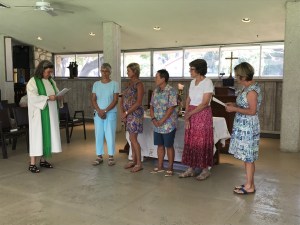
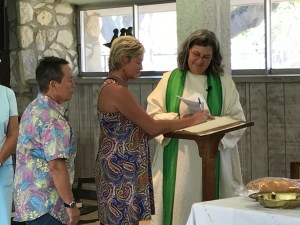
Yesterday, Rhonda Lay and Penny Hammond joined Lakewood United Church of Christ.

photos by Yoko Nogami
Click on any picture for a larger image.
Yesterday, Rhonda Lay and Penny Hammond joined Lakewood United Church of Christ.
photos by Yoko Nogami
Click on any picture for a larger image.
Click on any picture for a larger image.

After sandbagging all the doors that leak in heavy rains, taking off the roadsign letters, moving plants and nursery gear indoors, and arranging interior to prevent damage, the hearty crew pauses for a selfie: (L to R above) Hilton Jones, Bill Lindsay, Yoko Nogami, Rev. Wells, Gary Long, Victoria Long, and Bill Parsons.
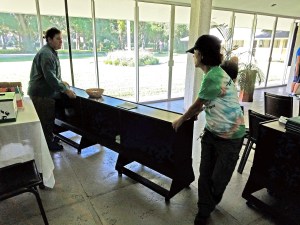
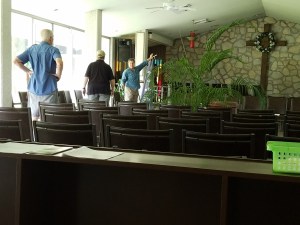
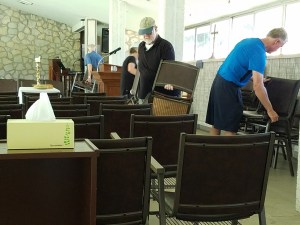
Just filled 10 sandbags for the church at Azalea Park in the middle of the day in the rain. No waiting! (tweeted 12:05 PM – 6 Sep 2017 from St Petersburg, FL by Rev. Kim Wells)

Date: August 27, 2017
Scripture Lesson: Matthew 15:10-28
Sermon: The Power of the Mouth
Pastor: Rev. Kim P. Wells
So, a man was seen fleeing down the hall of the hospital just before his operation. “What’s the matter,” he was asked.
He replied, “I heard the nurse say, ‘It’s a very simple operation, don’t worry, I’m sure it will be all right.’”
“She was just trying to comfort you. What’s so frightening about that?” he was asked.
“She wasn’t talking to me. She was talking to the doctor.”
Even when we may have the best of intentions, our mouths can get us in trouble; at least I know that mine does. And it’s usually with my kids. . . Do you ever have that problem? Something is said. The impact was not anticipated. And we’re mired in a mess. What comes out of our mouths can be a problem. Our words can get us into trouble as the president keeps reminding us!
And, surprisingly, Jesus shows us this, too. The writer of Matthew shares the story of Jesus teaching about the power of what comes out of the mouth. The religious legalists were worrying about what was going into the mouth – eating certain foods and not eating other foods. Ok. But they were not worrying about what comes out of the mouth. Jesus reminds us that what comes out of the mouth comes from the heart which generates evil intentions, murder, adultery, fornication, theft, false witness, and slander. Whew! All these things lurk in the heart and come out of the mouth. Jesus teaches that this is what people should really be worrying about. Fixing what is in the heart and what comes out of the mouth is what brings us closer to God.
Then, in the next story, we are told of Jesus’ mouth getting him into trouble. It’s quite ironic, actually. A woman comes to Jesus begging for healing for her daughter. And first he does not respond at all. Nothing comes out of his mouth. Then the story has Jesus saying, “I was sent only to the lost sheep of the house of Israel.” This person pleading for her daughter is not from the house of Israel. She is a Canaanite. An indigenous person. A Gentile. And a woman. She has several strikes against her from the first century Jewish perspective. Jesus ignores her and then refuses her. Then, he insults her: “It is not fair to take the children’s food and throw it to the dogs.” Yup, in the story Jesus calls her a dog. In terms of what is coming out of the mouth, this story goes from bad to worse.
The encounter in this story echoes with the racism that we have seen in this country. Can’t you hear a traditional, respectable white man telling a black woman that he isn’t going to help black trash like her? Even a white doctor, years ago, saying that to someone black in need of medical treatment? Sorry. Can’t treat blacks. And probably putting the message across in far less civil terms? Jesus basically tells this woman, I was not sent to help the likes of you. The way this story is written, Jesus’ mouth is getting him in trouble. And in the story just before it, the writer has Jesus telling people to be careful about what comes out of their mouths. Interesting.
The mouth can get us into trouble. By ignoring someone’s pleas, we ignore their humanity. We degrade them. We demean them. Does that make the pleading go away? Usually it just gets louder and more persistent. Think of all the people who are begging for help today. People in areas affected by sea level rise begging to be heard. People who are starving and have no access to food, perhaps because of drought or war. And they are pleading for food. For a place to live. For access to basic human necessities. There are people begging for the recognition of their full humanity. People pleading for access to economic self sufficiency. People begging for the freedom of self expression. Pleading to live in violence free communities. Begging to have access to health care. There are many voices imploring in the world.
Sometimes these needs are met with silence; just ignored which is a message in itself. You are not worth listening to, hearing, or paying attention to. You are worthless. Insignificant. Sometimes nothing comes out of the mouth but a message is still sent.
Sometimes our mouths deliver outright insult and injury. I was sent to the lost house of Israel. Not for you, you dog. You’re not my problem. Go home. Get a job. Even when we try to contain it and be more diplomatic, sometimes our mouths just let loose revealing what is truly in our hearts. And we find ourselves a long way from the compassion and justice that we are aiming for.
The mouth is a tricky thing and very hard to control. Words can wound. Our mouths can get us into trouble we did not expect or foresee.
Some years ago I was working part time for the Florida Conference of the United Church of Christ and I was assigned to help a church that was seeking a new pastor. As part of the process, the search committee creates a list of the ten characteristics that it feels are important in their next pastor. Then the committee rates each candidate on the list of ten characteristics. To practice, the committee reads a “dummy” profile, a dossier, and then uses the list of 10 characteristics and the rating system. So the committee did the reading and the rating and then we had a discussion of the process. An older gentleman on the committee asked, in all seriousness, “Well, that’s ok for the pastor, but how do we go about rating the wife?” The best I could do at the time was use every ounce of my will to keep my mouth shut. I was so stunned by the many insinuations of the question that I was afraid of what I might say, so I remember sitting there intently telling myself, Don’t open your mouth. Don’t open your mouth. Don’t open your mouth. Don’t open your mouth. Finally, I felt calm enough to begin to respond. I didn’t have to say much. Some of the women on the committee took over and set the man straight – about assuming the candidate would be a man, assuming “he” would have a wife, assuming the wife would be involved in the church, and so on. . . Whew!
It was a vivid reminder of how powerful the mouth can be. We see this from the Canaanite woman in the story of the encounter with Jesus. In the story, Jesus ignores her and then insults her. But she is undeterred. She continues to use her mouth to pursue her goal: healing for her child. We had a colleague in seminary who preached in chapel one day and I’ll never forget Ada Maria Isasi Diaz telling us that no matter your circumstances you are never powerless as long as you have a mouth. That Canaanite woman absorbed insult and injury and kept using her power, her mouth, to get the response she so desperately sought. Ok, we’re dogs, but don’t even dogs deserve crumbs? She will still take a crumb. She will do whatever it takes to get healing for her precious child.
The closing of the story again shows the power of words. We are told that Jesus does not go back on his commitment to address himself only to house of Israel. He doesn’t back peddle on ignoring the woman or insulting her. He attributes the result of the encounter to the woman herself: “Woman great is your faith. Let it be done for you as you wish.” And the daughter is healed. The healing is attributed to the woman’s faith not to Jesus. He saves face and she gets her healing. Ah, the power of words.
Words can cause incredible harm. Can you think of a time something has been said to you that has cut you to the core? Just pierced you? Words, sharp as a knife. And maybe closer to our hearts, more to the fore of our memories, are the times we have caused harm with our words. Can you remember something you have said that was hurtful or harmful? That you regret? That you would instantly take back if you could? We know that the ditty, ‘Sticks and stones can break my bones but words can never hurt me,’ is simply not true. Words can hurt.
But words can also heal. Yes, words are powerful, and that power can be positive. It can be constructive. It can be loving and healing. Words can do harm but they can also do good. Think of the times you have heard words that gave you relief and peace. Think of words shared that have led to understanding and reconciliation. “I’m sorry.” “I didn’t mean that.” “I did not understand how you felt.”
Recently my husband, Jeff, confronted a comment that was made to him using words to convey a powerful message. While he was cleaning up after a meeting, another white man said to him, “You do a pretty good job for a white guy.” Jeff responded with civility and candor and challenged the racism laden in that comment. After a calm, thorough exchange, the other man held his ground claiming his comment was not racially charged at all. Well, you can take the horse to water but you can’t make it drink.
Words are very powerful. Look at all the attention the words and signs have been getting at recent demonstrations. Some of the words are shocking and offensive. But many of the words are words of healing and hope. And as people of faith, and people with mouths that can speak words, we have the power to use our words for good.
When we went to the Women’s March in Washington, D.C. in January, we had the opportunity to visit the new National Museum of African American History and Culture. I snapped a picture of this quotation: “If I were white and believed in God. . . I would speak in no uncertain words against Race Prejudice, Hate, Oppression, and Injustice.” These are the words of Florence Spearing Randolph, spoken in 1941. Randolph had a long career of using words for healing and transformation. She was the first woman ordained by the African Methodist Episcopal Church of New Jersey. Randolph was born in Charleston, South Carolina into a family of free blacks. She was trained as a dressmaker and moved to the New York area to pursue her trade. She was involved at her church but had no inclination toward the ministry. It was her pastor that encouraged her. The authorization of a woman for ministry was extremely controversial and the source of much bitter debate. But in 1897, Randolph was licensed to preach and in 1900 she was ordained a deacon and then an elder. She was tutored by Dr. E. George Biddle, a graduate of Yale University, and a scholar of Greek and Hebrew. She studied at Drew University where a prize is given each year that is named for her – to a woman demonstrating powerful preaching and potential for outstanding pastoral leadership. In Randolph’s first 12 years of ministry, she served 5 churches, all small and poor and struggling, for, of course, no pay. She represented the AME Zion church at a conference in London and traveled to Scotland, Belgium, and France giving lectures and preaching. Randolph served on the mission field in Liberia and Ghana. She brought a young woman back from Africa and saw that she was educated in America. Then the woman went back to Africa to be a teacher.
In 1925 Randolph was called to Wallace Chapel AME Zion church on a temporary basis which then lasted for 21 years.
Randolph founded the New Jersey State Federation of Colored Women’s Clubs. Through this initiative, she organized people to address issues of race, gender, social inequality, and colonialism. She fought lynching and real estate laws that prevented blacks and Jews from living in certain neighborhoods. She promoted scholarships, health programs, and the inclusion of African American issues in the state and national press. She was an active suffragist seeking the vote for women, all women. She was active in the temperance movement. She promoted the celebration of what was then Negro History Week. She was recruited to work on the presidential campaign of Warren G. Harding and in the 1930’s ran for assemblywoman in New Jersey.
Randolph used her mouth in the church and beyond as voice for the healing and transformation of society and left a long, noteworthy legacy of her efforts for the benefit of the individual as well as society as a whole. But she knew that her power was limited as a black woman, and so she encouraged white people of faith to use their mouths for good in the world. In 1941, at 75 years old, at her church in Summit, New Jersey, she preached a sermon, “If I Were White.” And she told the congregation, “If I were white and believed in God. . . I would speak in no uncertain words against Race Prejudice, Hate, Oppression, and Injustice..In the city of Summit, I would speak of the unjust housing problems affecting Negroes, the school problem…the lack of Negro books in the library, the ignorance of Negro history because it is not taught in schools.” Personally, I think that she deserves a statue.
Can’t you see the spirit of the Canaanite woman in Randolph? The persistence? The clarity? The faith?
Each one of us has a mouth. And, yes, sometimes that mouth is going to get us into trouble. We’re going to say the wrong thing. The negative sentiments of our hearts are going to slip out of the mouth. But we also have love in our hearts. We have the deep desire and yearning for justice and compassion in our hearts. Think of that Canaanite woman so intent on the healing of her daughter. We, too, are desperate for the healing of our lives and our world. We must be sure that we are letting that out of our mouths. We can speak words that are poignant and savvy. We can utter words of honesty and integrity. Our mouths can form words that convey the sentiments of those who are ignored. Like the Canaanite woman and Florence Spearing Randolph we must intentionally form words of healing and love with our mouths. Amen.
For information about Florence Spearing Randolph, please see:
http://blog.nj.com/ledgerarchives/2008/01/black_history_month_a_look_for.html
https://bestofnj.com/black-history-nj-florence-spearing-randolph
http://www.summithistoricalsociety.org/historian/2016/3/26/the-rev-florence-randolph-pastor-of-wallace-chapel-helped-spearhead-womens-suffrage
A reasonable effort has been made to appropriately cite materials referenced in this sermon. For additional information, please contact Lakewood United Church of Christ.
Scripture Lesson: Matthew 5:43-48
Sermon: Living in the Light
Pastor: Rev. Kim P. Wells
Are you all ready to watch the eclipse tomorrow? Do you have your protective glasses? Have you picked your watch site? Will you join others or watch from home?
Jon and Susan Brewster of Monmouth, OR have been planning for this solar eclipse for about half their lives. They bought the property for their home in the early 1990’s at a location which they believed would be absolutely ideal for observing the solar eclipse of 2017. They built their house to insure perfect viewing of this 2 minutes of totality.
Jon Brewster says, “This thing is coming at us like a freight train. It’s been decades, and then it was years, and then it was months, and now it’s weeks.”
“We’re testing things, we’re doing trial runs, we’re amping up the logistics, because everybody wants to come,” he says.
Looking to Monday, Brewster concedes, “All of this work, all of this time, all of this effort, and it’s cloudy that day — it’s Oregon, it could be cloudy. It’s part of the game. It’s not a problem. We’re going to get two minutes of darkness followed by hamburgers.” [https://www.circa.com/story/2017/07/19/scitech/jon-brewster-susan-brewster-of-salem-oregon-engineer-house-for-solar-eclipse]
12.2 million people in the US live in the path of totality. Between 1.85 and 7.4
million people are expected to visit the path of totality tomorrow. Hotels are full
and highways are expected to be jammed. We can hear more about that next week
from Charlie and Mary Beth Lewis, and Grace Lewis and Sarah who have gone to South Carolina to see the eclipse.
Michael Zeller, of Santa Fe, New Mexico works in geographic information systems. I think that means that he makes maps. He is also a devotee of eclipses. Zeller has done a thorough statistical analysis of populations and highways and the path of the eclipse. And he gives 5 reasons that he believes account for the high numbers of people that will be experiencing the totality of the eclipse tomorrow. He says:
• The path of totality cuts a diagonal path across the nation from Oregon to South Carolina and most Americans live within a day’s drive to the path of totality.
• The United States has an excellent highway system and most American families have it within their means to take a short driving vacation.
• August is an ideal month for a vacation; the weather is warm and the chance of summer storms has diminished in much of the nation.
• Most schools have not yet begun their fall session by August 21st and some schools near the path of totality are scheduling a late start.
• Social media will have a huge impact on motivating eclipse visitors. The eclipse is exactly the type of event guaranteed to go viral on Twitter, Facebook, Instagram, and other social platforms. We expect that many people will only make plans to go in the week before eclipse day.
[Eclipse information comes from Zeller’s website, GreatAmericanEclipse.com,
https://www.greatamericaneclipse.com/statistics/]
Well, Zeller and his practicalities aside, this solar eclipse, this one of a life time for many, has captured our imaginations. We have become fascinated by this heavenly event. And this fascination with the skies may be motivated in part by the mess that is taking place here on the ground in the US. Our spirits need a lift. Something to look up to for a change! And here comes this eclipse.
Throughout human history, we have looked to the sun in awe and reverence. Even before we could know that the sun was essential to supporting life, to growth, to fertility, and as an essential power source. We have been devoted to its rising and setting. The shortening and lengthening of daylight through the year. Humans have always been drawn to the sun.
The sun has been of religious significance since prehistoric times. Stonehenge is a marvel of engineering, miraculously constructed over 4000 years ago by people with limited resources and technological abilities. While its role and function is not fully understood, the positioning of the stones relates to the sunset at the winter solstice and the sunrise at the summer solstice. So the erection of those stones, some up to 50 tons in weight, some having been transported up to 150 miles, is related in some way to the sun. [From Wikipedia, “Stonehenge”]
The Mayan Temple at Chichen Itza in Mexico, important from 600-1200 CE, is positioned for the fall and spring equinoxes. In the late afternoon the sun falls just so on the steps of the pyramid casting triangular shadows that look like a slithering snake, a symbol of one of the Mayan gods. Amazing the significance we have given to the sun throughout history.
We also see the importance of the symbolism of the sun and its association with the Divine in our own religious tradition. In the Genesis story of Creation, the sun is cast as a light for the Earth, for the land and waters, for the activities of the life forms, for the doings of earthlings. The sun is associated with the presence of God. When people were afraid and anticipating the end times, they expected the sun to go out. The prophet Ezekiel tells us: “When I blot you out, I will cover the heavens, and make their stars dark; I will cover the sun with a cloud, and the moon shall not give its light.” [32:7] From the prophet Joel, we hear: “I will show portents in the heavens and on the earth. . . The sun shall be turned to darkness, and the moon to blood, before the great and terrible day of God comes.” [2:31] And from the prophet Amos: “‘On that day,’ says God, I will make the sun go down at noon, and darken the earth in broad daylight.” [8:9] So we see that in the Bible, the darkening of the sun is associated with the judgment of God. No sun. No light. No enlightenment. No power of love. No Divine presence. The end.
We see this symbolism powerfully used in the stories of the crucifixion of Jesus.
In three of the gospels we are told that at noon on the day that Jesus was crucified
on the cross the sky became dark. There was no sun, no light. This is a drastic portrayal of the crucifixion as a traumatic event of cataclysmic proportions. The presence of God is not seen. The sky turning dark, the absence of the sun, is the most compelling way to convey that God’s presence is not experienced.
The sun continues to attract our attention and our imagination as this upcoming eclipse reminds us. Fundamentally, existentially, viscerally, we are drawn to the sun. It is our life line – physically and spiritually. I think the sun, this crucial image of human dependence on the Divine, is very intentionally and effectively used in the verses that we listened to this morning: God makes the sun rise on the good and the bad, and sends rain on the just and unjust. It is the Creator’s intention to sustain all of life. God’s presence and love is given to all. No exceptions.
How would this have gone over in Jesus’ day? Well, Jesus was Jewish, and was a teacher in the Jewish tradition. The Jews were living under the occupation of the Roman Empire. Rome was their enemy. Then there were all the Gentiles, non Jews, who were not all considered enemy, but were certainly not considered to have the same favored status with God that many Jews thought they had. And there were the Samaritans, considered enemies of the Jews for their deviance from mainstream Judaism. And there were various groups within Judaism that did not exactly agree about matters of faith and practice. So, there were plenty of divisions and factions among the people of Jesus’ day. Not surprisingly, this gave rise to what we would name as prejudice and bigotry and supremacy issues probably as intense if not more intense than we are experiencing today.
So these words associated with Jesus, God makes the sun rise on the good and the bad, and sends rain on the just and unjust, far from being pacifying pablum or spiritual sentimentalism would have been heard as extremist, harsh, jarring, and very controversial. Love your enemy? Never. The sun rises and sets on those who are evil? The rain falls for them? God is blessing ALL? No way. Not the people we hate. Not the people who hate us. But that is the message that was given. God loves all and as children of God, that love is in all of us, too. Yup. Love for the neo-Nazis. Love for the Jews. Love for the white supremacists. Love for the African Americans. Love for the transgendered. Love for the whites. Love for the homophobes. Love for the beneficiaries of white privilege. Love for the immigrants. Love for the haters. Love for terrorists. Love for those who vote red and for those who vote blue and even for those who don’t vote. Love – for all those upon whom the sun shines and the rain falls.
In a phone conference this week among people from the Florida Conference of the United Church of Christ, the Rev. Bernice Powell Jackson, a pillar of the human rights movement, schooled by, among others, Desmond Tutu, reminded us, “People have a romanticized understanding of love.” Exactly. The love we see in Jesus is not romanticized or sentimental or sweet. It is love that is harsh. It is severe. As the sun can be.
Jesus shows us that Divine love encompasses all. And like the sun, it doesn’t cover things up. It shines the light like our sunshine laws in our government here in Florida are supposed to do. Divine love exposes. Reveals. It tells the truth. It fosters growth. And the truth is that we learn to hate. We learn to discriminate. We learn to show bias. We learn to differently value the lives of people who are not like we are whatever our race or identity or gender or culture or economic status. We learn these things. The song from the musical “South Pacific” reminds us that you’ve got to be “Carefully Taught” and we are. Divine Light shows us that all hatred is wrong. And that prejudice and bigotry are not morally justifiable. The light reveals the evil of fascism, white supremacy, and racist ideology. The light shows us that just as we learn prejudice and bias and greed, we can learn love. We can learn to value all lives like the God we see in Jesus. We can learn to find goodness in ourselves and in all others. We can learn equality. We can learn justice. Like the power of the sun, with its transforming light, heat, and energy, love can transform us, heal us, and help us grow more completely into the image of God within and enable us to see that image more clearly in others. Love has that power.
There are many protests going on in our country. As Christians, we are called to be on the side of love and anti violence of every kind – physical, verbal, legal, economic. Every kind of violence is wrong in the eyes of Christ. We must stand for the kind of radical love that we see in Jesus. It is important to be part of these demonstrations. It gives us a constructive, needed avenue for expressing ourselves. It gives us the opportunity to show our support for one another, and to sustain one another on the journey. It helps show the wider public the voice of justice and a moral compass. There are many important reasons to be part of demonstrations and protests. But will these events actually help those who have been taught hatred and bigotry to change? To be transformed? To see another way? I don’t think so. I don’t think that happens through competing demonstrations. I think the best hope for transformation is one on one engagement in a context of mutual respect. I think listening is important. I think seeking understanding is important. I think empathy is needed. This kind of love, shared in what may be difficult interpersonal interactions, has the power to create change.
My daughter once reminded me, “Mom, you told us what needs to happen to get rid of homophobia in America.”
And I said, “I did?”
She said, “Yes. You said that everybody needs a gay friend and that will take care of it.” See its that personal one to one relationship. And the church is perfectly positioned to do this kind of work; to embody this kind of difficult love all the while bearing witness to our own faults, injustices, and biases including our complicity in the wider systems of society that keep people down and shut them out. There are groups that are well situated to change policy, laws, regulations, habits, etc. but the church is in a prime position to change the heart, which can then lead to changed policy and action. The love that Jesus talks about is just as challenging and transforming today as it was 2000 years ago. And we are here, because like those before us, we are being drawn to the light and called to shine that light, not just on Sunday, not just on the day of an eclipse, but everyday. Everyday, we are to be witnesses to the power of love.
Remember that eclipse is coming tomorrow. Asmo Wiyono is a native of Patuk, Java, Indonesia. This is what he learned about eclipses when he was growing up: “My grandmother and my father have told me this story of eclipses. They are caused by Betara Kala, an ugly, giant son of god who was thrown out of heaven. He is trying to eat the sun in his vengeful anger. I know this is not modern thinking. But we think if we make enough noise, we can scare the giant away.” [From Simply Living: The Spirit of the Indigenous People, edited by Shirley Ann Jones.]
There are enemies of the light. We know that. Sometimes even we are enemies of the light. Of love. Of goodness. But Jesus reminds us that we are created to be drawn to the light of love. To overcome our fears and our prejudices and our preconceptions. To let ourselves be in a continual process of transformation. To live in the light. And to raise our voices on behalf of love. To make some noise!
Tomorrow there is going to be a solar eclipse. Come rain or shine. The eclipse is going to happen tomorrow. Cloudy or clear. The eclipse is going to happen tomorrow. There may be another terrorist attack but the eclipse is still going to happen tomorrow. More police may be killed. And the eclipse is going to take place tomorrow. More statues may or may not come down. And the eclipse is going to happen tomorrow. There may be another change in the White House staff. But guess what? Tomorrow there is going to be an eclipse. We do not control the sun. We do not control the eclipse.
And just like we cannot stop the eclipse, we cannot stop the power of Divine Love: Shining sun on the good and the bad, falling rain on the just and unjust alike. As Unitarian Minister Theodor Parker so beautifully observed, “I do not pretend to understand the moral universe; the arc is a long one, my eye reaches but little ways; I cannot calculate the curve and complete the figure by the experience of sight; I can divine it by conscience. And from what I see I am sure it bends towards justice.” We cannot stop the light of love from shining. So, don’t miss the eclipse tomorrow. And make sure to shine the searing, revealing, healing light of love each and every day. Amen.
A reasonable effort has been made to appropriately cite materials referenced in this sermon. For additional information, please contact Lakewood United Church of Christ.

