Sermon June 5, 2016 – I Kings 17 – Linked Together

Scripture Lesson: I Kings 17:1-16

Pastor: Rev. Kim P. Wells

In 1958, the People’s Republic of China initiated the Great Sparrow Campaign. This initiative was an effort to kill the sparrows that were eating the grain seeds which, it was thought, was impeding food production. The birds were shot and killed. Peasants banged pots and drums scaring the birds and preventing them from landing which led to their death from exhaustion. They dropped from the sky by the thousands. Nests were destroyed and eggs broken. Every effort was made to eradicate the grain-eating sparrow and it was nearly driven to extinction. Schools and towns were given awards and recognition for their efforts. The ultimate goal of the Great Sparrow Campaign was to increase agricultural output.

In the aftermath of the Great Sparrow Campaign, it was found that rice yields actually decreased rather than increased. It was the opposite of the intended result. What became clear was that in addition to eating grain, the sparrows were also consuming vast quantities of insects that also ate grain. Without the sparrows, the insect population soared, and locusts and other bugs decimated the rice fields. The Great Sparrow Campaign, combined with the effects of rapid industrialization, drought, and flooding, contributed to the Great Leap Forward Famine which accounted for anywhere between 15 and 45 million deaths in China. When the negative effects of the Great Sparrow Campaign were recognized, it was ended, but it was too late to mitigate the negative consequences.

The Great Sparrow Campaign is but another reminder that creation is connected. The world is an interconnected web of mutual interdependence. Nature and humanity, all species, plant and animal, land and sea, mutually dependent and intertwined. The more we learn about nature, the more we become aware of the connections and relationships among the many components forming an intricate, vibrant, living whole. Imbued into creation is essential interaction and relationship, even between the most unlikely life forms. We see that mutuality is essential to life.

This is borne out in the story that we heard this morning from I Kings. First Elijah,
God’s mighty prophet, who declares a drought that lasts for 3 years, and kills 950
prophets of foreign gods, this great prophet is driven to seek shelter in the wilderness where he is sustained by the ravens and a creek. The birds see to his existence. They keep Elijah alive. The humble birds. Creation, doing God’s bidding, saving the life of a human. Here we see interdependence and relationship.

Then when the creek dries up because of the drought, Elijah is directed to the town of Zarephath in Sidon, to seek out a widow who is to keep him alive. Sidon is the region that is home to Jezebel, the wife of King Ahab, the king of Israel. Jezebel is credited with encouraging Ahab to introduce the foreign god, Baal, into Israel, complete with shrines where Baal can be worshipped. This has caused the God of the Israelites to send Elijah to straighten out Ahab about Baal. The drought will last until Ahab cleans up his act and shows his loyalty to the one God of Israel. When he is sent to Sidon, Elijah is sent into enemy territory. And he is sent to be served by a woman who is most probably a worshipper of Baal, the very god Elijah is trying to cast out of Israel. This is not an arrangement that we would expect or predict.

And there is more that makes this woman an unlikely person to be helping Elijah. She is a widow. She is poor. She is vulnerable. She is restricted in her economic options. And, to an Israelite, she is an outsider. Virtually powerless, she is bereft.

How is this widow supposed to take care of Elijah and save his life when she herself is preparing to die, with her son, of starvation? They have nothing but a bit of food for a last meal. And why would she even be willing to help Elijah? It is his God that is responsible for the drought that is killing her, her son, and her community. She is a victim of Elijah and his God.

This is a very unlikely pairing, Elijah and this widow. Someone with
nothing is supposed to keep someone else alive and the two are virtual enemies. Yet as the story unfolds, Elijah asks the widow for help. She gives it. And the two of them, along with her son, are sustained through the drought. In the next part of the story, the son becomes sick and dies and Elijah brings him back from death. These two unlikely characters are brought together and sustain each other. The widow, even given the little that she has to offer, helps Elijah. And Elijah, who has no sustenance, is instrumental in keeping the widow and her son alive for 3 years. There is a mutuality and interdependence that is at work. Unlikely parties are of benefit to each other in unexpected ways; connected, their destinies intertwined.

In this story, we see that the God behind it all intends for us to live in mutuality with each other and with nature. We are mutually dependent. The ravens minister to Elijah, and this widow and Elijah keep each other alive. God intends for us to be interconnected and interwoven in a web that promotes life. The path of life is a strand in this vast, unlikely whole; involved with and dependent upon those we least expect.

The way of life is the way of connection and relationship. When we are connected to God, to each other, and to the natural world, we are sustained and life is rich and full. In the life and ministry of Jesus, we see this borne out. Jesus interacts with those who are considered foreign, enemy, other. He feeds, heals, and forgives those who are considered beyond the pale even by his religious tradition. We are told of Jesus being anointed with oil by a woman. So we see that he lets others minister to him. Jesus has given us the story of the Good Samaritan where the most unlikely character does the right thing. And the story of the Prodigal Son, where the father, who is expected to be angry and indignant, overwhelms his son with forgiveness and grace. In the teachings of Jesus, we see unexpected mutuality and changed paradigms of power in relationships.

Jesus interacts with all of humanity and all of creation as it is, imbued with the holy. He sees the divinity in all of life and in the earth itself. He is not defined or constrained by the artificial divisions and barriers that we tend to construct for perceived self protection.

The Bible and the way of Jesus show us what is of the most benefit to humanity, what is the most life giving, what is in service to our highest good; engagement with all of creation and all of life. Elijah goes to the enemy for food. And he is given life. The widow serves her enemy, and she and her son find life. We are meant to live in mutuality and interdependence, not in isolation and separation. Our well-being is intertwined with all of humanity, all of life, and all of creation. When we are engaged, even with unlikely partners, we thrive. The path of life is one of solidarity and cooperation.

Yet so often what we see around us is isolation and separation. We define ourselves over and against other people. We value ourselves and our kind above others. We think the natural world is here to serve us not to sustain us. This separates us not only from one another and from nature, but it also separates us from God, the source of love and life. We become alienated from the divinity within ourselves, others, and nature. We become afraid and selfish. Life is barren and death awaits. Even if we have material wealth, we are bereft.

Life expectancy has gone down in the US for the first time in 13 years. This is largely due to drug use and suicide. These are conditions that result from a broken soul, from alienation, from separation; not necessarily from material poverty, but from spiritual poverty. Life becomes dry and barren when we are separate and disconnected. Addiction looms. Drugs beckon. Life devolves into self absorption and pleasure seeking that is elusive.

When we are connected to each other, to the sacred, to life, to nature, we grow in our mutuality and interdependence. We know the importance of the world and the community around us. We appreciate our own worth. In service, we find our value and our wholeness. When we are served by others, we give them the opportunity to experience their worth and value. When we are separate and self-centered, our world becomes small and we wither.

Our son lives in California where there is a drought creating severe water shortages and necessitating severe restrictions. This is having a detrimental effect on farming. In an agricultural area of the state, our son saw signs put up by farmers and farm workers saying, “Is growing food wasting water?” “No Water = No Jobs” “Stop the Congress Created Dust Bowl.” These are signs of alienation and separation. People are not listening to each other and working together with the land to sustain each other. There is definitely a difference of outlook between those who live in the city and those who are farmers about the drought. City dwellers want nice lawns. Farmers want to eat. Instead of cooperation, which could lead to life for all, there is conflict and acrimony which detracts from finding mutually beneficial solutions.

Elijah and the widow show us the divine intention for our mutuality and cooperation. Strangers, enemies even, giving each other life. We see it in Jesus befriending foreigners, women, sinners, Romans, the clean and the unclean. We see it in nature – remora and shark, birds and bugs, orchids and bees, oxygen breathers and carbon dioxide eaters – living in balance and mutuality. Elijah was fed by the raven. China, though they did not know it, was being served by the humble sparrow. When we vanquish an enemy through violence or extinguish a species it may very well prove to be at our own peril. The world has been designed so that we depend upon each other and all the other species that populate this sacred planet to sustain our lives. Creation is a vast, intricate, complex web. Who knows? Our future, our very lives, may depend upon the fate of the
endangered Florida Grasshopper Sparrow. We’ll see. Amen.

A reasonable effort has been made to appropriately cite materials referenced in this sermon. For additional information, please contact Lakewood United Church of Christ.

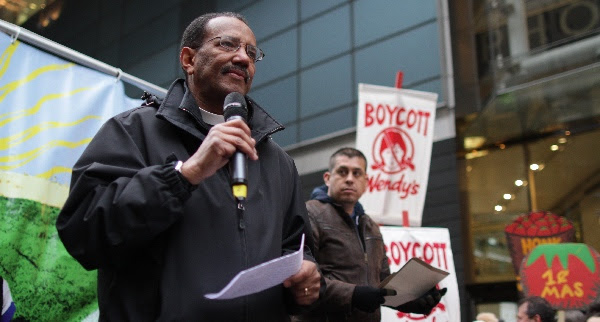
United Church of Christ, representing one million followers, endorses Wendy’s boycott!

CIW list header
BREAKING: United Church of Christ, representing one million followers, endorses Wendy’s boycott!

Rev. Michael Livingston, Executive Minister of Manhattan’s towering Riverside Church, a part of the United Church of Christ, speaking at the launch of the Wendy’s boycott in March 2016

“Wendy’s has turned its back on successful efforts in Florida to protect workers’ basic human rights and has moved its supply chain to Mexico where human rights abuses are rampant…”

Joining the Presbyterian Church (U.S.A.) as well as T’ruah: The Rabbinic Call for Human Rights, the United Church of Christ has, once again, taken a stand alongside farmworkers and formally endorsed the Wendy’s boycott.  In a sweeping resolution, the UCC, which represents over 1 million worshippers in the United States, affirmed the just cause of farmworkers fighting for dignity in the fields, and condemned Wendy’s for its stubborn refusal to support those efforts.

In announcing the endorsement,  The Rev. John C. Dorhauer, General Minister and President of the UCC,  and Rev. Dr. Traci D. Blackmon, Executive Minister, Justice & Witness Ministries, put out this simple but powerful statement:


“The United Church of Christ has a long history of standing with farm workers against the injustice and invisibility that often accompanies the labor that satiates our consumerism. Through its recent resolution, the United Church of Christ Board of Directors affirms this history.

Our comforts must not be provided at the expense of our neighbor’s discomfort.

For ten years the Coalition of Immokalee Workers has asked Wendy’s to join other industry partners, by participating in the Fair Food Program in partnership with tomato growers, farm workers, and buyers, to improve the lives of farm workers.

For 10 years the request has been simple and fair: a zero-tolerance policy for slavery and sexual harassment, an additional penny per pound of tomatoes picked, and a formal grievance policy to address worker concerns.

Ten years is long enough to simply ask a major corporation to do the right thing.” …

Head over to the CIW website for the full story on the UCC’s breaking endorsement
of the Wendy’s boycott!

You are subscribed to the CIW Mailing List. To unsubscribe, Click here to unsubscribe.

Coalition of Immokalee Workers • PO Box 603, Immokalee, FL 34143 • (239) 657-8311workers@ciw-online.org

The First Memorial Day

Memorial Day
The first Memorial Day was actually started on May 1, 1865 by former slaves in Charleston, South Carolina to honor 257 dead Union Soldiers who had been buried in a mass grave
in a Confederate prison camp.

They dug up the bodies and worked for 2 weeks to give them a proper burial as gratitude
for fighting for their freedom.

They then held a parade of 10,000 people led by 2,800 Black children where they marched, sang and celebrated.
Memorial Day

1st Memorial Day participants

Sermon May 22, 2016 "Heart Condition"


Sermon Title: Heart Condition                                                                                 Scripture Lessons: Acts 2:42-47 and Romans 5:1-5                                                 Pastor: Rev. Kim P. Wells

Heart disease is one of the biggest health threats in America today. We all know people with heart-related health problems. We know folks whose hearts beat irregularly and they have a defibrillator or a pace maker. There are doubtless those who have had angioplasty among us this morning. We know people who have had bypass surgery and valve replacement. And even heart transplants have become routine since the first such surgery in 1967. We know people who have what is commonly called “hardening of the arteries” with the build up of plaque in the arteries limiting blood flow. We know people with high blood pressure. All these conditions and more limit the full functioning of the heart, which, of course, is necessary to the functioning of the body.

Symbolically, the heart is also essential to good health and happiness. The term “heart” is used to refer to the seat of emotion, will, and purpose. “She stole my heart.” “My heart wasn’t in it.” “Have a heart.” The military gives the honor of the purple heart. We talk about someone being cold hearted – uncompassionate and insensitive. All these examples show how we use the term heart to refer to our emotional state as well as our sense of moral courage.

The Hebrew word for heart, lev, implies the seat of emotion, the mind, and the actual organ in the chest. There are many examples in the Psalms of orienting one’s whole heart to God: “Happy are those who keep God’s decrees, who seek God with their whole heart.” [119:2] “Give me understanding, that I may keep your law and observe it with my whole heart.” [119:34] “I will give thanks to God with my whole heart.” [9:1] This expresses the intention to be completely devoted to God, with emotion, intellect, and body. In addition, the heart was thought of as the throne of God in the human being.
Our tradition tells us that we are born as God intends: With a heart oriented to God. With a heart filled with divine love. We are created with the capacity to love as God loves. We see this exemplified in the life of Jesus who shows us what it is to live a human life with a whole heart devoted to God; fully expressing divine love in our daily lives and sharing that love with the world.

That is the ideal of which we are all capable. But things happen. Life intercedes. We are hurt or betrayed by those we love. And our hearts break. Disappointment gathers as life goes on. Guilt burdens us. We have regrets. These things start to block the love in our hearts like the plaque that clogs our arteries. We look back on what we should have done. We are sorry about the path we chose. We did not live up to our dreams. We disappointed others who are important to us. Perhaps we have experienced neglect or abuse. Maybe our failures weigh on us. All these things make our hearts heavy. Maybe restricting the flow of love. To ourselves. To others. And to the world.

The gift of our faith is that it is intended to help our hearts be healthy, yes, physically, but also spiritually. Our spiritual path is one of heart health. The Christian faith helps us to work through the difficulties and challenges of life in a way that encourages healthy hearts – hearts of single purpose, hearts flowing with love, hearts committed to the common good, hearts of moral courage. The kind of heart that we see in Jesus.

In the scripture that we heard today from Acts, we heard about the follow up to Pentecost. Last week we commemorated that glorious festival that marks the beginning of the church. After Peter preaches about the infinite love and grace of God as seen in Jesus, love and grace so vast that it includes those responsible for the killing of Jesus, 3000 people choose to be baptized. Three thousand people find themselves moved to accept this God of grace and love. Three thousand people want to be part of this new reality, this new creation, which is really a return to the original intent of creation – humanity and nature and God living in harmony, an appreciation of the sacred in all of creation, a spirituality without the keeping of accounts, a way of life in which no gift is too great, even the giving of one’s life for the good of the world, a new vision of community in which everyone has an equal place at the table.

On Pentecost we see people drawn to this vision: People whose lives are clogged by poverty and the oppression of the Romans. Those whose consciences are heavy with guilt, perhaps even over the death of Jesus. Those who are tired of a religious establishment that seems more intent on taking than giving. People hear a message of grace and hope that is life-giving and life-affirming and inclusive of all. They sense the presence of a bigger God, a universal God, a loving God not a judging God. Their hearts rejoice in this good news.

So the story tells us that 3000 are baptized. What did they do then? We are told that they “devoted themselves to the apostles’ teaching and fellowship, to the breaking of bread and the prayers.” So they have had this transcendent moment but that is just the beginning. To follow up, the people immerse themselves in this new community and in the teachings of Jesus. They meet together, eat together, pray together, discuss and spend time together. Daily. They reorient their lives. They put their energy, time, and effort into going deeper into this new way of life. Like the changes in diet and the regular exercise needed for the health of the physical heart, these people show us a reorientation of their daily lives that supports their commitment to the health of their spiritual/emotional hearts, their center. They are committed to working to get rid of former habits, former ways of thinking, former behaviors and attitudes that block their living wholeheartedly for the God they have experienced through Jesus.

For some, this new wholehearted spiritual devotion with its disciplines and commitment meant leaving family. Some families were so against this new movement that they would try everything to keep their loved ones from pursuing involvement with these Jesus followers. And the new believers were so convicted and passionate about this spiritual path to new life that they were forced to choose between family and the Jesus way. And many chose the way of Jesus. Yes, mothers even left their children. For some who were drawn to this movement, it meant leaving jobs and work, and facing the challenge of economic uncertainty. It was a drastic, risky commitment, this new path toward heart health.

Then we are told of how the people sold their possessions and pooled their resources and thus provided for the needs of all. This is definitely a communitarian arrangement. And it was as wild and controversial an arrangement then as it appears to us today. I am intrigued by this portrayal of the community and how it relates to heart health. One way to look at it is that the people’s hearts have become so healthy, so filled with the love of God, that they freely abandoned their attachment to property and wealth and held nothing back: The love pushed the blockage of attachment to ownership out of the way. When we look at it this way, we may think that our hearts are just still too clogged for such signs and wonders today. We are willing to give, maybe a trickle, but we aren’t enlightened enough to expect the wild rush of the opened floodgates of generosity.

Another way of looking at this, though, is that in light of the teaching and praying and fellowshipping, they were directed perhaps by the leaders, to put their money where their mouths were. They were told in the teaching that this is the way of Jesus. That this is humility. That this is universality. That this is equally valuing each person as God does. That this is an expression of full devotion and trust in God as we see it in Jesus. No holding on to money or property as security or for status. Full blown devotion to God and God alone means giving up your possessions and property and knowing that you and everyone else will be taken care of. It is a giving up of control and power, things that can block the flow of love. So maybe those early Jesus followers did this because they were directed to. They were told to do this because it would make their hearts healthy. Maybe they chose to remove the blockage. And then they experienced the full flow of love.

We are told that “they ate their food with glad and generous hearts, praising God and having the good will of all the people. And day by day God added to their number those who were being saved.” Maybe this happened, this gratitude, this sense of well being, this intense experience of life-giving community, maybe that came as a result of their having sold their possessions and goods. Maybe you don’t experience the full love and joy until you completely release your attachment to your money and goods and all that is associated with it. So maybe the utopian community developed because they gave up their private property. Maybe the full flow of love was possible because they removed that obstacle.

So when it comes to setting free the flow of love, sometimes it might be that we need to do the work of removing the obstacles and that might involve risky, daring choices. And sometimes it may be that the love pushes the blockage out of the way. I think it can happen both ways.
When we hear these stories of the early Jesus community, we see that to reorient your life to a whole new world view – the common good, a radically egalitarian vision of community, including economics – is drastic and taxing. Life giving. Yes. Passionate. Yes. But also challenging.

So, we see that there is suffering and sacrifice involved. Paul, who wrote the epistle to the Romans, knew well of this. He went from persecuting Jesus followers to planting churches. He endured the hazards and discomforts of traveling far and wide in the Roman Empire. He left the economic security of his profession. He left the social connections of his community. And for his wholehearted zeal for the love and grace of God that he experienced in the way of Jesus, he was jailed and finally killed. So, he knew well the pain and risk that can come from commitment of one’s whole heart to God.

People of the first century, much like people of today, expected their devotion to God to lead to an easy life including health, economic prosperity, and status in the community. Those were the expected consequences of devotion to God. But the crucifixion of Jesus, and the killing of his followers, and the persecution of the early Christians, tell a different story. Our tradition shows us that faith, and dedication to the way of love, does not necessarily lead to a life of ease and comfort. In fact, it may quite likely lead to the opposite. But this should not be a cause of despair because, as we are told in Romans, suffering, too, can bear fruit in a way that contributes to heart health. Maybe it is like strenuous exercise for the physical heart.

Here we want to note that commitment to the gospel leads to suffering when we are in solidarity with others who are being oppressed, or when we choose to make a sacrifice for the good of others. That kind of suffering is redemptive. This is not an endorsement of suffering for suffering’s sake. It is not encouragement of abuse of ourselves or others. It is not a defense of the inevitability of victimhood for some as a good thing. When we are effected by undeserved suffering, I think of those harmed in war, or those who have been raped, or the grief of the loved ones of someone who has been shot, this is not suffering that has been sent to improve the person’s character. But, whatever befalls us, it can be redeemed. Through God, all things can work together for good. All things are possible.

As we are told in Romans, “suffering produces endurance, and endurance produces character, and character produces hope, and hope does not disappoint us, because God’s love has been poured into our hearts . . .” [Romans 5:4-5] So suffering, however it may come, can lead to our seeing more clearly the love of God that has been poured into our hearts.

Sometimes it is through these challenges that we learn to depend on God. It can be in times of hardship that we see all that we have to grateful for. In times of desperation, we may feel more fully the divine love that is flowing into us to meet our need. We may discover divine love within ourselves and others that we never could have supposed was there. So even pain and hardship – whether a consequence of conscience, chosen sacrifice, or victimization – can help to promote heart health in people.

The way of God provides us with many different paths to help lead us to heart health. To help us be healthy of heart, wholehearted in our devotion to love. Fully committed to a life of purpose and moral courage.

So, to be physically healthy, we need our fist-sized hearts to pump out 6 quarts of blood through our 60,000 miles of blood vessels supplying nutrition and oxygen to our tissues and organs and removing carbon dioxide and other waste from our system. And heart health is, for the most part, something that is the result of personal choices. What we eat, our exercise and activity level, and whether we smoke are the main factors in determining whether our hearts are healthy.

In terms of our spiritual heart health, we also see that healthy habits contribute – study and learning, relationships with people of common commitments, eating together, praying, suffering and serving together. All these things help to keep divine love flowing in our lives, in our communities, and in the world. So, here’s to a healthy heart. Amen.

A reasonable effort has been made to appropriately cite materials referenced in this sermon. For additional information, please contact Lakewood United Church of Christ.

Sermon Pentecost May 15, 2016

Sermon:  Pentecost in Practice or A New Creation

Date:  May 15, 2016 Pentecost

Scripture Lessons:  Psalm 104:1, 4 and Acts 2:1-24, 37-41

Pastor:  Rev. Kim P. Wells

“In the beginning. . .” In the beginning of our story, the story of our faith, the story of our identity as Christians, and the story which shapes our community and culture, we are told that, “In the beginning when God created the heavens and the earth, the earth was a formless void and darkness covered the face of the deep, while a wind from God swept over the face of the waters.” [Genesis 1: 1-2]  The Spirit was brooding over the waters. The Spirit was stirring things up. Something new was about to emerge from the divine imagination, a new reality was about to be born.

“And then God said, ‘Let there be light,’ and there was light. And God saw that the light was good. . .” [Genesis 1:3-4a]  There was the sun to light the day and the stars to light the night. Fire burning in the heavens lights this new creation. Wind and fire mark the inception of our first story of creation.

Now science tells us of a cloud of dust particles swirling through space and the explosion of a star creating fiery, chaotic forces that eventually formed our solar system including Earth. Again, we see fire and wind, the conditions for creation.

This morning we heard the Pentecost story. The disciples are gathered in Jerusalem for the Festival of Pentecost. This was a harvest festival held 50 days after Passover. It was a celebration of the first harvest of the summer. Jewish people from many lands came to the Temple in Jerusalem for this festival. And what happens? Wind and fire. We are told that the Spirit of God comes – something like flames appear on each person. And there is the wind. The writers are struggling for words to convey what it was like because they hadn’t experienced anything like this before. But they know what they want to get across. They want to express a sense of a new creation. So they choose the images of wind and fire.

Wind and fire. The wind brooding over the waters in Genesis. The daytime sky lit by the fire of the sun. The night lit by the fire of the stars. Breath, wind, giving life to humanity. Wind and fire signal creation. Pentecost is a story about something being created.

These images of fire and wind are images of energy and life. Fire warms. It brings light. It provides energy and power. It is fuel. And wind spreads seeds for vegetation to flourish. It is a source of power and energy. Wind sails boats and powers machinery. Wind refreshes and cools. So there is creative, constructive power in wind and fire.

And just like the first creation story, the Pentecost story is a story of chaos and power beyond human control leading to a new kind of order.

The Pentecost story begins with a small group of Jesus followers from Galilee. They are in Jerusalem for this festival attended by people from all over the Empire. It’s a cosmopolitan crowd. And Galileans were known for being, well, we might say, hicks. From a backwater province. And here these unsophisticated people start speaking in the languages of all the other people who are there from all over the known world. These people are enabled to speak in every language so that everyone hears about what God is doing; no one is left out. God’s message of love and grace is for all people. Period. Not just for this group. Or that sect. Or this culture. Or that ethnicity. Or this religion. Or that socio-economic class. That’s the way religion worked in the past. That’s what people associated with the gods in past eras. Pentecost is telling of something new. This story is telling us that God wants to make sure that everyone knows of the love and grace at the heart of reality. No exceptions. No divisions. No favoritism. No privileging one group over another.

The story of the Tower of Babel was a story to explain why people are different and divided. The story of Pentecost is a story about bringing everyone together around the message of universal love. This is a new beginning, a new reality, of commonality and unity though not uniformity. Everyone hears in their own language; they do not all learn one language.

We also want to notice that the story begins with a small group of Galileans, and ends with 3,000 people being baptized that day. People from all over the world. From every culture. From all walks of life. Every strata of society. All these people are drawn to the message of divine love that they hear spoken directly to them in their own tongue.

Now, with the immediate baptizing of over 3,000 people, we are being told that there was not time for a test of creed or credentials. There was no theological screening. There was no background check. Man, woman, slave, free, Jew, Gentile, whosoever, let them come. They all heard the message. They were all free to respond by being baptized. No exceptions. This is an amazing expression of egalitarian community. All these different people, all these different languages, brought together by divine love. Drawn together as gravity pulled the swirling dust particles disturbed by the supernova together to form the solar system. Here the Holy Spirit is disturbing the crowd of diverse peoples and bringing them together in an unlikely, uncommon, unique mass, a new community free of the divisions and separations that previously defined orderly human society.

The Pentecost story is about the creating of a new reality where all the divisions we create and all the things that separate us are overpowered by the universality of divine love. In this new reality, we don’t get to control things, especially the faith community. There is no place in this new reality for the church to create tests and barriers that mete out divine love. There is no room for humanity to consider controlling divine forgiveness, grace, and love. The faith community is to completely submit itself to the power of the divine. There are simply to exceptions, no exclusions, and no fine print. And the results, the impact, the influence, the effect is beyond our wildest imaginings.

In this new creation, divine blessing is poured out on all of humanity and all of creation; “. . . the great sea monsters and every living creature that moves, of every kind, with which the waters swarm, and every winged bird of every kind. . . and the wild animals of the earth of every kind, and the cattle of every kind, and everything that creeps upon the ground of every kind. . .” [Genesis 1: 21, 25] The Pentecost story conveys the Spirit of God poured out on all, as wind blows and touches whatever is in its path; as fire illuminates whatever is present. Divine love imbues all of creation and our calling is to reverence the sacred in every person, every life, and all of the cosmos.

This is the new reality that we pray for: Thy Kin-dom come, thy will be done, on earth as it is in heaven. A new creation, with fire to consume all that prevents universal blessing. We think of the images that we have seen of the conflagration engulfing the area of Fort McMurray, Canada. Fire definitely has destructive capacity. The fire of the Holy Spirit has the power to destroy pettiness, selfishness, ethnocentric attitudes, classism, and all divisions and separations that perpetuate conflict. And wind also has destructive capacity. We think of the images of Hurricane Katrina or Andrew. The wind of the Holy Spirit has the ability to wipe out our fears, grudges, illusions, and delusions. All of this creating the conditions for the Spirit to ignite our passion of eternal love and caress us with refreshing joy and peace.

There is a photon in every atom, including every atom of our bodies. We are fire and light. And we live by breathing; wind, spirit flowing through our nostrils and lungs. Fire and wind. Each of us a new creation, Spirit filled, a message of divine love for the universe. Amen.

A reasonable effort has been made to appropriately cite materials referenced in this sermon. For additional information, please contact Lakewood United Church of Christ.