[slideshow_deploy id=’9962′]
Author: lakewooducc
2014 World Communion Sunday at Lakewood UCC
Altar arrangement by Colleen Coughenour; items from the collection of Rev. Wells.
World Communion Sunday at Lakewood UCC was celebrated with an emphasis on the church in Africa. All the music in the service–hymns, anthem, prelude, offertory, and postlude–were of African origin. The pictures below are of the choir singing an African anthem with the accompaniment of percussion instruments.
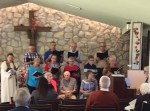
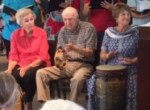
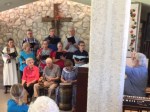

Below is the podcast of Rev. Wells’ sermon for World Communion Sunday, followed by a text version of that sermon. The recording begins with Liturgist, Susan Sherwood, reading Exodus 17:1-7 and John 7:37-38, followed by Rev. Well’s sermon.
Podcast
To listen, right-click (HERE) and select the save link option and play the downloaded file with your computer’s media player. If you have a one-button mouse (on a Mac), press and hold the “Control” key and click the link and select the save link option.
Sermon Text
Sermon Title: Lessons from Africa
World Communion Sunday
10/5/14
Scripture Lessons: Exodus 17:1-7 and John 7:37-38
A land of tremendous natural resources, the home of iconic wildlife, the cradle of humanity, and the site of stunning natural beauty, Africa is incredible. Our family had the opportunity to go to Kenya in 1995. I remember flying over the Sahara Desert. You look out the window of the plane and all that can be seen is sand. An hour later, you look again. Sand. Several hours later. Still more sand. It was unbelievable. But Africa is HUGE. It is as big as China, India, the US, and most of Europe combined. The population is 1.69 billion people with subSaharan Africa being the fastest growing region on the earth. Africa is stunning.
The problems there are stunning as well. About 25% of the population is HIV positive. There are over a million deaths a year attributed to AIDS. Malaria is still of epidemic proportions in Africa. The deforestation rate is twice that in the rest of the world with 90% of the population relying on wood for fuel for cooking and heating. There is the the assault on the animal population by poachers. 35,000 elephants were killed last year. There are fewer than 900 mountain gorillas left. The rhino, lion, and Grevy’s zebra are also under attack. We can add to that the toxic legacy of the colonial era in which rich countries raped Africa of its natural resources. There continues to be political unrest and war in many parts of Africa and we hear of Boko Haram and other groups fomenting violence. There is a huge refugee problem as people leave areas of violence and war seeking safety. And there is drought and famine to contend with. And, now, we hear daily of the erupting Ebola crisis. There are over 7,000 people with Ebola and about half that many deaths to date.
The suffering of Africa is tragic. If ever there were a place ripe for cynicism and despair, it is Africa. This continent in crisis has so many reasons to cry out and complain and lament like the Hebrews wandering in the wilderness. Surely the people of Africa could cry out for water. And for food.
Given the problems of Africa today, one could expect this to be a godless land. All these troubles and sufferings. How could there be a good and loving God? Has God abandoned Africa? Are the people forsaken? And yet Christianity has deep roots in Africa and is growing and thriving. There are many churches in Africa: Episcopal, Catholic, Protestant, Orthodox, Pentecostal, and Evangelical. There are many, many expressions of Christianity in Africa. And the people are dedicated in their faith. The ethics and values of Christianity blend very well with traditional tribal cultures. There is the focus on hospitality, on community, on consensus, on forgiveness, and on solidarity. This fits well with the teachings of Jesus.
The people of Africa can also identify with the sufferings of Jesus. He, too, traveled from place to place, as the refugees of Africa. He lived under a repressive regime. He was concerned with fulling the basic needs of people for food, water, and community. Jesus faced death threats and violence and hardship. He was killed. And through it all, he maintained his trust and love of God. This is the kind of faith that we see in the people of Africa.
In the face of so many problems, the Christians of Africa still appreciate God’s blessings. They rejoice in the gift of life. They gather to praise God. When we were in Africa, we stopped by a church in a rural small town to see a friend of our family. The women had gathered at this church for a retreat over Saturday and Sunday. The woman we knew had walked 6 hours to get to the church. She left on Friday as the sun went down to avoid the heat of the day. She carried food to share with the others who would gather there. They slept on the bare wood of the church floor. They prayed and sang all day Saturday and into Sunday. Then, Sunday, at sundown, they began their walk home, in the cool of dusk, another 6 hour trek. People in Africa routinely walk hours to go to church each week. I was stunned. Here, people find it hard to manage a 10 minute drive and an hour or so for church on Sunday morning. Have these Africans nothing else to do? Hardly. They labor intensively to eke a subsistence existence from the land. It is time consuming and taxing. And yet they make time for church. They have a saying. “For us, religion is like our skin.” It is fundamentally part of who we are. It is not like clothing that we take on and off and change. [Once Upon a Time in Africa: Stories of Wisdom and Joy compiled by Joseph G. Healey]
For these Christians of Africa, their faith pervades their lives. When a baby is born, they rejoice. When a baby dies, they entrust the child to God, trust God to heal their grief, and rejoice that the child has gone to the heart of love. They serve one another and others around them. A child at a doctor’s office shares a precious piece of candy with another sick child. A child carries a sibling on a long journey feeling no sense of burden or resentment. A girl knits a blanket for her new baby brother using thorns from a nearby tree as knitting needles. A government worker who abused the lepers under his care is buried by those same lepers who have forgiven him and taken care of him in his last days. People with next to nothing kneel and pray in gratitude for the blessings they have received. [From Once Upon a Time in Africa] These are not the arrogant, spoiled Hebrews of the wilderness. They are resilient, strong, and trusting. If there is a stick and a rock, they will work for water. And they will share each and every drop. They are unsparing in generosity – with food, water, clothes, and material possessions, as well as time, gratitude, hospitality, service, and forgiveness.
There is one area where the church of Africa has lost its way and that is around homosexuality. Church groups in Africa mobilize their substantial faith and energy to promote homophobia, to advocate for laws that punish gay people even with death. Are they concerned with covering their bases to avoid God’s wrath? Is this to distinguish them from non-Christians and those who practice animistic religions? Is it to resist the West. I don’t know. In traditional tribal societies, homosexuality was accepted as special. A gay person was often considered holy because he was different. They were thought to have special powers. Maybe being anti gay is a way to undermine the power of superstition associated with traditional religions. But in any case, the church of Africa is definitely at odds with the churches of the west and the rest of the world in its vehemence against homosexuality. While other churches may see it as sin, they do not advocate for the death penalty. But, hopefully, there will be a transformation soon. New living water will flow. And the people will be cleansed and healed and reconciled of this sin of homophobia.
When we were in Kenya, one of the vehicles we used had a leak in the radiator. We had to constantly seek out sources of water to fill the radiator. This could be very challenging. At one point, we had to stop by the side of the road at night. We could go no further. We were not in a town or village, but out on a remote road. We got out of the wagon and looked around. Three men were walking down the road. They stopped to talk with us. We told them about our problem. Oh, water? There’s some right here. Jeff took the two empty jugs and went with the men down a steep, grassy slope. Then I could no longer see him, and the kids and I waited at the car. I am not given to alarmism but it did occur to me that I might never see my husband again. About 10 minutes later, the three men came back up the hill with Jeff right behind them struggling with the two jugs evidently filled with water. Jeff thanked the men for their help and offered to pay them something. Oh, no. They refused, saying they were Christians. And off they went. To church? Who knows.
Evidently, at the bottom of the hill was a pvc pipe above the ground. The men took Jeff right to a spot where the pipes had been connected and could be separated so that the water could be accessed. He filled the jugs and they put the pipes back together and came up the hill. Who would have known about the pipe and the location of the break to open the pipe? These men knew exactly what to do. Amazing! Like a stick and a rock, as far as we were concerned. And off we went back to Nairobi.
For the Christians of Africa, religion is truly their skin. The Christians of Africa are constantly in need and trusting God to sustain them. And they are willing to gather the elders, climb the mountain, find the rock, and strike it with the stick. Whatever it takes. They are willing to work in partnership with God to sustain life. And the joy, trust, and faith that they show is as beautiful as any view of the Rift Valley, or Mount Kilimanjaro, or Victoria Falls.
This World Communion Sunday Christians around the world celebrate communion as a symbol of the unity of the body of Christ. We all come to the table together. We rejoice in our common bond through Jesus. Praising God. Following Jesus. Serving the world. Christ Jesus is the host at communion. We are all guests. There is no one superior or inferior, no one above or below, we are all side by side.
Historically, we of the west have taken from Africa. Natural resources. Labor. In recent times, we have given to Africa. Assistance and aid. Maybe motivated by guilt. Maybe with a patronizing attitude of condescension. But this World Communion Sunday invites us to think about coming to the table as a community, as equals, as sisters and brothers. In this spirit, we see that there is much that we have to learn from Africa. The Christians of Africa have much to teach us about faith, trust, service and community. African Christians exhibit trust in a God who seeks nothing but our highest good. And they partner with that God in any way they can for the good of the world.
Pediatrician Alan Jamison was in Liberia when the Ebola virus broke out and the country slipped into chaos. He treated as many patients as he could before being called back to the US by his sponsoring organization. But Dr. Jamison wants to go back to Africa. “This is where the need is,” he said. “This is my calling.” [The Christian Century, 10/1/14, p. 8] It may be hard to understand why Dr. Jamison wants to go back to a place so dangerous and fraught with problems. I imagine that Dr. Jamison wants to go back to Africa because he senses the deep hope and faith of the people. Their spirit of love and community has infected him. And he wants to be part of that context of faith and trust even in the face of horrific suffering. The Christians of Africa have no fear. With no grumbling, but gladly, rejoicing, probably with drums and dance, they strike the rock with the stick. And living water flows. For all. Amen.
UCC Helps Child Refugees from Central America
The United Church of Christ is actively engaged in providing safety and hospitality to children who are coming to the US as refugees from Central America. The UCC Bethany Children’s Home in Womelsdorf, PA has received sixty children so far and plans to help hundreds more. Yuma UCC in Yuma, AZ is providing food, clothing, water and other supplies to women and children left by the Border Patrol in parking lots to fend for themselves. The California Nevada Conference of the UCC is supporting the San Diego Immigrant Rights Consortium which is collecting and distributing aid. The United Church of the Valley UCC in Murrieta, CA is providing a peaceful presence and advocacy. And, the UCC Southwest Conference is collecting relief supplies and coodinating relief efforts.
We can be grateful for the faithful witness of the UCC in response to this terrible tragedy.
Sermon September 28, 2014 The Bottom Line
Scripture: Matthew 20:1-16
Pastor: Rev. Kim P. Wells
A household inventory may be used for the purposes of home owner’s insurance or for a will. In the novel, The Invention of Wings by Sue Monk Kidd, there is an inventory of the Grimke household of Columbia, South Carolina in the early 1800’s. Each item enumerated includes a figure; a monetary value. The harpsichord is listed with a value of $29. Two Brussels carpets and a cover are valued at $180. Then, on the last page, there is a list of additional goods and chattel. Lucy, 20 years old, Lady’s Maid, is valued at $400. Tomfry, 51 years old, Butler and Gentleman’s servant, is valued at $600. [Sue Monk Kidd, The Invention of Wings, pp 110-111]
This kind of valuing of human life is abhorrent to us. And yet, we place economic value on human life all of the time. All the factory workers in developing countries that have plenty of people who need to work are paid little because they are not considered to be worth much. They can be easily replaced and there is little competition for sources of labor. There are other individuals in our world paid millions upon millions each and every year. These figures are more than wage indicators. They are numbers that indicate how people are valued. We routinely value people according to their economic productivity. Just think of the question, “What’s he worth?” We may be thinking about a professional athlete or a corporate mogul or an entertainer. And we are referring to financial assets. But those numbers also become intertwined with our sense of the value of the actual person.
If you want to see this at work, go to a place where there are a lot of low income people. Visit the health department or the social security office or the Salvation Army community services office. The conditions of the facility and the treatment of the clients speak volumes. Low income, low economic productivity translates to low worth as a human being. Then think of how we fawn over rich, successful, powerful, prestigious people. High income is associated with high worth as a human being. We may not buy and sell people any more, but we still make associations between economics and the value of human life.
This morning we listened to a parable that is told around an economic situation. A parable is a story that is intended to convey multiple meanings and to speak on differing levels. Scholars have much to say about this parable. In this story, there can be seen a message about those in the early Christian communities of the first century. Some of the people were Jews who believed that Jesus was the Messiah that the Jews had long awaited. Others who became part of the Christian community were Gentiles who had never been Jews. They were essentially pagans who became associated with the Christian community. There was some tension between these groups. Does Matthew include this story to show that Jews, like the early workers, and Gentiles, like the late workers, all receive the same salvation in the end? This could be one way to understand the story. Some see in this story an economic critique: An expose of the wealthy landowners who have taken the land from the peasants, creating an unemployed under class. A story of the elites and the expendables and the economic injustice of the day which leaves the wealthy landowners free to do as they please. We could see in this story a justification of economic disparity and affirmation of the rich who appear to be generous. And that line, “Am I not allowed to do what I want with what is mine?” This sounds like the declaration of a good democracy-loving capitalist. There are many messages to be found in this story and that is the intention of a parable. To speak many truths.
To me, there is one thing that is inescapable about this story. The workers are all paid the same amount. Given our proclivity then and now for equating economic productivity with a person’s value, this story seems to indicate that all are of the same value. Hardworking and able-bodied hired early in the day. Older, sick, disabled people left to last and hired late in the day. Those in the middle. All paid the same. Of the same value as a human life in the divine economy. In God’s design, persons are not valued for their economic productivity or lack thereof. Each life is of equal value. Certainly people have differing capabilities and skills and are not the same by any means. But they have the same value because they are a human being created in the divine image.
Today we live in a time of economic upheaval. There’s a movement for an increased minimum wage. Fast food workers are agitating for a living wage. The wealth gap in the US is a growing problem contributing to greater societal instability. Are CEOs really worth 354 times the average worker? [“Pay gap more like a canyon,” Roberto Ferdman, Tampa Bay Times 9/26/14] The wealth gap world wide fuels violence and terrorism and social and political unrest. Underlying many of these economic issues is the connection between economic productivity and the value of a life. People who are underpaid feel undervalued and second class. People at the top financially have a sense of privilege and entitlement. And this situation is becoming more and more
volatile.
I was asked by someone in the congregation to address the issues that are facing us in our day. What is a Christian response to ISIS and the Islamist threat? To globalization? To school resegregation? To the economic system and its inequities? What is a Christian foreign policy? How do we put our beliefs into practice relative to the issues of our time?
Underpinning all of this, the foundation, the bottom line presupposition for our approach to social issues, economic problems, and security concerns, is the core message of this parable that we have discussed. The parable tells an equalizing story which points to the equal worth of each and every person. That is the heart of the realm of God, the commonwealth of heaven, the divine intention for creation. Each and every person, each and every life, of fundamentally equal value. Each beloved; each precious. To function as individuals, as citizens, as a community from that fundamental commitment is transforming.
Imagine thinking about a social problem and speculating about a response with the bottom line that each and every life is of equal value. If that is the bottom line, then all students are going to have the opportunity to learn and grow provided for them by the school system. The situation at home for the child cannot be controlled by society, but what the school system offers will be fair and just treatment of each and every student. In thinking about foreign policy, if the bottom line is the fundamental equality of value of each and every human life, then the picture of the world today would be quite different. US foreign policy begins with the assumption that the lives of US citizens are worth more than the lives of people of other nations, and there is a pecking order among those other nations. With a commitment to the wellbeing of each and every person, foreign policy would be much more oriented toward empowering other countries and cultivating self determination, helping them achieve their hopes and dreams, and creating a community of equals among nations and peoples. Instead, we not only protect US interests but promote and privilege US interests worldwide over the interests of other peoples with a heavy handed attitude of superiority and this creates enemies that we then have to defend ourselves from. The assumption is that these other people are not as important or as valuable as people of the US and US interests.
The world, our society, the community around us, does not embrace the egalitarianism of the gospel. All around us, one person in a situation is treated one way, and a different person in a similar situation is treated another way. This has been a glaring message in the episodes involving police brutality against blacks. I had a black friend tell me, “A black life is not considered of equal value to a white life in this country.” A so-called Christian country could never tolerate that because that is fundamentally antithetical to the Christian faith.
The parable with the scenario of equal pay sends a strong message of equality in terms of the value and worth of a life. To put that message at the core of our ethics, our economics, our policies, our personal and international relationships, would be a drastic change that would transform reality as we know it. And this is what Christianity should be about, in a fundamental way, in the world. This message is radical. It is offensive. It is faithful. And it is true to Jesus.
In the book, Enrique’s Journey, author Sonia Nazario tells of a young man who leaves Honduras to come to the US to find his mother who is here illegally trying to make money to support her children in Honduras. The book tackles the issues around immigration as well as the story of one youngster and his perilous trek to the North. The journey involves taking buses and trains, walking and hiding. There is law enforcement to evade. There are thieves and bandits who prey on the migrants. The authorities abuse and extort and rob the migrants. There is constant threat not just from the elements and the moving trains, but from the people along the way.
But at some points on the journey the people help the migrants. There are people who take the migrants in offering food, first aid, and medical treatment. The kindness and generosity of some is as stunning as the violence and abuse of others. They hear the train coming and race to the tracks to throw bundles of food and clothes to the migrants on the trains. These are people who live on $2-3 a day. Whose existence is constantly in peril. Who themselves are barely hanging on in the face of debilitating poverty. Nazario tells us, “Families throw sweaters, tortillas, bread, and plastic bottles filled with lemonade. A baker, his hands coated with flour, throws his extra loaves. A seamstress throws bags filled with sandwiches. A teen ager throws bananas. A carpenter throws bean burritos. A store owner throws animal crackers, day-old pastries, and half-liter bottles of water. People who have watched migrants fall off the train from exhaustion bring plastic jugs filled with Coca-Cola or coffee. . . Migrants who haven’t eaten in days in days sob when they are handed a bundle of food. . . As the procession of migrants has grown, so has the determination to help.” [Sonia Nazario, Enrique’s Journey, pp. 105, 107] This is what happens in certain areas particularly in the state of Veracruz.
When the people who offer help were questioned about their generosity, they were humble:
“If I have one tortilla, I give half away. I know God will give me more.”
“I don’t like to feel that I have eaten and they haven’t.”
“It feels good to give something that they need so badly.”
“I figure when I die, I can’t take anything with me. So why not give?”
“What if someday something bad happens to us? Maybe someone will
extend a hand to us.”
“God says, when I saw you naked, I clothed you. When I saw you hungry, I gave you food. That is what God teaches.” [pp. 105-107]
This last perspective refers to the story of the last judgment which is in the gospel of Matthew just a few chapters after the parable that we heard this morning. In the story we are told that whatever you do for “the least of these” you are doing for Jesus. The people along the migrant route that help others do so in large measure because the bishop and the local priests encourage the generosity as an act of faith. One church has organized teams that defend the migrants from the police. Church member Gloria Sanchez Romero says, “They aren’t animals. They are human beings. You’d never want to be treated that way.” [p. 112] That is the heart of their goodness and generosity. The belief, based on their Christian faith, that each and every life is precious to God. That all people are equally loved and valued in the eyes of God.
These people are treating the migrants like human beings. Like people. To honor our own humanity, to respect the sacredness of life, involves treating others as human beings as well. Of equal value and worth as ourselves, as one another, and as Jesus.
Yes, people are different. We have differing skills, abilities, talents, and interests. These differences are reflected in the monetary economy and translate into varying value and pay. While those differences are important and understandable from an economic perspective, for a Christian, there is still the bottom line that each and every person is precious, cherished, beloved, and sacred in the divine economy, in the eyes of God, in the fundamental reality of creation.
What can we say for a Christian approach to foreign policy and social issues? Every life of equal value. Every life valued as our faith tradition teaches that God values the life. Every life valued as Jesus valued the lives of those he encountered. Every life valued as your own.
In The Invention of Wings, the inventory of the Grimke household that is found by a slave, Handful, aka Hetty. When she sees that her mother has the highest monetary value of the women slaves, she is proud. And she, Handful, is second only to her mother. She marvels at this. Later in the day, she reflects: “Goods and chattel. The words from the leather book came into my head. We were like the gold leaf mirror and the horse saddle. Not full-fledged people. I didn’t believe this, never had believed it a day of my life, but if you listen to white folks long enough, some sad, beat-down part of you starts to wonder. All that pride about what we were worth left me then. For the first time, I felt the hurt and shame of just being who I was.
“After a while, I went down to the cellar. When mauma saw my raw eyes, she said, ‘Ain’t nobody can write down in a book what you worth.’” [p. 112]
That, my friends, is the scandal of the gospel. Each and every person is of incalculable value in God’s economy. And the Christian path involves living out that truth. Trusting that equality. Banking on that value. Taking that risk. Amen.
A reasonable effort has been made to appropriately cite materials referenced in this sermon. For additional information, please contact Lakewood United Church of Christ.
Podcast for 8/17/14 sermon — The Bottom Line

9/28/14
Rev. Wells
The recording begins with Liturgist, Jean Johnson, reading Matthew 20:1-16, followed by Rev. Well’s sermon.
To listen, right-click (HERE) and select the save link option and play the downloaded file with your computer’s media player. If you have a one-button mouse (on a Mac), press and hold the “Control” key and click the link and select the save link option.
 Lakewood United Church of Christ