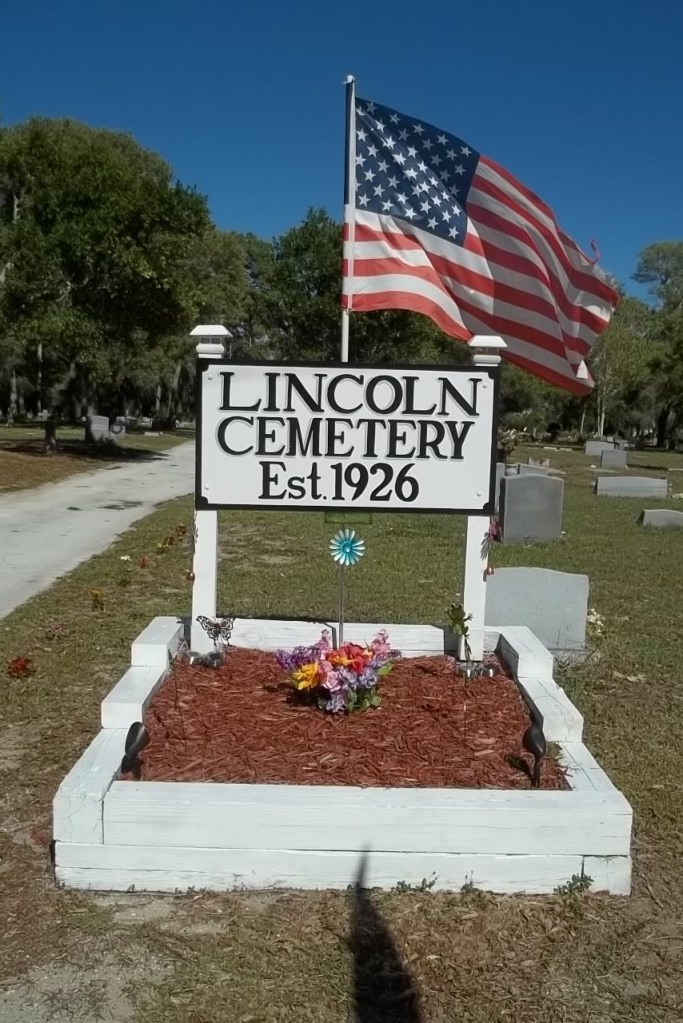
Lincoln Cemetery

The Lincoln Cemetery

There is a long history associated with the Lincoln Cemetery which was at one time designated for burial of Black people in St. Petersburg.  The land was ceded by the city  to Gulfport.  Now there is an initiative for the city boundaries to be redrawn with the Lincoln Cemetery back within the boundaries of the City of St. Petersburg.  

Most of the people who are buried in the Lincoln Cemetery were from the City of St. Petersburg not Gulfport.  Some of the families who still live locally and have loved ones buried in the Lincoln Cemetery would like to have the Cemetery reincorporated into St. Petersburg.  The reclaiming of the Lincoln Cemetery is what we as Christians would call a prophetic action.  It is a symbolic action that honors the lives of those in the Cemetery and their families and redresses a past wrong. 

This initiative has been led by Josette Green who is part of the weekly labyrinth walk community at Lakewood church.  

The annexation of the Lincoln Cemetery is coming before the St. Petersburg City Council.  Please consider contacting your council member and expressing your support for the reclamation of the Lincoln Cemetery by the City of St. Petersburg. 

Click here for a sample letter.

Protecting Public Education from Christian Nationlism

SB 1044/HB 931: Why Chaplains in Public Schools Are a Bad Idea Government-sanctioned chaplains make sense in some settings, but not in public schools.There are contexts in which individuals cannot access their religious services — such as the military, a prison, or a hospital — which is hardly the case for children in public school. Military members may have security or language barriers in finding a house of worship while on deployment. Incarcerated individuals are not given a “religious hall pass” to leave prison and attend the corporate worship service of their own choosing. Hospitalized patients may be too sick or far away from their congregations to engage in meaningful religious exercise. Public school children simply do not face the barriers to religious exercise that service members, prisoners, and patients face.

Here are some talking points about this bill:Families, not the government, are responsible for their children’s spiritual development. The government should not assert authority for the spiritual development and formation of public school children. Public schools should not interfere or alter parental decisions in the realm of religious exercise or spiritual care.Parents or guardians must have the right to choose the religious leaders who will influence their children’s spiritual journey. In order to do this, they must have enough information to choose a spiritual care provider. Awareness of a chaplain’s religious/denominational affiliation (or none) is not enough information to make an informed decision. Faith is voluntary and should not be coerced. There is no requirement in this law that the chaplains refrain from proselytizing while at schools or that they serve students from different religious backgrounds. This lack of proper boundaries surrounding what chaplains are allowed to do is very problematic. Passing a background check is not a sufficient litmus test to be given the title of “chaplain.” Professional chaplains have specific education and expertise to fulfill their role in helping others engage their own religious practices and traditions.Chaplains are typically required to have a graduate theological degree and be supported by an approved organization connected to their spiritual tradition. In some settings, chaplains also must have one to two years of full-time experience as a religious or spiritual leader prior to becoming a chaplain. Many chaplains are ordained in their faith tradition. Board certified chaplains in healthcare go through a rigorous certification process, pursuing hundreds of hours of extensive training and hands-on experience. More information is needed about the requirements for becoming a volunteer chaplain within this bill. Proper chaplaincy training prepares chaplains to follow the lead of the individuals seeking spiritual care without imposing their own faith tradition upon the individual. (For example, a Jewish military chaplain would advocate that a Muslim service member be able to pray the five daily prayers while deployed. A Christian hospital chaplain would help an atheist patient explain to her family that she has peace of mind in her belief that there is no afterlife because it is the type of spiritual care requested.)Consider supporting religious freedom and parental rights by rejecting this harmful program to have government-approved chaplains in our public schools. Contact your legislators TODAY!Click on the proposed house and senate bills which are identical to read more: SB 1044HB 931. To read about the advocacy work done in Texas on a similar school chaplains bill, click here
We are looking for clergy and laity who are willing to set aside time to go to Tallahassee ONE TIME during the 2024 Legislative Session in order to make visits and give testimony before Florida legislators. Please consider joining us to make your voice heard. 

Your participation can make such a difference for Florida children and families!!

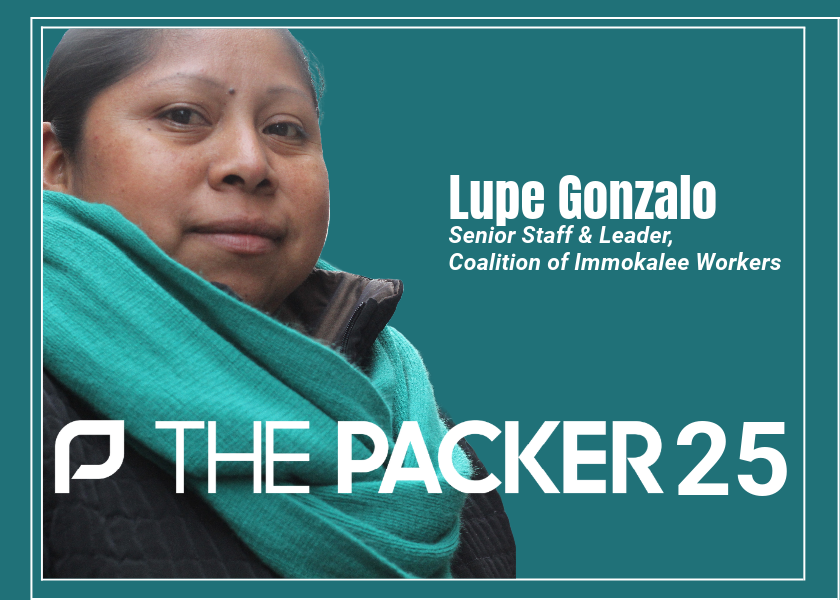
CIW’s Lupe Gonzalo named one of top agents of change

Lupe Gonzalo has visited Lakewood UCC to talk about the farmworkers.

The following is reposted from https://ciw-online.org/blog/2023/12/ciws-lupe-gonzalo-named-as-one-of-top-25-leaders-innovators-and-agents-of-change-across-the-fresh-produce-supply-chain/?emci=75b9396d-909e-ee11-bea1-002248223f36&emdi=82ff9cfa-939e-ee11-bea1-002248223f36&ceid=13383002

CIW’s Lupe Gonzalo named as one of top “25 leaders, innovators and agents of change across the fresh produce supply chain.” 

Posted on

The Packer: “Drawing on her experience with the Fair Food Program, Gonzalo has helped to train, mentor and educate workers from other regions and industries on the Worker-Driven Social Responsibility model.”

“Gonzalo also was a member of the CIW team working with Futures Without Violence, which collaborated with CIW and other Fair Food Program partners on the first sexual harassment training curriculum for the agricultural sector in the U.S.”

As 2023 draws to a close, farmworkers with the Coalition of Immokalee Workers are celebrating the organization’s 30th anniversary. In the last 30 years, the CIW — which began as a loose gathering of farmworkers meeting weekly in a borrowed church hall in the small, crossroads town of Immokalee — has grown in size and success to become the founder of the Presidential Medal-winning Fair Food Program, the leading social responsibility program in the US agricultural industry today, and of the Worker-driven Social Responsibility model, the new paradigm for human rights protection in global supply chains to which the FFP gave rise. And along the way on this remarkable journey, many of the CIW’s longtime farmworker-leaders have emerged as key agents of change in the trillion-dollar food industry. 

With the tireless leadership of farmworkers themselves, the CIW forged the Fair Food Program from the ground up – an unprecedented  partnership among workers, buyers, growers, and consumers to monitor and enforce the basic human rights of farmworkers by harnessing the purchasing power of some of the world’s larges food corporations. Lupe Gonzalo, an indigenous Guatemalan farmworker who worked for years in Immokalee’s tomato fields before joining the CIW staff, knows all too well the life of a farmworker outside the protections of the FFP. 

Raised in a rural village in Guatemala, Lupe journeyed to the United States in hope of finding a better life — but was instead met with the kind of outrageous exploitation that remains all-too-common in agriculture and low-wage work beyond the protections of the Fair Food Program. Once she found out about the Fair Food Program, however — which happened during a visit by the CIW’s Worker-to-Worker Education Team to the farm where she was picking tomatoes in the early days of the FFP — she immediately saw an opportunity to right the historic wrongs the plagued US fields, and has never looked back since. 

Through her more than a decade of work with the CIW, Lupe has become a prominent leader in a global human rights movement centered around the Worker-driven Social Responsibility model, which ensures humane working and living standards for low-wage workers, and which was born in the same Immokalee, FL, fields in which Lupe toiled when she first arrived to the U.S. 
Christian Call in Day for Ceasefire in Gaza

Christian Call in Day for Ceasefire in Gaza
Wednesday December 20
NCC continues to be concerned about the ongoing war in Gaza. The ecumenical community, our member denominations, and our partners have consistently called for a ceasefire in Gaza to protect civilians who are being killed (view numerous statements and relief efforts).With more than 18,000 killed in Gaza so far – 70 percent of them women or children – our partner, Churches for Middle East Peace, is co-sponsoring a call-in day to call the White House and ask President Biden to push for a ceasefire in Gaza.Please consider participating in a Christian Nonviolence Call-in Day:On Wednesday Dec 20, 2023 please call the White House between 11am and 3pm ET (8am-12pm PT). The White House call-in number is 202-456-1111.You might need to wait on hold some time before getting an operator to take your comment. If you have trouble getting through, please send an email to the White House here: https://www.whitehouse.gov/contact/  For scripts and background information, visit https://franciscanaction.org/christian-nonviolence-call-in-day/