
Advent Devotion 13 – Hope

This holy season is a time for hope. But what is hope? Is it the desire and anticipation of getting a certain gift for Christmas? Is it expecting something different to happen? Is it simply not giving up?

Former Czech president Vaclav Havel has said that, “Hope is definitely not the same thing as optimism. It is not the conviction that something will turn out well but the certainty that something makes sense, regardless of how it turns out.” I like that description of hope. To me, hope means that I care about something. The outcome matters to me. I feel deeply about that for which I hope. But hope also means that I don’t have ultimate control over the situation. With hope, there is a dose of the unknown, the mysterious, that which is beyond our direct control.

Here’s a trivial example. I am hoping that we have a safe flight to Boston on Christmas Day. But I am not a mechanic and don’t control the condition of the plane. I am not a pilot and don’t control the operation of the aircraft. And I certainly don’t control the weather. But we want to be together as a family for Christmas so we have bought the tickets, we will pack appropriately, follow the directions, and hope for the best.

What kinds of things do we hope for that are of more significant import? Peace on earth. An end to poverty and hunger. The eradication of prejudice and bigotry. Respect and dignity for each and every human being regardless of life circumstances. A good education for every young person. A stop to global climate change. Access to health care for all people. Getting along with others. A steady job. What kinds of things do you hope for?

If we hope for these things, then it makes sense that we do something about them whether or not we will succeed. Regardless of the outcome. That is the nature of hope. And hope is embedded in the Christmas stories that we have from the gospels. In the story in Luke, God comes to Mary telling her the plan for her to have a baby. God had hope that Mary would cooperate but did not control her response. The child of promise is born to poor people in a setting of extreme political and economic adversity. Who can control the outcome of that plan set in motion? In the gospel of Matthew, Joseph takes Mary and Jesus to Egypt to keep them safe, but that, too, could have turned out badly. We are told that the magi journey for months to find Jesus. Again, many things could have gone wrong. And then there is all the promise invested in the baby. The infant morality rate was high. There was a lot of violence in the culture. That Jesus would live to adulthood was not assured. Yes, the stories were created after the fact but they are imbued with hope.

The Christmas season invites us to live out of hope. To do what makes sense because it is right, because it is something we care about, because we believe in it. What are we doing as we prepare to celebrate Christmas that expresses our deeply felt yearnings, dreams, and hopes? To embody hope is not to be assured of the outcome, but to have conviction about the prospect.

You grew weary from your many wanderings,
but you did not say, “This is hopeless!”
You rekindled your desires
at the expense of your anxieties.
Isaiah 57:10

Prayer: We pray to be people of hope. We pray to care about things that truly matter. We pray to live in a way that brings God’s hopes and dreams to fruition. Amen.
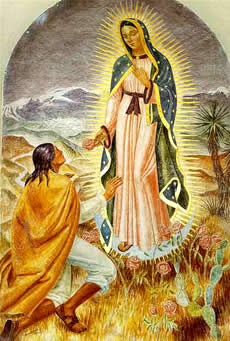
Advent Devotion 12 – The Virgin of Guadalupe

virgin-guadalupeDecember 12 is the Virgin of Guadalupe Day. This Mary is the patron saint of Mexico and revered not only throughout Latin America but around the world. Up on the top of a rugged, blustery mountain outside of Pamplona, Spain, on the Camino de Santiago, there was a small shrine to the Virgin of Guadalupe. She gets around.

As Protestants who worship God, not the Virgin Mary, and who don’t venerate the traditional Catholic saints, why pay any attention to the Virgin of Guadalupe? I was in a Protestant church here in St. Petersburg recently and there were 14 male images adorning the sanctuary. Sitting in the pew, one was surrounded by men. There were no female representations in the sanctuary. The setting did not feel very welcoming to me. I never have that feeling in a church in Mexico. Every church you go into has at least one representation of the Virgin of Guadalupe. There are always male and female images in the churches there. So one thing that is important to me about the Virgin of Guadalupe is that she brings a female image, a female representative, into a tradition that is dominated by male figures.

In the story of the Virgin of Guadalupe, she appears several times to Juan Diego. He is a poor, indigenous peasant. An Indian. In the midst of a religious tradition dominated and controlled by European men, the Virgin Mary appears to a poor, native person. She instructs Juan Diego to have the bishop build a church on a certain hill that is sacred to the Indians. She does not appear to the local priest or bishop, or to other church higher ups from Spain. She appears to the most humble of personages. I like that. I like it that her story involves including the witness of the native people. It shows that God is for/with everyone, not just church officials and those of European descent. God is the God of everyone and values everyone equally. That’s what I see in the Virgin of Guadalupe: A God of universal love creating a church with equal access for all.

These themes are present in the birth stories of Jesus. Jesus comes from the bottom of society born to parents who are not of high birth or status. In his ministry, Jesus creates a faith community inclusive of all people including women, sinners, rich, poor, Jew and Gentile. He embodies the universal nature of divine love. So let us join with the people of Mexico and around the world celebrating the Virgin of Guadalupe – another representation of divine universal love.

But the angel said to them, ‘Do not be afraid; for see – I am bringing you good news of great joy for all the people.”
Luke 2:10

 “Hear me and understand well, my son the least, that nothing should frighten or grieve you. Let not your heart be disturbed. Do not fear that sickness, nor any other sickness or anguish. Am I not here, who is your Mother? Are you not under my protection? Am I not your health? Are you not happily within my fold? What else do you wish? Do not grieve nor be disturbed by anything.”

Our Lady of Guadalupe to Juan Diego

Advent Devotion 11 – Comfort and Joy

In the old English carol, “God Rest Ye Merry Gentlemen,” the refrain refers to, “Tidings of comfort and joy.” In this season of making merry and fulfilling often extensive obligations what might feel like comfort and joy? Does spending and overspending bring a sense of comfort and joy? No. It often brings stress and worry; the opposite of comfort and joy. Does participating in event after event, getting tired, and falling behind bring comfort and joy? Hardly. It can be hard to remember what comfort and joy feel like in the midst of the holiday swirl which can threaten to suck us under!

The original meaning of the word “comfort” involved a sense of strength and fortitude. Comfort was the strength to see you through difficult times, hard challenges, and stressful situations. Surely there are times when we all need that kind of strength. Maybe Advent is just such a time. We need fortitude; to resist excess, to deal with family, to manage heavy schedules, to deal with the volatile emotions of those around us, or within ourselves. The message of comfort tells us to be strong, stay solid. Don’t get sucked under!

And what of joy? Joy is not fleeting happiness or momentary pleasure. Joy is deeper, more long term. Joy is a sense of well being in the grand scope of things. It is enchantment with the amazing wonders of life. Joy is not contingent on a certain gift or circumstance. Joy is ongoing regardless of the situation. Again, this is something we need this season when there is the potential for disappointment and unmet expectations.

So, these old fashioned, archaic words which we often think of as quaint and dated actually speak very vividly to our current situation. While the word “gentlemen” in the old carol could use updating to a less gender specific term, “comfort” and “joy” are still relevant. They remind us of the life of the babe born in Bethlehem. They tell of the one who remained strong and solid in the midst of contention and conflict. They remind us of the one who lived with joyful abandon in the midst of strife, oppression, and opposition. May we hear tidings of comfort and joy this season. May we speak tidings of comfort and joy to others.

I tell you all this that my joy may be yours,
and your joy may be complete.
John 15:11

Prayer
In this season when things are hectic and disappointments are many, may we stay focused on the true gifts of the season – comfort and joy. May we look for the deeper messages and the sources of strength around us. May we offer others comfort and joy in the spirit of Christ. Amen.

Advent Devotion 10 – Human Rights Day

December 10 was designated as Human Rights Day by the United Nations in 1950. This date commemorates the adoption of the Universal Declaration of Human Rights by the United Nations on December 10, 1948. In the wake of World War II it was determined that the nations of the world needed to agree on a universal standard of human rights.

The first few articles of the Declaration set forth the tone of the document:

Article 1.
All human beings are born free and equal in dignity and rights.They are endowed with reason and conscience and should act towards one another in a spirit of brotherhood.

Article 2.
Everyone is entitled to all the rights and freedoms set forth in this Declaration, without distinction of any kind, such as race, colour, sex, language, religion, political or other opinion, national or social origin, property, birth or other status. Furthermore, no distinction shall be made on the basis of the political, jurisdictional or international status of the country or territory to which a person belongs, whether it be independent, trust, non-self-governing or under any other limitation of sovereignty.

Article 3.
Everyone has the right to life, liberty and security of person.

Article 4.
No one shall be held in slavery or servitude; slavery and the slave trade shall be prohibited in all their forms.

Article 5.
No one shall be subjected to torture or to cruel, inhuman or degrading treatment or punishment.

Article 6.
Everyone has the right to recognition everywhere as a person before the law.

Article 7.
All are equal before the law and are entitled without any discrimination to equal protection of the law. All are entitled to equal protection against any discrimination in violation of this Declaration and against any incitement to such discrimination.

How perfect that this was the day to celebrate the life of Nelson Mandela, a great champion of human rights.

Some of us participated in an interfaith dialogue event this evening here in St. Petersburg: Tell Me About the Muslim Faith. Nine people from Lakewood UCC were present. We heard a presentation about Islam and then engaged in dialogue about our faiths in diverse groups over dinner. It was a very enlightening evening.

Article 18 of the Universal Declaration of Human Rights declares:

Everyone has the right to freedom of thought, conscience and religion; this right includes freedom to change his religion or belief, and freedom, either alone or in community with others and in public or private, to manifest his religion or belief in teaching, practice, worship and observance.

Given that affirmation of religious freedom and respect, the interfaith event at the Enoch Davis Center was also a fitting way to mark Human Rights Day.

The Universal Declaration of Human Rights does not stop with matters of conscience, but also addresses very practical concerns. Article 25 states:

Everyone has the right to a standard of living adequate for the health and well-being of himself and of his family, including food, clothing, housing and medical care and necessary social services, and the right to security in the event of unemployment, sickness, disability, widowhood, old age or other lack of livelihood in circumstances beyond his control.

Here we still need to do a lot of work. As Christmas approaches and we prepare to celebrate the birth of one who truly honored and defended the human rights of each and every person, this is a time to think about how we are standing up for human rights. And when we look at the scope of the Declaration, we realize that we have opportunities to work for human rights right here in our own community.

People will sit under their own vines and fig trees with no one to make them afraid.
The mouth of Yahweh Omnipotent has spoken.
Micah 4:4

Prayer: In this season we prepare to celebrate the birth of one who embodied respect for the human rights of each and every person. Jesus shows us how to live out the universal love of God. He teaches us to love beyond the divisions and prejudices that we learn consciously and unconsciously. May we honor Jesus by extending human rights to all persons. Amen.

To read the entire Universal Declaration of Human Rights, follow the link below:

http://www.un.org/en/documents/udhr/index.shtml#atop

Advent Devotion 9 – Naughty or Nice?

The classic image of Santa involves the critical question – Have you been naughty or nice? The answer determines your fate with Santa. Many people project this kind of thinking on to God and feel God makes a similar determination the result of which accounts for our destiny with God.

So, are we naughty or nice? The vast majority of people want to be or intend to be nice. Basically, people want to be good and do the right thing. But does that intention really make us good? And can being good actually make us bad?

Apparently, doing good can give us the impression that we are good people. We’ve done the right thing. We have been generous. We have helped someone. So, we feel good about ourselves and we feel that we are good. That’s all fine. But we start to think of all this good like “money in the bank.” Then when the opportunity comes to do something morally questionable, we think, “Well, I’ve done all this good, it’s ok if I do this bad thing. I have done plenty of good to make up for it.” We think of our good as the counter balance to the bad thing we do.

A minor example could have to do with eating. Say we are trying to diet. We eat a low calorie salad and flavored water for lunch. In the mid afternoon, we are feeling a bit hungry. So, we have some chips and dip to tide us over, thinking it’s ok because we only had a salad for lunch.

But this kind of thinking also happens with regard to moral decision-making by individuals and corporations. We may donate a lot to charity. Then when we are doing our tax returns, we think we’ve been generous, we have been good so, we’re entitled to cheat on our return and not declare something we should really be disclosing. Or a company may do all kinds of things that are helpful to the environment and then feel that that makes it ok for them to ignore an EPA regulation and dispose of waste inappropriately.

With this kind of thinking, we convince ourselves that being good makes it ok to be bad once in a while. Being good earns us the right to to be bad.

So as we prepare for Christmas, beware. Pay attention. Are you being nice or good or generous and then using that as an excuse to do something selfish, or wrong, or bad?

The message of Christmas is that we are loved naughty or nice. Naughty AND nice.

When you do acts of charity, for example, don’t have it trumpeted before you; that is what hypocrites do in the synagogues and the streets, that they may be praised by others. The truth is, they’ve already received their reward in full. But when you do acts of charity, don’t let your left hand know what your right hand is doing; your good deeds must be done in secret, and your Abba God – who sees all that is done in secret – will repay you.
Matthew 6: 2-4

Prayer: This Christmas season and all year, we pray for hearts that are pure. We want to be good and we want to do good, not as license to do bad or out of self interest, but in response to the unconditional love at the heart of life. May we forgive ourselves and others with the same abandon God extends mercy to us. Amen.