
Sermon text 9.1.24

LAKEWOOD/TRINITY UNITED CHURCH OF CHRIST
2601 54th Avenue South  St. Petersburg, FL  33712
On land originally inhabited by the Tocabaga
727-867-7961

lakewooducc.org
lakewooducc@gmail.com

Date: September 1, 2024
Scripture Lessons: Luke 24:1-12, Mark 16:9-11, John 20:11-18
Sermon:  Seeking Jesus
Pastor: Rev. Kim P. Wells

Mary Magdalene is mentioned 12 times in the gospels and there are an additional 2 implicit references to her.  She is named along with blood relatives of Jesus.  She is the first when there is a list of named women.  This is all literary evidence of her importance.  [See Six New Gospels:  New Testament Women Tell Their Stories by Margaret Hebblethwaite.]

Just as a contrast, Bartholomew, one of the named 12 disciples, is referred to 3 times in the gospels.  Once in Matthew, Mark, and Luke in a list of named disciples.  The disciple Matthew is referred to 4 times.  And Thaddeus, twice. 

So then the 14 references to Mary are significant when seen in their context.  The references in the New Testament, particularly the story of Mary as the first witness to the resurrection, make it clear that she was very important among the followers of Jesus.  It even appears that she was considered number two next to Jesus.  This is reinforced by writings that refer to Peter’s jealousy of Mary.  We know that Mary was a very influential, important follower of Jesus.  A leader in the Jesus movement. 

It is also interesting to note that Mary is always referred to as Mary of Magdala, or Mary Magdalene.   Typically women were referred to in terms of their relationship to men:  Nancy, wife of Mark.   Adelaide, sister of Frank.  Sabrina, daughter of Steve.  But Mary is always referred to in association with her home city,  Magdala.  Magdala was a significant city of some 40,000 people on the shore of the sea of Galilee.  The main industry was fishing.  It had a fleet of some 230 boats.  [Hebblethwaite]  So, Mary was a significant person from a significant city. 

Some of the references to Mary tell us that she, along with other women, were part of the inner circle of Jesus followers that travelled with him around Palestine; going from town to town, city to city, sharing the gospel, healing people, feeding people.   This group of women including Mary was part of this ministry day in and day out with Jesus.  We might not see that this, in itself, was absolutely scandalous.  Unheard of.  A woman did not leave home, family, her obligations in the household, to follow an itinerant preacher.  Men, ok.  But women, absolutely not.  First, they would not be allowed to leave by the men in their lives who controlled their existence.  And secondly, there would be no need for them.  They were not permitted to have a role in public life.   And thirdly, they would not have been allowed to mix with a group of men that were not their relatives.  And yet we are told again and again, that the women, including Mary Magdalene were with Jesus. 

And we are told that Mary Magdalene and other women not only were present but they supported the ministry of Jesus with their service and with their resources.  They were helping to fund this ministry.  Their participation was core to the mission.  They were likely ministering especially to the women who came to hear the teachings of Jesus.  Talking with them.  Offering them food.  Healing them?  In these tiny details, we see the great importance of women to the ministry of Jesus.  And we see his radical break with the patriarchy of his time. 

Yes, Mary Magdalene and other women were important in the ministry of Jesus.  He clearly called them and was training them to continue his mission.  We also see that the presence of Mary and other women was significant in the stories of the crucifixion and resurrection. 

We are told that Mary and the women were present at the crucifixion.  They watched their beloved teacher suffer and die.  This is mentioned in all four gospels.  And where were the 11 named disciples and the other men who followed Jesus?  They fled.  They were hiding.  They betrayed and denied Jesus.  But the women remained faithful through Jesus’ death, regardless of the danger it may have posed for them.  They stayed constant. 

Then after the crucifixion, they continued to serve Jesus, to minister to him, to his body.  They went to the grave.  And in all 4 gospels, we are told that it is women, including Mary of Magdala, who are the first to find the empty tomb.  They are the first to find out that Jesus is not dead and buried.  The tomb is empty. 

In Jewish law, women were forbidden to be legal witnesses.  The male disciples discredit the witness of the women as an “idle tale” in the gospel of Luke.  [Luke 24:11]  In Mark they simply don’t believe the women.   So, they go and see for themselves that the tomb is empty.

Then the women, Mary included, tell the men that they are to meet the risen Christ, as he told them.  So the women become the bridge, they create the path for the disciples who have betrayed and deserted Jesus, to return to him and be reconciled with their teacher.  Mary is not just a listener to Jesus, she embodies his message.  It is incarnate in her.  It is not just a theological statement or an article of belief.  She lives out the power of Love that she has experienced in the ministry of Jesus. 

And so Mary Magdalene is designated ‘the apostle to the apostles.’  And there is a gospel attributed to her.  The Gospel of Mary of Magdala.  It was written in the early second century CE.  In the late 19th century, fragments of a copy of this gospel were discovered, a Coptic translation.  Since then, two additional fragments in Greek have been discovered.  The fragments remain incomplete.  Fewer than 9 pages.  What there is offers an interesting perspective on the teachings of Jesus.  The character of the Gospel of Mary of Magdala is described this way by Professor Karen King of Harvard Divinity School:  “Salvation is achieved by discovering within oneself the true spiritual nature of humanity and overcoming the deceptive entrapments of the bodily passions and the world.  The Savior concludes this teaching with a warning against those who would delude the disciples into following some heroic leader or a set of rules and laws.  Instead they are to seek the child of true Humanity within themselves and gain inward peace.” [The Gospel of Mary of Magdala:  Jesus and the First Woman Apostle, Karen L. King, p.4.]  This is an interesting  way of looking at the Good News of Jesus Christ.  The focus is not on heaven but on finding the realm of God within yourself here in this life.  But this voice, this version of the Gospel, was not deemed worthy of inclusion in the New Testament.  Those who selected the canon of the New Testament had political interests, economic interests, and power interests to consider.  This message associated with Mary Magdalene did not further their goals.  And yes, they were men.

It is also interesting that in the Gospel of Mary, Jesus is not referred to as the Son of Man, or with other typical male titles used in the gospels.  He is called the child of true Humanity, Savior,  and the term Lord is used.  And in reference to God, there is no mention of Father.  Instead, God is repeatedly referred to as the Good.  Here is an example:  “For this reason, the Good came among you, pursuing the good which belongs to every nature.”  [King, p. 13.]  And in this gospel there is this teaching associated with Jesus:  “‘Peace be with you!’ he said.  ‘Acquire my peace within yourselves!’

“Be on your guard so that no one deceives you by saying, ‘Look over here!’ or ‘Look over there!’  For the child of true Humanity exists within you.  Follow it!  Those who search for it will find it.’” [King, p. 14.]

Of course, those who established the early church wanted a message that they could control and dominate and enforce.   Something they could impose with external authority.  The Gospel of Mary of Magdala did not make the cut. 

But still the power of the witness of Mary Magdalene was such a threat to established male power in the church that the church resorted to turning her into a prostitute to discredit her and disempower her as a faith leader.  There is no mention of Mary of Magdala as a prostitute in the New Testament.  She is referred to as the one from whom Jesus cast out 7 demons.  There is no mention of prostitution.  Now the church had Mary, the mother of Jesus, a virgin.  And Mary of Magdala, a prostitute.  This reinforced the characterizing of women chiefly by their sexuality, by the excesses of hyper sexuality, and defined them primarily as sexual creatures. 

The battle about control of the role of women and defining women continues today.  Sadly.  The perceived threat of female power to toxic masculinity is being played out day after day in the current presidential campaign.  And it is not pretty.  It is a disgusting, demeaning, and degrading display. 

At the beginning of the gospel of John, Jesus asks, “Whom are you looking for?”  Then, in the encounter between Jesus and Mary in the garden at the end of the gospel, the one she perceives as the gardener asks, “Whom are you looking for?”  In the gospel of John, Jesus teaches, “You call me teacher and Sovereign, and you are right, for that is what I am….” [John 13:13]  And in the garden encounter, Mary of Magdala refers to Jesus as Rabbouni, an intimate form of the word for teacher, and then she refers to him as Sovereign.  [See The Women’s Bible Commentary, Carol A. Newsome and Sharon Ringe, eds. p. 301.]  So she sees him for who he is.  Teacher and Savior.  She accepts the fullness of his witness.  She embraces his vision of egalitarian community and the mission to help people discover the Divine within themselves.  Everyone is free from stereotypes and from cultural and religious confines.  Everyone can be an agent of healing, peace, and reconciliation. 

This is the question we must continue to ask ourselves today.  Who is Jesus for us?  Who are we looking for?  Whom are we seeking?   Is Jesus our authoritative teacher and Sovereign?  Do we accept his vision of full egalitarian, free community?  Are we looking for the Divine within ourselves and others?

Denying the full humanity of women is not just about harming women.  It’s about harming humanity and Creation.  It is about denying the fullness of humanity for all people.  And allowing toxic masculinity to thrive creates suffering for everyone and the planet.  What we see in the legacy of Mary Magdalene is that the gospel is about the fullness of humanity for everyone for the good of everyone. 

This past week, the Interdenominational Ministerial Alliance, the IMA, a clergy group of which I am a member, sponsored a retreat with Gary Mason.  He is an international peace practitioner from Ireland.  He is a Methodist minister and the Executive Director of Rethinking Conflict, a conflict transformation organization in Belfast.  He played an integral role in the Northern Ireland peace process.  He’s a smart, well read, likable person with a winsome spirit and a delightful sense of humor.  The group that met with him here in St. Pete was small so the conversation was lively and honest.  Revealing, even.  At one point, he mentioned that in the peace process in Ireland, there were women at the table.  Then he noted that in the peace talks between Israel and the Palestinians, there are no women present. The implication was that the peace process would be furthered in that conflict if women were at the table.  

Denying the full humanity of women hurts everyone. 

In the Gospel of Mary, Jesus’ parting words to the disciples are:  “Go then, preach the good news about the Realm.  Do not lay down any rule beyond what I determined for you, nor promulgate law like the lawgiver, or else you might be dominated by it.” [King, p. 14.]     Amen.

In addition to the sources cited, the following resources were used in the preparation of this sermon:

In God’s Image:  Archetypes of Women in Scripture, by Craig Ballard Millett.

Praying with Women of the Bible, by Bridget Mary Meehan.

And the New Interpreter’s Bible, sections about the resurrection and Mary in all 4 gospels. 

A reasonable effort has been made to appropriately cite materials referenced in this sermon. For additional information, please contact Lakewood United Church of Christ.
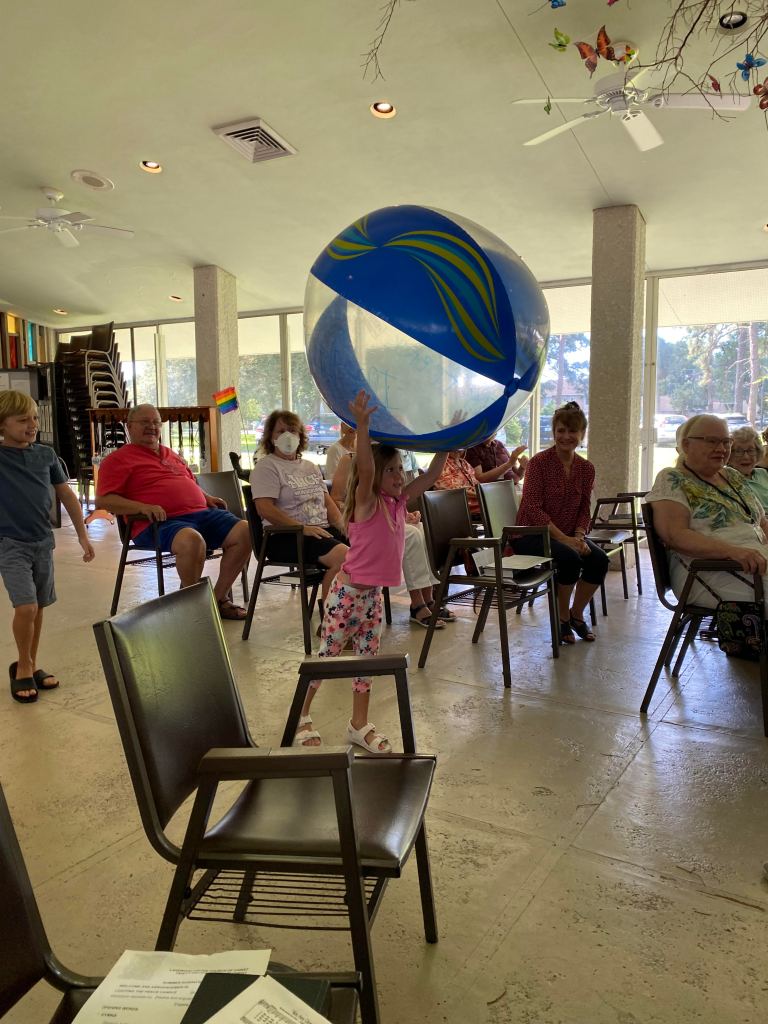
Rev. Wells’ Welcome to Whispering Pines

Rev. Wells’ Welcome to Whispering Pines

These remarks were delivered on Friday morning August 9 at the official opening of Whispering Pines, the Boley-sponsored housing complex that has been built next to the church.

Good morning!  I am Rev. Kim Wells, pastor of the church next to Whispering Pines.  This day has been a LONG time coming and we are thrilled to welcome our new neighbors at Whispering Pines.  When we were first told of the project, it was emphasized that there would be a substantial fence between the church and the development.  We said, Please put a big gate in the fence!

We welcome our new neighbors.  As a church, we are ‘love your neighbor’ kind of people.  That’s what a church is.  And we are excited to have new neighbors.  

There is a story in the gospels attributed to Jesus that includes the image of building a house on sand and building a house on rock.  A house built on sand may be temporary and unsafe.  We know a house built on sand may be blown away by gusts of wind and rising waters.  A house built on sand may be flattened by trends in the economy.  It may be crushed by the erosion caused by embedded inequality.  A house built on sand may be razed by the power of greed.  A house built on sand is unstable and precarious.  

A house built on rock is safe and stable.  The residents have access to food, shelter, healthcare, recreation, the arts, and faith, if they so choose.  A house built on rock stays standing and can be depended upon.  A house built on rock creates the opportunity for residents to positively contribute to the community and to society.  

Whispering Pines joins over 50 Boley housing communities in Pinellas County as a house built on rock – enhancing and contributing to the stability of life not only for the residents of Whispering Pines but also for the community at large.  

We close with a words from a Jewish folk song based on a verse from Micah 4:4 in the Bible:  Let everyone beneath their vine [pine] and fig tree live in peace and unafraid.  

Welcome, Whispering Pines!

Sermon text 8.25.24

LAKEWOOD/TRINITY UNITED CHURCH OF CHRIST
2601 54th Avenue South  St. Petersburg, FL  33712
On land originally inhabited by the Tocabaga
727-867-7961
lakewooducc.org
lakewooducc@gmail.com

Date: August 25, 2024
Scripture Lesson: Romans 12
Sermon: Something Happens Here
Pastor: Rev. Kim P. Wells

We begin with a story from a Catholic missionary to Africa. 

“When I served as a priest in Tanzania, I spent a year preparing a group of Maasai for baptism.  I had to decide who seemed ready and who needed more study.

“Ndangoya, the oldest man, stopped me politely but firmly.  ‘Padri, why are you trying to break us up and separate us?  During this whole year you have been teaching us.  We have talked about these things when you were not here, at night around the fire.  Yes, there have been lazy ones in this community.  But they have been helped by those with much energy.  There are stupid ones in the community, but they have been helped by those who are intelligent.  There are ones with little faith in this village, but they have been helped by those with much faith.  Would you turn out and drive off those lazy ones and the ones with little faith and the stupid ones?  From the first day, I have spoken for these people — and I still speak for them.  Now, on this day one year later, I can declare for them and for all this community that we have reached the step in our lives where we can say, ‘We believe.’’

“I looked at the old man.  ‘Excuse me, old man,’ I said.  ‘Sometimes my head is hard and I learn slowly.  ‘We believe,’ you said.  Of course you do.  Everyone in the community will be baptized.’” 

[From Once Upon a time in Africa: Stories of Wisdom and Joy, compiled by Joseph G. Healey.  This story comes from Father Vincent Donovan. p. 50.]

The Christian faith is fundamentally a religion that is realized in community.  Our faith holds many promises.  We are promised that we are loved and that we have the capacity for great love.  We are promised comfort and solace.  We are promised new life and transformation.  We are promised forgiveness and reconciliation.  We are promised a life of abundance and joy.  We are promised healing and support through troubled times.  We are promised that broken hearts can mend.  We are promised peace at the end of this life.  These and so many more promises are part of our commitment to the way of Jesus.  And the New Testament, the gospels and epistles, make clear that the promises of our faith are borne out in community, in relationship with other people. 

This should not be surprising because Christianity emerged from the earlier tradition of Judaism.  And Judaism is based on the story of the relationship between God and the Jewish people who were called to embody the love, the shalom, the peace, the justice, and righteousness of God in community as a model for the world.  Judaism has always had a communal orientation. 

So it should come as no surprise that Jesus, a Jew, began his ministry by calling a group of disciples, followers.  They are to embody the gospel, the good news, of Divine Love.   And this group stays with Jesus to learn, to grow, to mess up, to misunderstand.  And yet they stick together because somehow, someway, they experience the reality of God that Jesus talks about manifesting itself among them. 

Several weeks ago I was part of a panel discussion for “Florida This Week” on PBS with Rob Lorei.  And one of the most interesting comments to me was made by Rev. Russell Meyer, head of the Florida Council of Churches, a Lutheran minister, and a close colleague.  He mentioned that the group of 12 disciples were people who would never have been closely associated in their regular lives.  They were diverse and disparate and would not have been part of the same group.  And yet these are the ones that Jesus called to embody the reality of God.  And, eventually, they do!

The early Christian communities were known for their love.  Church historian Tertullian, writing at the turn of the second century, tells us:  “What marks us in the eyes of our enemies is our practice of lovingkindness: ‘Only look,’ they say, ‘look how they love one another!’”  [Beyond Belief: The Secret Gospel of Thomas, Elaine Pagels p. 10.]  They were known for referring to each other as brother and sister, family.

The Christian faith, the teachings of Christianity, the Christian religion is meant to be lived out in community.  Together, we practice love for one another and for those beyond the faith community.  Together, in relationship, we learn to forgive.  Together in worship we experience awe, transcendence, and the reality of Divine Love.  The promises of our faith are made real in communal relationships and experiences. 

Yes, there is a strand in our tradition from the earliest days of monasticism.  Those who separate themselves from society to draw nearer to the Divine.  But even monastics are known for devoting themselves to prayer for the well being of others, of the world.  And even monastics who live in community face challenges that require them to learn and grow in Christian love as they seek to live together for God and for good. 

The gospel of John begins, the word became flesh.  Ours is a faith of incarnation.  Love expressed in flesh.  Yes, even yours and mine. 

And so the epistles are full of instructions for those in emerging faith communities about how to live together in Christian community and so experience and be transformed by the power of Divine Love.  These people are often dependent on their faith community as their only family.  They have been ostracized by their biological or social families and communities of support.  The attraction to the transforming power of love in community has led them to be part of a Christian community.  They are seeking a new way of being, of belonging, a new reality, a path of love.  And there is much direct instruction that is needed for people to understand and participate in and benefit from the power of this new community.  And so as we heard, the writer of Romans, probably the apostle Paul explains: 

“I say to everyone among you not to think of yourself more highly than you ought to think. . . For as in one body we have many members, and not all the members have the same function, so we, who are many, are one body in Christ, and individually we are members one of another.  We have gifts that differ according to the grace given to us. . .”

The writer goes on:

“Let love be genuine; hate what is evil, hold fast to what is good; love one another with mutual affection; outdo one another in showing honor  . . . Rejoice in hope, be patient in suffering, persevere in prayer.  Contribute to the needs of the saints; extend hospitality to strangers.”

And there is more which bears hearing again: 

“Bless those who persecute you; bless and do not curse them.  Rejoice with those who rejoice, weep with those who weep.  Live in harmony with one another; do not be haughty, but associate with the lowly; do not claim to be wiser than you are.  Do not repay anyone evil for evil, but take thought for what is noble in the sight of all.  If it is possible, so far as it depends on you, live peaceably with all.  . . . ‘if your enemies are hungry, feed them; if they are thirsty, give them something to drink; for by doing this you will heap burning coals on their heads.’  Do not be overcome by evil, but overcome evil with good.”

I don’t know about you, but I can’t do this by myself.  I need help.  I need encouragement.  I need inspiration from others.  Friends, we cannot do this work alone.  We need each other.  And the world desperately needs the witness of people who truly love each other, love themselves, love strangers, and love enemies.  Perhaps, this message is needed now more than ever. People need to see what it is to love.  And this is what we are about as a faith community. 

Church is about giving us a community, a context, in which to embody our divinity, our love for one another.  Here the promises of God, the goodness of the gospel, becomes reality.  And I am going to share just a few examples of that within the context of this congregation. 

One Sunday, a young man came to church who had recently been released from jail.  He was white.  He was gay.  After church, he made it a point to talk with people.  And he specifically told them that he had just gotten out of jail.  He expected them to turn and walk away, or maybe politely excuse themselves.  But that did not happen.  Each person he spoke with asked him how he was doing.  How things were going.  They engaged with him and took an interest in his situation.  He told me later that was the last thing he expected from people at a church.  He would be back.  And he did participate in the church until he moved away from the area.

Then there was the Sunday that a church member wore a new dress to church.  On the way out of church another church member asked her, Is that a new dress?  Yes, it is.  Well, the other woman remarked, It doesn’t do anything for you.  And she walked out the door.  The woman with the new dress laughed.  She did not hold it against the other woman.  There was no umbrage between them.  She just let the whole thing go.  We can learn that here at church.  To be forgiving.  To let things go.  To concentrate on what matters. 

Then there was the time that a church member asked for meals to be brought to her and her husband for two weeks.  They were home bound because of health issues.  The meals could be dropped off or the people could stay and eat with them.  We passed around a sign up sheet on a clipboard on a Sunday morning.  After the service people were complaining:  By the time the clipboard got to them all the slots were filled.  What a beautiful expression of Christian community!

There was the Sunday that a random family, two parents and two children, from Columbia, showed up at church.  They did not speak any English.  And yet we were able to find them a place to stay, give them money for food and other necessities, connect them with others who could help, and they have gone on to make a home for themselves in Tampa. 

And then there was the first Sunday of October last year.  The first Sunday that Trinity and Lakewood officially worshipped together as partners in cooperative ministry.  A person from Lakewood shared a heartfelt prayer concern and was moved to tears.  A person from Trinity, sitting one seat away, moved over and put an arm around the person who was crying.  These were two strangers who did not even know each other’s names.  Yet here they were in church, part of the faith community and embodying the gospel of love.  I knew then that things would be ok between Trinity and Lakewood whatever actually unfolded. 

The promises of God, the good news of the gospel is meant to be experienced in community.  In community we practice how to love one another and ourselves.  We are relieved of the loneliness, isolation, and separateness that can undermine our truest humanity and our deepest joy.  We become part of the larger reality of the realm of love.  In community our souls are nourished and we experience transformation. 

I can also tell you that there have been people who have left the church because being part of a Christian community was ‘working on them.’  Changing them.  Re-forming them.  Making them more loving.  And they resisted and left.  This happens.

Being part of a faith community, a church, it changes you.  I know that being part of this church community has changed me.  That is probably why I have stayed here so long.  I am continually challenged to grow in love and trust.  I find out new things about myself.  I am given the opportunity to make mistakes and learn from them without condemnation.  I learn from all of you ALL the time.  How to be a better person.  How to be more forgiving.  How to reach out in love.  How to trust.  How to face adversity.  So many things I am learning from all of you all the time. 

The promises of our faith, the joy and abundance, the comfort and solace, are all made known to us in relationship.  Divine Love is bestowed upon us by other people.  We express our connection to the Divine through our love of others.  This is the source of our faith, our trust, and our joy.  And so the writer of Romans tells us, “Do not be conformed to this world, but be transformed by the renewing of your minds, so that you may discern what is the will of God — what is good and acceptable and perfect.”  [Romans 12:2]

George MacDonald, a Scottish clergyperson and writer, who lived from 1824 to 1905 emphasizes:  “This love of our neighbor is the only door out of the dungeon of self.” 

Here, in church, we become the body of Christ for one another and for the world.  May it be so.  Amen. 

A reasonable effort has been made to appropriately cite materials referenced in this sermon. For additional information, please contact Lakewood United Church of Christ.