
Advent Devotion 14 – Newtown: 26 or 28?

A year ago today, we were stunned by the news of a school shooting in the sleepy town of Newtown, CT. Grief poured from news outlets and social media. President Obama choked up when he spoke.

But then there have been more than 16 mass shootings in the US in the past year and another attack at a school yesterday near Columbine nonetheless. And then there are the multitudes of children killed by gun violence day in and day out not to mention the adults murdered each and every day.

This morning, I heard an interview with a Newtown parent. She spoke of planning a vigil in the aftermath of the tragedy. They struggled over whether to light 26 candles for the children and staff that were murdered or 28 candles including the killer and his mother. They decided to light 28. After all, there were 28 deaths.

I think 28 candles was the right choice. Yes the children and staff were beloved by God, but so were Adam Lanza and his mother. There had to be grief in the heart of God for a precious creature gone so wrong as well as the death of the woman who gave him birth.

Actually, I think that God has still not stopped crying over the continuous murders of precious children by other precious children. Why don’t we get the sacredness, the divinity, at the heart of all of life? If we did, we would end not only gun violence and murder but global climate change, arguably the greatest threat to human life.

And, what must be the worst part of this for God, is that our country, perpetrator of such horrific violence, has so many Christians and people of faith. That’s the crowning irony. We’re supposedly not a “godless” country. And yet we are not allowing ourselves to be transformed by the horror of 20 children murdered at school. “When will they ever learn,” the song “Where have all the flowers gone” asks.

There is a quote attributed to Edmund Burke, statesman of the 1700‘s: “The only thing necessary for the triumph of evil is for good men to do nothing.” Since the evil of gun violence to continues its rampage in our country, it appears that good people are not doing their part. Violence is not the consequence of having a free society; it is the consequence of having a sick society. We have accepted the pandemic of violence; integrated it into our lives. We have accepted it as being as natural as the air we breathe. For people of God, this acquiescence to violence is delusion, denial, and flat out sin as grave as the apostasies of the Hebrew scriptures rife with the worship of foreign gods. We, too, are worshipping gods foreign to the God of Jesus Christ. We make gods of the Constitution, personal rights, profit, and individualism, at the expense of a peace-loving society.

How many candles will it take to illumine the truth?

They dress my people’s wound carelessly,
saying, “Peace, Peace,” knowing that there is no peace.
Are they ashamed of their loathsome conduct?
No, they feel no shame; they don’t even know how to blush.
Jeremiah 8:11-12a

Prayer: Help us to see our complicity with the violence in our society and in our world. This Christmas season, may we receive the Prince of Peace and allow him full sway over our lives, our hearts, our values, and our behavior. May we be converted by the birth of Jesus so that we might be agents of transformation of the world around us. Amen.
Advent Devotion 13 – Hope

This holy season is a time for hope. But what is hope? Is it the desire and anticipation of getting a certain gift for Christmas? Is it expecting something different to happen? Is it simply not giving up?

Former Czech president Vaclav Havel has said that, “Hope is definitely not the same thing as optimism. It is not the conviction that something will turn out well but the certainty that something makes sense, regardless of how it turns out.” I like that description of hope. To me, hope means that I care about something. The outcome matters to me. I feel deeply about that for which I hope. But hope also means that I don’t have ultimate control over the situation. With hope, there is a dose of the unknown, the mysterious, that which is beyond our direct control.

Here’s a trivial example. I am hoping that we have a safe flight to Boston on Christmas Day. But I am not a mechanic and don’t control the condition of the plane. I am not a pilot and don’t control the operation of the aircraft. And I certainly don’t control the weather. But we want to be together as a family for Christmas so we have bought the tickets, we will pack appropriately, follow the directions, and hope for the best.

What kinds of things do we hope for that are of more significant import? Peace on earth. An end to poverty and hunger. The eradication of prejudice and bigotry. Respect and dignity for each and every human being regardless of life circumstances. A good education for every young person. A stop to global climate change. Access to health care for all people. Getting along with others. A steady job. What kinds of things do you hope for?

If we hope for these things, then it makes sense that we do something about them whether or not we will succeed. Regardless of the outcome. That is the nature of hope. And hope is embedded in the Christmas stories that we have from the gospels. In the story in Luke, God comes to Mary telling her the plan for her to have a baby. God had hope that Mary would cooperate but did not control her response. The child of promise is born to poor people in a setting of extreme political and economic adversity. Who can control the outcome of that plan set in motion? In the gospel of Matthew, Joseph takes Mary and Jesus to Egypt to keep them safe, but that, too, could have turned out badly. We are told that the magi journey for months to find Jesus. Again, many things could have gone wrong. And then there is all the promise invested in the baby. The infant morality rate was high. There was a lot of violence in the culture. That Jesus would live to adulthood was not assured. Yes, the stories were created after the fact but they are imbued with hope.

The Christmas season invites us to live out of hope. To do what makes sense because it is right, because it is something we care about, because we believe in it. What are we doing as we prepare to celebrate Christmas that expresses our deeply felt yearnings, dreams, and hopes? To embody hope is not to be assured of the outcome, but to have conviction about the prospect.

You grew weary from your many wanderings,
but you did not say, “This is hopeless!”
You rekindled your desires
at the expense of your anxieties.
Isaiah 57:10

Prayer: We pray to be people of hope. We pray to care about things that truly matter. We pray to live in a way that brings God’s hopes and dreams to fruition. Amen.

Advent Devotion 12 – The Virgin of Guadalupe

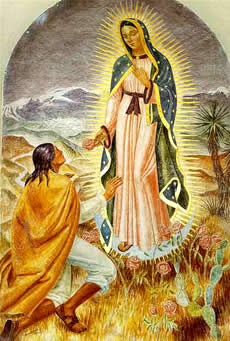
virgin-guadalupeDecember 12 is the Virgin of Guadalupe Day. This Mary is the patron saint of Mexico and revered not only throughout Latin America but around the world. Up on the top of a rugged, blustery mountain outside of Pamplona, Spain, on the Camino de Santiago, there was a small shrine to the Virgin of Guadalupe. She gets around.

As Protestants who worship God, not the Virgin Mary, and who don’t venerate the traditional Catholic saints, why pay any attention to the Virgin of Guadalupe? I was in a Protestant church here in St. Petersburg recently and there were 14 male images adorning the sanctuary. Sitting in the pew, one was surrounded by men. There were no female representations in the sanctuary. The setting did not feel very welcoming to me. I never have that feeling in a church in Mexico. Every church you go into has at least one representation of the Virgin of Guadalupe. There are always male and female images in the churches there. So one thing that is important to me about the Virgin of Guadalupe is that she brings a female image, a female representative, into a tradition that is dominated by male figures.

In the story of the Virgin of Guadalupe, she appears several times to Juan Diego. He is a poor, indigenous peasant. An Indian. In the midst of a religious tradition dominated and controlled by European men, the Virgin Mary appears to a poor, native person. She instructs Juan Diego to have the bishop build a church on a certain hill that is sacred to the Indians. She does not appear to the local priest or bishop, or to other church higher ups from Spain. She appears to the most humble of personages. I like that. I like it that her story involves including the witness of the native people. It shows that God is for/with everyone, not just church officials and those of European descent. God is the God of everyone and values everyone equally. That’s what I see in the Virgin of Guadalupe: A God of universal love creating a church with equal access for all.

These themes are present in the birth stories of Jesus. Jesus comes from the bottom of society born to parents who are not of high birth or status. In his ministry, Jesus creates a faith community inclusive of all people including women, sinners, rich, poor, Jew and Gentile. He embodies the universal nature of divine love. So let us join with the people of Mexico and around the world celebrating the Virgin of Guadalupe – another representation of divine universal love.

But the angel said to them, ‘Do not be afraid; for see – I am bringing you good news of great joy for all the people.”
Luke 2:10

 “Hear me and understand well, my son the least, that nothing should frighten or grieve you. Let not your heart be disturbed. Do not fear that sickness, nor any other sickness or anguish. Am I not here, who is your Mother? Are you not under my protection? Am I not your health? Are you not happily within my fold? What else do you wish? Do not grieve nor be disturbed by anything.”

Our Lady of Guadalupe to Juan Diego

Advent 1, 2013 (podcast)

12/1/2013
Rev. Wells

The recording begins with Liturgist, Roger Jackle, reading the scripture, Isaiah 35:1-10, followed by Rev. Well’s sermon. To listen, click the following link:
 
Advent 1, 2013 (podcast)

If you experience problems playing the podcast, download the audio file and play it with your computer’s media player. To download, if you have a two-button mouse, right-click the link and select the save option. If you have a one-button mouse (on a Mac), press and hold the “Control” key and click the link and select the save option.


Advent Devotion 11 – Comfort and Joy

In the old English carol, “God Rest Ye Merry Gentlemen,” the refrain refers to, “Tidings of comfort and joy.” In this season of making merry and fulfilling often extensive obligations what might feel like comfort and joy? Does spending and overspending bring a sense of comfort and joy? No. It often brings stress and worry; the opposite of comfort and joy. Does participating in event after event, getting tired, and falling behind bring comfort and joy? Hardly. It can be hard to remember what comfort and joy feel like in the midst of the holiday swirl which can threaten to suck us under!

The original meaning of the word “comfort” involved a sense of strength and fortitude. Comfort was the strength to see you through difficult times, hard challenges, and stressful situations. Surely there are times when we all need that kind of strength. Maybe Advent is just such a time. We need fortitude; to resist excess, to deal with family, to manage heavy schedules, to deal with the volatile emotions of those around us, or within ourselves. The message of comfort tells us to be strong, stay solid. Don’t get sucked under!

And what of joy? Joy is not fleeting happiness or momentary pleasure. Joy is deeper, more long term. Joy is a sense of well being in the grand scope of things. It is enchantment with the amazing wonders of life. Joy is not contingent on a certain gift or circumstance. Joy is ongoing regardless of the situation. Again, this is something we need this season when there is the potential for disappointment and unmet expectations.

So, these old fashioned, archaic words which we often think of as quaint and dated actually speak very vividly to our current situation. While the word “gentlemen” in the old carol could use updating to a less gender specific term, “comfort” and “joy” are still relevant. They remind us of the life of the babe born in Bethlehem. They tell of the one who remained strong and solid in the midst of contention and conflict. They remind us of the one who lived with joyful abandon in the midst of strife, oppression, and opposition. May we hear tidings of comfort and joy this season. May we speak tidings of comfort and joy to others.

I tell you all this that my joy may be yours,
and your joy may be complete.
John 15:11

Prayer
In this season when things are hectic and disappointments are many, may we stay focused on the true gifts of the season – comfort and joy. May we look for the deeper messages and the sources of strength around us. May we offer others comfort and joy in the spirit of Christ. Amen.