Sermon March 16, 2015 "Snakes Alive!"

Scripture Lessons: Numbers 21:4-9 and John 3:14-21
Pastor: Rev. Kim P. Wells

Tomorrow, millions of people the world over, will engage in the wearing of the green to celebrate St. Patrick’s Day. Well, they won’t only wear green. There will be festivals, parades, and plenty of drinking. St. Patrick’s Day is celebrated on March 17, the traditional date of Patrick’s death. And while the date usually falls in Lent, the church officially lifts lenten restrictions for the day, to allow for “mindless alcohol-fueled revelry” as it is described by one priest. [Wikipedia, “St. Patrick’s Day,” Father Vincent Twomey, The Irish Independent, 12 March 2007]

St. Patrick’s Day will be celebrated around the world including festivities in Japan, Malaysia, Russia, the Caribbean, and even on the International Space Station.

St. Patrick’s notoriety comes with the tradition that he brought Christianity to Ireland baptizing thousands and converting the sons and daughters of the wealthy to become priests and nuns. St. Patrick is also credited with driving the snakes out of Ireland. As legend tells it, Patrick went up a hill for a 40 day fast. While there, he was attacked by snakes and he banished them to the sea.

Nigel Monaghan, keeper of natural history at the National Museum of Ireland in Dublin, has examined extensive evidence concluding that there never were any snakes in post glacial Ireland. [Wikipedia, St. Patrick]

So, why is there a legend about snakes associated with St. Patrick? Well, it goes back to the Bible and beyond. Snakes have long had religious significance for humans. Many religions include snakes in their symbolism including Judaism and Christianity. In Egypt, the snake was a symbol of divinity and the pharaohs had the snake on the headdress for protection and power. Think of the well known mask of Tutenkahmen. There is a snake at the top.

Snakes were prominent in the religions of pre-Columbian Central and South America. At many of the pre Columbian ruins in Mexico, there are snakes featured in the construction of the temples and the relics associated with them. At the ruins of Chichen Itza in the Yucatan, the stairways of the pyramid are lined with 4 serpents representing the feathered serpent god Kukulkan. In the late afternoon on the spring and autumn equinoxes, the shadows cast create the appearance of the snakes slithering down the staircase.

Snakes figure prominently in Asian religions as well. In Angkor in Cambodia, serpents are symbols of protection. The buddha is shielded by a hooded serpent while meditating.

In the indigenous religions of North America, the snake is an important symbol. In Hopi culture the snake is a symbol of fertility. This symbolism is part of our Abrahamic tradition as well. The snake was associated with sexual passion – for obvious reasons.

The snake with the shedding of its skin has symbolic associations with transformation, rebirth, immortality, and healing. These are common religious themes so it is no surprise that snakes have religious significance.

The image of the snake is very powerful in many ways and still used in today’s culture. In Harry Potter, the evil Voldemort has a manifestation as a serpent, the basalisk, and as the snake, Nagini. But the snake is also used as a symbol of good and of healing. The caduceus, a snake twisted around a pole, is a medical symbol that is taken from the very story we heard this morning. The snake is an important symbol used throughout human history into the present time, a symbol with both positive and negative associations.

We want to note that the snake is a significant symbol in our own religious tradition. Very early in our scriptures, in the book of Genesis, there is the story of Adam and Eve and the serpent in the garden of Eden. This story was originally seen as a way to explain why humans have free will. Later, with Augustine, in the 4th/5th centuries, the snake of that story became associated with his doctrine of original sin. The snake was probably chosen for the story because of its religious significance. Many cults and religions already incorporated the image of the snake. The story of Adam and Even could have had a rat visit them and entice them with the apple. Or a bird. Or a deer. Yet the story is told with a snake because a snake was already a powerful religious symbol.

The snake appears again in the saga of Moses. Moses and his brother, Aaron, are sent to the Pharaoh to seek the liberation of the Hebrew people. There is a contest and Moses and Aaron and the priests of Egypt turn their staffs into serpents. But Aaron’s snake consumes the snakes of the Egyptians. In the Moses saga, there is also the story that we heard this morning and we’ll say more about that in a moment.

When the Israelites settle in the land and build a Temple, snakes are used as imagery of the divine. Serpents and snakes figure in the fiery railings of the prophets and in Revelation. And in the gospels, there are several references associated with Jesus that mention serpents. Be wise as serpents, innocent as doves, we are told by the Jesus of the gospel of Matthew. [10:16] And as an image of the generosity of God, Jesus asks, “Is there anyone among you who, if your child asks for bread, will give a stone? Or if the child asks for a fish, will give a snake?” [Matthew 7:9-10] And a whole stream of Christianity has arisen around two verses from the gospels. One from Luke: “See, I have given you authority to tread on snakes and scorpions, and over all the power of the enemy; and nothing will hurt you.” [10:19] And the verse at the end of the gospel of Mark: “And these signs will accompany those who believe. . . they will pick up snakes in their hands, and if they drink any deadly thing, it will not hurt them. . .” [Mark 16:17-18] These two references have led to an expression of Christianity that includes snake handling in its services as proof of true faith. And this does not just go on in some remote jungle somewhere but is practiced right here in the US.

It is not surprising that snakes are such a powerful symbol. They are glorious animals. They appear in an amazing diversity of colors, sizes, and patterns. Their skeletal structure and their scales are uniquely suited to their needs and their protection. They have the mobility to procure food. They can be fast. Their fangs are arranged for maximum effectiveness in killing prey – curved into the mouth so when the animal to be eaten pulls, it is more securely hooked. The musculature of snakes gives them strength far beyond what their size and shape would indicate. The skeleton amazingly passes the prey through the digestive track with ease. Their structure is incredibly flexible. The venom of poisonous snakes it extremely toxic doing the job with efficiency. The markings and hoods of some snakes make them fearsome to predators. Think of those two large spots on the hood of the cobra threatening would be attackers. Other colorings serve as camouflage protecting the snakes from being eaten. Snakes are truly a marvel. Our daughter and our son had snakes as pets, so I speak from direct personal experience. Snakes almost seem to be designed from the imagination of a science fiction writer. It is no wonder that such an incredible, amazing animal has become so symbolic. Of both good and evil.

Now to the snake story that we heard this morning. We heard what is the last of six murmuring stories of the Hebrews wandering in the wilderness. The people have complained to Moses before. Moses has taken their petitions to God. And God responded giving them what they asked for. But in this last story, it is as if God has finally lost patience with them. God appears sick and tired of their whining and moaning. Instead of the usual pattern of complaint and fulfillment with Moses as mediator, in this story we are told that God punishes the people for their complaining. Instead of sending something new for the menu, God sends venomous snakes to attack them. The snakes bite people and they die. Now the people really have something to complain about of far more significance than the bad food. But the snakes help them to see the error of their ways. They see that they have bought this problem on themselves with their lack of trust in God and their lack of gratitude. They see that their complaining has done them in. They realize that they have sinned by defying God and God’s servant, Moses. They see their role in their problems. They acknowledge their complicity. And they repent. They change course. At least for now.

Once they have repented, God responds. But notice, God does not take the snakes away. In the story, God has power over the snakes, for God sent the snakes to attack the Hebrews. Then surely God has the power to remove the snakes. But God does not do that. Instead, God tells Moses to make the likeness of a snake and put it on a pole. Those who are bitten may look upon the serpent on the pole and live. There will still be snakes. The snakes will still deliver fatal bites. It will be up to the person bitten to seek help by looking at the bronze snake on the pole and being saved. God provides the way of healing but it is up to the people whether they will avail themselves of the cure.

We see a similar message in the lesson from the gospel of John. Jesus is like the snake on the pole. God does not take away evil or the consequences of sin. But God gives Jesus as a way of healing and it is up to us whether we will seek that healing or not.

The image of the snake gives us important messages about spirituality and religion. The snake is an image of power. Power can be used for good or evil. It can be healing or destructive.

Religion has power. And that power incorporates both good and evil. Religion must offer honest insight into the power of good and the power of evil. The snake is a symbol of transformation and rebirth and hope. The venom can be used as a cure. It can be healing. Religion, too, can be a force for healing. It can be a force for justice and peace. It can be a sustaining force. It can motivate goodness and generosity. We see this in the charitable work of the church and in the advocacy for justice. We see this in the many institutions and initiatives of the church for good in the world. People of all faiths may be motivated by their religion to do good and serve the wellbeing of others and the world.

We also see the power of the snake as evil. The toxic bite. The drop of venom that kills. Religion, too, can be toxic. It can be used to foster domination, control, violence, and evil. We have seen this in our own religion in the past as well as today. People do heinous things in the name of Christianity. The members of the Ku Klux Klan were church goers. People today still attack and kill and perpetrate violence in the name of Christianity. And we see the impulse to use religion for evil purposes glaringly perpetrated in the middle east and Africa today as well as in other lands including our own.

But in the story of the Moses and the Hebrews in the wilderness, we see that God does not simply bow to the desires of the people. God is angry with them for their repeated selfish complaining. They are acting like ungrateful, pampered, spoiled brats. And they are missing the amazing liberation God has accomplished for them in response to their cries of anguish in the throes of slavery. God has rescued them from slavery and is giving them a whole new lease on life and they are crabbing about the temporary conditions. They just want God to do everything for them. And God wants them to be co-creators, take responsibility, have a little skin in the game, too.

So, there is a dimension of judgment and punishment. God punishes the people with the snakes. And this leads to their eyes being opened and their confession and repentance. Sometimes that’s what it takes for us to see what is really happening. We may look at the world today and wonder why things are so awry and why God doesn’t do something about it. Maybe these travails are leading us to conversion, repentance, and rebirth as a human community. Maybe when we see our complicity, the log in our own eye, our vision will be cleared and we can see the way out. The way to healing. The way to new life. The way of resurrection.

For a snake to grow, there must be a shedding process. During the shedding, the snake is vulnerable. Similarly, for us to grow, for there to be healing and wholeness in our lives and in the world, there has to be a shedding process. We have to leave our old ways behind. We have to be willing to look beyond ourselves to the way of healing that is being offered to us. Our choices may lead us to pain and suffering. But honesty helps us to see our errors and take responsibility for them. That is the path to living in love and joy. But you get there through a process of confession and repentance. In the story with Moses, the snake is symbolic of the punishment and the cure. True religion incorporates honest assessment and transformation. Jesus helps us to see our failings and the consequences of our sin, but we are also given a way of reconciliation, joy, and new life. It is up to us whether we will avail ourselves of the power of our religion to heal. But the healing process can be painful. For Jesus it meant death on the cross.

St. Patrick didn’t literally drive the snakes out of Ireland because there were none. But he knew the dangerous proclivities of the human spirit. And he knew the power of faith to free us from the clutches of sin. We, too, know the reality of sin and evil in us and in the world. There is oppression and abuse in our culture. There is greed and violence in the economic system pervading our society. Our motives are not pure. We, like the Hebrews, are well acquainted with being selfish and feeling entitled. There is sin, that which is not of God, and it separates us from our highest good and the well being of the entire Creation. We can put our heads in the sand. We can ignore the cause of the problems. With our head in the sand, we only experience the despair and suffering of our dis-ease. We do not see the cure. Our faith has the power to heal. Healing that comes from honest, even brutal, self-examination and repentance. We have to have an accurate diagnosis to take the right cure. St. Patrick, devout, pious, servant that he was, would likely be shocked by the drunken revelry associated with his legacy. He went to Ireland to offer healing and hope and new life, not a hangover, to people he believed were living in spiritual darkness. He went to drive out despair and suffering. To hold up the snake on the pole and offer healing. May this Lenten season be a time of healing for us. Amen.

A reasonable effort has been made to appropriately cite materials referenced in this sermon. For additional information, please contact Lakewood United Church of Christ.

Sermon March 8, 2015 "Up Close and Personal"

Scriptures: Exodus 20:1-17 and John 2:13-22
Pastor: Rev. Kim P. Wells

Orcinus orca is one of the most magnificent creatures to grace this planet. Scientists who study the orca whale are stunned by its beauty and intelligence. They even use the word humor in reference to the orca. In addition, orcas in different parts of the oceans are known for having differing cultures. Their behaviors, actions, and relationships differ depending on what group they are part of. Orcas from separate groups treat each other as strangers while orcas from the same areas are quite familiar with each other. An orca from near Iceland, for instance, has different habits, diet, and communication than an orca from the northern Pacific Ocean. Orcas from some areas eat mainly sea mammals while others eat only fish. The ones that eat mammals often play with them and toss them around before eating them. The fish eaters might work as group and corral a school of fish and slap them with their flukes to stun them and then eat their fill. This is highly social, cooperative behavior. Orcas are at the top of the food chain and have no natural predators.

Orcas are observed frolicking, jumping from the water, and rubbing against each other all in delightful play. They have been seen swimming onto a stone covered beach and rubbing their bellies on the stones – as a massage, or to scratch themselves, or to hear the sounds of the stones rubbing together? We don’t know. The whales make an extensive array of sounds including whistles, clicks, and calls which they use to communicate with each other. They navigate and find food using echolocation.

These huge mammoths are known for helping each other. They will share food. A female will help another female in the birthing process. When an orca is injured, others will support it from either side and see that it gets to the surface for air until it has recovered.

The pods of orcas in some oceans are matriarchal with groups including infants, juveniles and adolescents as well as aunts and grandmothers. The young stay with the natal family. The male orcas stay with their mothers. A male orca 10 years old will still spend 40-75% of its time within a body length of its mother. And it will help its mother care for subsequent calves.

It is clear from observation in the wild that Orcinus orca is a highly developed, social creature with a magnificent life in the oceans. They live together, they play and take pleasure in life. They help one another and communicate in complex ways in a rich and stimulating environment that provides for all of their needs. They thrive and flourish living a glorious life.

Orcas have been much in the news in recent years in the wake of terrible occurrences at marine life theme parks. We hear much about this due to our proximity to Sea World. In captivity, orcas will bang their heads repeatedly against the cement wall of the tank, cut and scratch themselves on metal nodules developing skin lesions, float motionless for hours, grind their teeth on the bars of the gates to the pen, and interact with each other with hostility. And then there are the attacks on humans.

Taken away from their natural setting with all of its stimulation and freedom, removed from their social network, placed in contact with orcas of other cultures and habits, forced to breed repeatedly at a much younger age than in the wild and far more frequently than in the wild, problems develop. And the problems are compounded for the males that are removed from their mothers. In an environment that is unnatural, deprived of the appropriate social structure, the whales develop unnatural and aberrant behaviors. It is completely understandable that these amazing whales with a highly complex social and communication system, used to living with all of the space found in the ocean, would flounder when removed from that setting. Then there is the stark boredom of the tank compared with the involved undersea environment with its richness of sights and sounds. My intent is not to go into the roiling debate about whether or not such creatures should be kept in captivity, but just to note that when an animal is not in the intended setting, behavior can go askew. Problems may occur. And we should not be surprised.

This same kind of comparison can apply to humans as well. People who are in settings where they are familiar and comfortable, where they know the culture, and where they have an appropriate social system of relationships, can thrive and flourish. They can take delight in life and find abundance and joy. People who are in situations that are alien to them, that are unfamiliar, that separate them from their intended social and environmental setting, may behave in unexpected ways. There can be problems.

In our tradition, it is our understanding that the ten commandments were given to the people of Israel as a way of defining the social, spiritual, and cultural setting in which they will thrive and flourish. These ten decrees describe the intended environment for this group of people that will foster their well being. Adherence to these commandments will result in a community of justice and joy. Living by these commandments will lead to a strong community in which the people will take delight and prosper. These laws describe an intended environment in which people will grow and live in a healthy manner.

Thus we also note that to ignore these commandments, to deny their significance, can result in humans being in an environment which is alien. It can lead to the disruption of the intended social and spiritual community, and then behavior may very well be unpredictable and dangerous. We ignore these commandments at our own peril. They are not intended to be punitive. In fact, just the opposite. They are intended to help us live out our highest good in solidarity with all of humanity and all of Creation. They are intended to keep us close to God and one another in relationships and balance which leads to our deepest joy and peace.

Teachings such as the ten commandments are found in all major religions because they point us toward our best selves and a beautiful life. And they prevent us from straying in ways that cause peril for us and for others.

The teachings of Jesus and his ministry are also intended to describe and define an environment – social, spiritual, and economic – in which humans thrive and flourish. In the gospels we are told that Jesus brings abundant life, the realm of God, that our joy may be full. He has not come to punish or berate, but to bring to the fore once again Divine intentions for the health of humanity. He shows us how to create communities of mutual support, connected to one another, to God, and to Creation in ways that are life-giving and life-sustaining. His teaching is intended to create an environment that is conducive to human life that is rich and full.

In the gospel of John, after the prologue Jesus is baptized and calls the disciples. Then his ministry begins with the story of the wedding at Cana. Jesus is at a wedding and the wine has run out. In the story, Jesus sends the servants to fill several huge urns with water and when they taste the contents, it is wine. Very fine wine. Right at the outset, the gospel writer wants us to see the rich, full, and abundant life that God intends. This is a beautiful image for the life that God desires for humanity.

And right after that story is the one that we heard this morning: the story of the money changers in the Temple. Jesus goes to the Temple in Jerusalem for a festival, an important religious holiday. People come from far and near. It is crowded. And there are offerings to be made and sacrifices to be attended to. That is part of the observance of the holy day. Coming from far away, people cannot bring the animals with them for sacrifice. And since they are in the Roman Empire, the money they have bears the image of the Empire and cannot be used in the Temple precincts to buy the pigeon or goat to be offered in sacrifice. So, there are money changers who will take people’s Roman coins and exchange them for Jewish money which can then be used to buy the needed animals for sacrifice. And, just like people of every time and every place, there is the temptation to take advantage. To give in to greed. To capitalize on this influx of people who must use these services. And so the money changers and animal sellers take advantage of the those who have come to fulfill their religious observance. What should be a celebration of freedom and Divine deliverance, the Passover, has become a travesty of greed. The money changers and animal sellers have a captive audience and they abuse their power and let their greed hold sway. They incorporate huge profits into the exchange rates and the prices of the animals for sacrifice.

Now Jesus is well acquainted with injustice and greed and selfishness. He is familiar with abuse of power and authority. After all, they live under the thumb of the Romans who are bleeding them dry at every turn.

But what really gets Jesus going in this story is that these are Jews taking advantage of other Jews and in the name of religion: Religion which is supposed to be creating a healthy environment for the flourishing of all life. Religion which is supposed to lead people to the joy and abundant life that God intends for all people. Religion that is intended to be a blessing to all creating communities of justice, compassion, and generosity. What these money changers are doing in the name of religion, no less, is skewed behavior that needs to be corrected. They are exhibiting the very problems that religion is supposed to be working to overcome. It is full-fledged hypocrisy, betrayal, and irony. So it is not surprising that in the story this really sets Jesus off. It is going in the opposite direction of what religion should be offering to people and Jesus can’t abide it. He is furious. This is the one story we have that shows us an angry Jesus lashing out with hostility which disrupts things but does not do harm to life. This corruption of religion, the very thing that should bless, is more than he can stand.

Jesus is angry because he knows that when the environment is out of balance, or disrupted, or askew, things go awry. People suffer. Life is not healthy for all. Human behavior becomes aberrant and abhorrent. Harm is done. People are robbed of the flourishing life that is part of the Divine design. They are denied the life God seeks to give.

Jesus is about setting things right. Getting the balance back. Drawing us away from that which prevents and deprives us of the rich and full life we can enjoy. Jesus’ ministry is about restoring the conditions of justice and compassion that bring out our best.

We are here because we are called to be carrying on the ministry of Jesus creating the ideal conditions for life to be all that it can be for the whole human family and all of Creation. We are not here to feather our own nest while others are left out in the cold. Our faith is intended to connect us to God, the sacred, and one another in ways that create a culture that fosters goodness and health for all. The gospel is intended to free us from captivity to the forces that deprive us of full life and joy.

In the book, Death at Sea World, David Kirby tells of the life of orcas in the wild. He tracks the history of orcas in captivity. This information culminates in the story of Tilikum. Tilikum was taken from the waters of Iceland at two years of age and has lived in captivity ever since. He is the whale that killed Keltie Byrne, Daniel Dukes, and finally Dawn Brancheau. Kirby ends the book: “Tilikum was trying to tell us something. It was time to listen.” [p. 424]

We have been given teachings in scripture that are trying to tell us something. Jesus is trying to tell us something. Something about our situation and our captivity. Something about the appropriate environment in which humans thrive. We have been given these stories that invite us to freedom and release so that we might live as we are intended to live in right relationship with God, one another, Creation, and, yes, Orcinus orca. It is time to listen. Amen.

The information about orcas in this sermon comes from the book Death at Sea World: Shamu and the Dark Side of Killer Whales in Captivity by David Kirby.

Sermon March 1, 2015 "Ever Evolving"

Scripture: Genesis 17:1-7, 15-16
Pastor: Rev. Kim P. Wells

“I was never more interested in any subject in my life, than in this of orchids,” wrote Charles Darwin to his colleague, Sir Joseph of Kew. [Goodall, p. 122] And it is no wonder. Orchids show the most amazing capacity for adaptation and have evolved with prolific diversity. Of course they were appealing to the great scientist Darwin with whom we associate one of the most important theories of in all of human knowledge: the theory of evolution.

Orchids began in tropical climes and now are found in almost all geographies save true desert and ice fields. There are 13 species found north of the Arctic Circle. They account for 8-10 % of all plants.

Orchids are amazing in their adaptive characteristics. They have aerial roots and receive nutrients from air and rain. This allows them to live in densely forested areas in the tops of tree canopies where they receive light.

Then there is the unfathomable diversity of orchids. Some are as small as one tenth of an inch. Others grow to sixty-five feet. One has a microscopic flower; another a bloom the size of a football. Some bloom only at night. Some smell like chocolate, or rotten meat, or vanilla. One looks like a flying white frog. One like a German Shepherd with its tongue sticking out. There are orchids which resemble an onion, a monkey, Mickey Mouse, a butterfly, a nun’s habit, and even one that looks like an octopus.

The amazing diversity of orchids occurs because the orchid is a cross pollinator. They have to attract pollinators, insects, to take the pollen from one plant to another to ensure fertilization. And the plants go to great lengths to make this happen. They have one petal that bends over serving as a landing pad for the insect. They must make themselves irresistible to the insects around them to be sure that pollination occurs. Some orchids look like the female species of the insect to attract the male to come and get the pollen. When the insect comes to the orchid and investigates the bloom, it gets the pollen on its body. Then realizing this is not a female insect, the insect flies off, at some point to another orchid, delivering the pollen. The bee orchid looks and feels like a female bee and emits a pheromone like the female bee to attract the male bees to pollinate. One orchid emits a perfume at night to attract nocturnal moths to accomplish pollination. Some orchids look like an enemy of a local insect. The insect attacks the orchid, gets the pollen on it in the attack, then attacks another orchid, delivering the pollen. The lady slipper orchid attracts the insect, then a petal closes over the opening of the bloom trapping the insect, which then travels through the bloom and out an opening at the bottom, covered with pollen. One orchid was found with a very deep throat of about a foot. What could pollinate such a bloom? Sure enough, a moth was found with a retractable coiling proboscis that could reach deep into the orchid flower.

With all of the machinations needed for orchids to pollinate, it may seem miraculous that they have not died out. But when pollination occurs and a seed pod appears, one pod carries millions of seeds; up to 4 million. And orchids are extraordinarily long lived. There is one plant in the New York Botanical Garden which has been alive since 1898. So, orchids are an amazing example of the glories of adaptation and evolution. They are prolific though certain species are rare due to habitat loss and human collecting. And, as Darwin believed, cross pollination has led to greater survival because the exchange of genetic material provides for greater adaptation which helps foster a greater chance of survival. That has certainly proved to be the case.

So orchids show us not only the beauty of the bloom but the beauty of adaptation and evolution. This is the amazing system built into the web of life to ensure that life flourishes and thrives against all odds and in the face of changing circumstances. Creation is a dynamic, changing, re-creating enterprise. It is never static. It is always in the process of transformation.

And that brings us to Abram and Sarai. Old. Childless. Sedentary. Doesn’t say much for propagation. Until, as the story we heard this morning tells us, there is an encounter with God initiating a covenant. We are told that God has singled them out and God is going to do something new. It is time for a new adaptation in the world of religion. This something involves Abram and Sarai moving to a new land. Expanding the range of their habitat. Making a new start for their descendants. And there are new names given to signify the change. They are now Abraham and Sarah. Yes, they will have children, despite their advanced years. God is bent on the flourishing of life and will see to it that this couple is the progenitor of great populations. And these people that will come from their union will be a blessing to all the earth. They will help others by giving them a faith that supports life through cooperation, mercy, justice, and compassion. This new initiative is being introduced by God to perpetuate the species and to encourage flourishing life. The story seems very much evolutionary. And we shouldn’t be surprised because we know that God has chosen to work through evolution as evidenced in Creation.

From scripture and our faith tradition, we see a God that does not shy away from doing something new. God chooses to promote adaptation. New circumstances might require new approaches, different responses, and changing behaviors. We see this within the Bible itself. There is differing guidance depending on the situation. For instance, we can find in the Bible the insistence upon male circumcision. And we can find in the Bible that circumcision is optional. We can find teaching in the Bible requiring that a woman who has committed adultery be stoned. And we can find teaching in the Bible against that. There is the admonition to make animal sacrifices before God. And then a stern declaration against such sacrifices.

The circumstances have changed, so a new approach is called for. We see this again and again in the Bible. Jesus is another example of the evolutionary process of our faith tradition. His ministry is a new adaptation of the covenant with Abraham. A new initiative is needed to meet new challenges. This is the way religion evolves and adapts so that it can fulfill its function, flourish and thrive, as a blessing to the whole earth, all of Creation.

Our circumstances are in some ways a far cry from Bible times. We face different issues and challenges. In Jesus’ day, people couldn’t have conceived of weaponry capable of destroying the earth. They could not have conceived of the biological knowledge we have today about plants, disease, the brain, and all manner of things. They could never have imagined the learnings we have about the cosmos and the planets. They could not have foreseen our tools and technology, our knowledge and understanding, our numbers and mobility, our diversity and communication. Our reality would not have in any way been imagined by the people of Abraham and Sarah’s time or even Jesus’ day.

For the faith and the covenant that God made with Abraham to be a living testament, adaptation is required. There was change from Abraham’s era to Jesus’ day. There have been significant changes in the faith between Jesus’ time and ours. And we must certainly expect, given the exponential rapidity of change, that if this faith, a faith intended to be a blessing to the world, is to continue to serve God, more change is needed and it needs to keep pace with the circumstances or it will become extinct. The ability to adapt and change has been built into our faith and our tradition.

But unlike the biological world, humans have more conscious input into the evolution of our faith. We have the capability of more intentional choice than any animal or plant. It is also part of the human condition that the more things change, the more we want them to stay the same. We resist change. And this is very evident when it comes to Christianity. I will never forget an experience on our trip to Russia in 1993 to visit our sister church there. As you may know, the Russian Orthodox Christians stand for the entire worship service which may last three hours, unless they get down on the floor to kneel or prostrate themselves. But mostly, there is standing. No sitting. In a conversation with our hosts, we asked about the standing. We were told that it is simply tradition. There is no great theological argument for standing. There is nothing specifically sinful about sitting. But they said that there were many changes occurring in their society and people needed the church to stay the same for a sense of security and stability. I can understand that. But sitting or standing doesn’t really cause harm. There are many traditions and attitudes in the church which do cause harm. They undermine the intent of Christianity. And if the church of today does not choose to change there may be no church of tomorrow. And God will have to figure out other ways to bless the whole world.

When we think of our calling to be a blessing to all of Creation, we have to see that many of the ways of the church today impede this goal. Theology and liturgy that is blatantly at odds with intellectual observation needs to be adapted and changed. Attitudes and doctrines that lead to the exclusion of children of God need to be altered. Practices and beliefs that privilege one group over another foster contention and conflict that is dangerous. This must be changed. Subjugation of peoples in the name of religion must be eliminated. Religion that serves imperialism has to go. Any endorsement of violence in the name of religion can no longer be accepted. Christianity must stop enabling greed and serving the interests of the rich. These and other characteristics of traditional Christianity are in dire need of adaption and transformation for our species, let alone our religion, to survive.

We have in our faith tradition, as heirs of the covenant with Abraham and Sarah and the ministry of Jesus, vast resources to draw upon that serve the interests of a God seeking to bless the whole Creation though us. We need to draw upon that heritage and foster the well being of the world. The church serves its best interests and the best interests of the world by promoting cooperation, mutuality, equality, acceptance, justice, and, most certainly, non violence. These kinds of values and teachings promote God’s desire to bless the world. They create community not division and conflict. Maybe other approaches were appropriate in the past given those circumstances and challenges. But today we need to evolve our religion to fit the circumstances of our current environment, to protect our habitat, to ensure the perpetuation of our species, and to promote our survival. Religion has the power to create contention and conflict. It also has the power to promote wholeness and well being. God’s intention in the covenant with Sarah and Abraham is clear. Be a blessing to all nations and all peoples and all of Creation.

Earlier, we looked at the incredible adaptability of orchids which has led to their flourishing the world over. People have been fascinated or maybe I should say obsessed with orchids for generations and given their prolific diversity, that’s hardly surprising. The orchid industry today involves over $44 billion a year. That’s quite a sum for a plant fascination. In addition to giving their money to orchids, people give their lives for orchids. Orchid hunters of the 1800’s and into the 1900’s scoured the earth facing environmental extremes that proved perilous. Some orchid hunters were ruthless scheming the demise of competitors. It was a cut throat enterprise. Today orchid smuggling and illegal trading continues. Florida is a hotbed for this kind of activity. And people are giving their lives and their fortunes to protect orchids and orchid habitat. One person sold his possessions and moved to Japan. Jane Goodall shares what he does: “There are a few species of very small epiphytic orchids in the forests there, but they are rarely seen, as they often grow high up in the trees. In the stormy season, however, many branches break off and end up on the forest floor. And that is when Tom sometimes finds tiny orchids growing on them. Knowing that these plants need fresh air and light to grow and are sure to die if he leaves them on a fallen branch, Tom collects the plants and nurtures them at home. Then, when the storms are over, he returns the orchids to the trees, each one to the correct host, since they are very selective and particular.” [p. 134] It is quite astounding to think of the risks and resources that people devote to orchids.

So, in this season of Lent, we ask ourselves how are we part of creating a faith expression that is a blessing to the world of today and tomorrow? How are we promoting the flourishing of all life? How are we holding on to what feels comfortable and safe afraid to change contributing to the extinction of the church as well as all of life? How are we devoting ourselves to Christianity and the ministry of the church and its adaptation to new realities? How are we investing ourselves in the good of the world? How are we promoting the adaptation and transformation of the body of Christ so that we can indeed be a blessing to all of Creation including the orchids? Orchids and other plants and animals don’t have to answer these questions because they are biologically driven to evolve. But our situation is more complex. And our choices about our evolution may very well determine their future. Amen.

The information about orchids used in this sermon comes from two sources:
Seeds of Hope: Wisdom and Wonder from the World of Plants by Jane Goodall with Gail Hudson and The Orchid Thief: A True Story of Beauty and Obsession by Susan Orlean.

Sermon Feb. 1, 2015 "Decisions, Decisions"

Scripture: I Corinthians 8:1-13
Pastor: Rev. Kim P. Wells

This New Year began with a pastor calling in a janitor who was to be fired. Apparently, the janitor pulled out a gun and fired at the pastor who then pulled out his own gun and shot the janitor. Only the janitor was wounded. And only the janitor was charged with attempted murder. And, if you’re wondering, yes, this happened in Florida, at Living Water Church outside Orlando. People in the church and community are defending the pastor making the case that what he did was morally right and right in the eyes of God because it was self defense. [http://www.orlandosentinel.com/news/breaking-news/os-pastor-shooting-self-defense-20141231-story.html] Myself, I find it hard to imagine how a pastor decides to go to work with a loaded gun. But there you have it. Frankly, I don’t think he’s read much of the New Testament, certainly not First Corinthians.

In the scripture we heard this morning, the writer is advising the people of the Corinthian faith community about how to make decisions based on their faith. The issue at hand is the eating of meat sacrificed to idols. The Roman religions involved worshipping many gods in the form of idols and sacrificing animals and bringing grain and other foods as offerings to those idols. The food was then eaten by the people in communal meals. Could Christians be part of those meals? Or would that be part of idol worship, something forbidden to Christians?

The way the discussion spins out, we learn how the decision whether or not to eat the food sacrificed to the idols is to be made. The writer is not against eating the meat sacrificed to idols because the meat is bad, or it was cursed, or it is a sin, or something like that. The writer is against eating the meat because of how eating meat sacrificed to idols will be perceived by others especially others in the faith community.

Apparently, there are those in the Christian community who are struggling to disentangle themselves from the Roman religious practices involving sacrifices to idols. It has been hard for them to give up that system of practices and relationships. They have become part of the Christian community and are leaving idol worship behind but that can be a difficult transition. The people are advised not to eat the meat sacrificed to idols because it would make things harder for those who are trying to leave that life behind. The outcome is to be determined by the effect the decision will have on others. They are to do what will be most helpful to the others in the community. Out of love and respect for the others in their faith community, they are to abstain. The decision is based on what is best for others. That is what is loving. That is love that builds up the community.

The reasoning is not based on moral teachings. It is not based on the Bible. It is not based on religious tradition. It is not based on legal principles of some kind. It is very practical. This will have an adverse effect on others so you are not to do it. You are to choose the path of love for others. And to eat that meat sacrificed to idols would not be loving toward those who are struggling to break free of that whole system of life.

The heart of the Christian life is concern for the community, for the wellbeing of the group, for the whole, for the needs of others. That is love which builds up. Behavior is determined not by a law code or by tradition or by authoritarian decree. Behavior is determined by the needs of the community and the good of those around you. The Christian faith is about promoting the lifestyle of love for others.

We see this in the tradition we have of the life and teachings of Jesus. He makes decisions based on the well-being of others and what is good for the community as a whole. He does not blindly follow religious dictates. His religious tradition forbade men speaking with women in public. We have stories of Jesus doing just that. Jesus’ religious tradition forbade eating with sinners. We have stories of Jesus doing just that. His tradition forbade working on the sabbath. We have stories of Jesus doing just that; healing and picking grain on the sabbath. His tradition forbade touching someone who was a leper. We have stories of Jesus doing just that. Jesus shows us that our deepest loyalty and commitment must be to love, love which builds up others and the community. That trumps all rules laws, dogmas, principles, and statutes.

Jesus knew the temptation for religious rules and practices to become idols in themselves. While the laws of Judaism were meant to bring people closer to God and form a strong community supportive of the weak, the following of the rules sometimes became more important than the outcome. The bottom line becomes the rule or the law and who has the power to enforce it. The bottom line is no longer love and the well being of the community and of creation. We see this same tendency in religion today. The rules or practices become more important than the outcome they were intended to foster. We see this is the fundamentalist expressions of all religions. The danger is that in the zeal for faith, we become structure legitimators, rule enforcers, line drawers, and become drunk with the power we feel in our righteousness.

We face many choices and decisions about how to live out our faith in our times. How do we embrace the Jesus life fully in all of our decisions and choices about every aspect of our lives? That is our calling as Christians who have been made a new creation and called to a new identity in Christ. How do we do this while avoiding the temptation to make our religion and its tenets an idol?

And how do we continually disentangle ourselves from the idols that surround us: the glorification of youth, sports and entertainment figures, the second amendment, religious dogma, the family, wealth, success, political ideology, and all the other things that people choose to give their worship and devotion?

These challenges have faced people of faith for eons. Our tradition gives us guidelines and some rules. We have the teachings of Jesus that have come to us in the New Testament. We have centuries of history in the life of the church to instruct us. But still, we, too, have to make decisions day in and day out about how we will live in the way of Jesus. What is good for the community? How will this be perceived by others? How do my decisions build up the community, help others, make the world a better place for all people, and contribute to the healing of divisions and injustice? These are the questions we need to be continually asking ourselves as we navigate the choices of our lives.

I recently heard of a mosque that was built adjacent to a Presbyterian Church and the two houses of worship share the parking lot that is between their facilities. This is a beautiful example of making a decision based on what is good for the community, on building others up in love. It makes a witness to the wider society about peace, mutual respect and cooperation. It undermines negative stereotypes of Muslims and of Christians.

Then there is the doctor who went to West Africa to help with the ebola crisis. He contracted the disease and came back to the US to be treated. He nearly died. Afterwards, he told of the excruciating experience of treating the ebola patients in Africa and of the moments of grace and hope. After his full recovery, Dr. Crozier is making plans to return to Africa to continue his work there. [The Christian Century, 1/7/15, p. 8] That is a decision based on what is good for the community, on the needs others, and on the perceptions of others. It speaks volumes not only of his faith, but to the people in Africa and to his community in the US. It is a testimony of selfless love, life lived for others, and commitment to the healing of the world.

Devoted to that kind of expression of Christianity, in that kind of community, we become a new creation, we are made whole, and the world is the better for it. Amen.

A reasonable effort has been made to appropriately cite materials referenced in this sermon. For additional information, please contact Lakewood United Church of Christ.

2014 World Communion Sunday at Lakewood UCC

Altar arrangement by Colleen Coughenour; items from the collection of Rev. Wells.CameraZOOM-20141005102757674
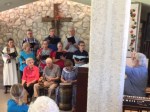
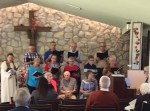
World Communion Sunday at Lakewood UCC was celebrated with an emphasis on the church in Africa. All the music in the service–hymns, anthem, prelude, offertory, and postlude–were of African origin. The pictures below are of the choir singing an African anthem with the accompaniment of percussion instruments.


Below is the podcast of Rev. Wells’ sermon for World Communion Sunday, followed by a text version of that sermon. The recording begins with Liturgist, Susan Sherwood, reading Exodus 17:1-7 and John 7:37-38, followed by Rev. Well’s sermon.

Podcast

To listen, right-click (HERE) and select the save link option and play the downloaded file with your computer’s media player. If you have a one-button mouse (on a Mac), press and hold the “Control” key and click the link and select the save link option.

Sermon Text

Sermon Title: Lessons from Africa
World Communion Sunday
10/5/14
Scripture Lessons: Exodus 17:1-7 and John 7:37-38

A land of tremendous natural resources, the home of iconic wildlife, the cradle of humanity, and the site of stunning natural beauty, Africa is incredible. Our family had the opportunity to go to Kenya in 1995. I remember flying over the Sahara Desert. You look out the window of the plane and all that can be seen is sand. An hour later, you look again. Sand. Several hours later. Still more sand. It was unbelievable. But Africa is HUGE. It is as big as China, India, the US, and most of Europe combined. The population is 1.69 billion people with subSaharan Africa being the fastest growing region on the earth. Africa is stunning.

The problems there are stunning as well. About 25% of the population is HIV positive. There are over a million deaths a year attributed to AIDS. Malaria is still of epidemic proportions in Africa. The deforestation rate is twice that in the rest of the world with 90% of the population relying on wood for fuel for cooking and heating. There is the the assault on the animal population by poachers. 35,000 elephants were killed last year. There are fewer than 900 mountain gorillas left. The rhino, lion, and Grevy’s zebra are also under attack. We can add to that the toxic legacy of the colonial era in which rich countries raped Africa of its natural resources. There continues to be political unrest and war in many parts of Africa and we hear of Boko Haram and other groups fomenting violence. There is a huge refugee problem as people leave areas of violence and war seeking safety. And there is drought and famine to contend with. And, now, we hear daily of the erupting Ebola crisis. There are over 7,000 people with Ebola and about half that many deaths to date.

The suffering of Africa is tragic. If ever there were a place ripe for cynicism and despair, it is Africa. This continent in crisis has so many reasons to cry out and complain and lament like the Hebrews wandering in the wilderness. Surely the people of Africa could cry out for water. And for food.

Given the problems of Africa today, one could expect this to be a godless land. All these troubles and sufferings. How could there be a good and loving God? Has God abandoned Africa? Are the people forsaken? And yet Christianity has deep roots in Africa and is growing and thriving. There are many churches in Africa: Episcopal, Catholic, Protestant, Orthodox, Pentecostal, and Evangelical. There are many, many expressions of Christianity in Africa. And the people are dedicated in their faith. The ethics and values of Christianity blend very well with traditional tribal cultures. There is the focus on hospitality, on community, on consensus, on forgiveness, and on solidarity. This fits well with the teachings of Jesus.

The people of Africa can also identify with the sufferings of Jesus. He, too, traveled from place to place, as the refugees of Africa. He lived under a repressive regime. He was concerned with fulling the basic needs of people for food, water, and community. Jesus faced death threats and violence and hardship. He was killed. And through it all, he maintained his trust and love of God. This is the kind of faith that we see in the people of Africa.

In the face of so many problems, the Christians of Africa still appreciate God’s blessings. They rejoice in the gift of life. They gather to praise God. When we were in Africa, we stopped by a church in a rural small town to see a friend of our family. The women had gathered at this church for a retreat over Saturday and Sunday. The woman we knew had walked 6 hours to get to the church. She left on Friday as the sun went down to avoid the heat of the day. She carried food to share with the others who would gather there. They slept on the bare wood of the church floor. They prayed and sang all day Saturday and into Sunday. Then, Sunday, at sundown, they began their walk home, in the cool of dusk, another 6 hour trek. People in Africa routinely walk hours to go to church each week. I was stunned. Here, people find it hard to manage a 10 minute drive and an hour or so for church on Sunday morning. Have these Africans nothing else to do? Hardly. They labor intensively to eke a subsistence existence from the land. It is time consuming and taxing. And yet they make time for church. They have a saying. “For us, religion is like our skin.” It is fundamentally part of who we are. It is not like clothing that we take on and off and change. [Once Upon a Time in Africa: Stories of Wisdom and Joy compiled by Joseph G. Healey]

For these Christians of Africa, their faith pervades their lives. When a baby is born, they rejoice. When a baby dies, they entrust the child to God, trust God to heal their grief, and rejoice that the child has gone to the heart of love. They serve one another and others around them. A child at a doctor’s office shares a precious piece of candy with another sick child. A child carries a sibling on a long journey feeling no sense of burden or resentment. A girl knits a blanket for her new baby brother using thorns from a nearby tree as knitting needles. A government worker who abused the lepers under his care is buried by those same lepers who have forgiven him and taken care of him in his last days. People with next to nothing kneel and pray in gratitude for the blessings they have received. [From Once Upon a Time in Africa] These are not the arrogant, spoiled Hebrews of the wilderness. They are resilient, strong, and trusting. If there is a stick and a rock, they will work for water. And they will share each and every drop. They are unsparing in generosity – with food, water, clothes, and material possessions, as well as time, gratitude, hospitality, service, and forgiveness.

There is one area where the church of Africa has lost its way and that is around homosexuality. Church groups in Africa mobilize their substantial faith and energy to promote homophobia, to advocate for laws that punish gay people even with death. Are they concerned with covering their bases to avoid God’s wrath? Is this to distinguish them from non-Christians and those who practice animistic religions? Is it to resist the West. I don’t know. In traditional tribal societies, homosexuality was accepted as special. A gay person was often considered holy because he was different. They were thought to have special powers. Maybe being anti gay is a way to undermine the power of superstition associated with traditional religions. But in any case, the church of Africa is definitely at odds with the churches of the west and the rest of the world in its vehemence against homosexuality. While other churches may see it as sin, they do not advocate for the death penalty. But, hopefully, there will be a transformation soon. New living water will flow. And the people will be cleansed and healed and reconciled of this sin of homophobia.

When we were in Kenya, one of the vehicles we used had a leak in the radiator. We had to constantly seek out sources of water to fill the radiator. This could be very challenging. At one point, we had to stop by the side of the road at night. We could go no further. We were not in a town or village, but out on a remote road. We got out of the wagon and looked around. Three men were walking down the road. They stopped to talk with us. We told them about our problem. Oh, water? There’s some right here. Jeff took the two empty jugs and went with the men down a steep, grassy slope. Then I could no longer see him, and the kids and I waited at the car. I am not given to alarmism but it did occur to me that I might never see my husband again. About 10 minutes later, the three men came back up the hill with Jeff right behind them struggling with the two jugs evidently filled with water. Jeff thanked the men for their help and offered to pay them something. Oh, no. They refused, saying they were Christians. And off they went. To church? Who knows.

Evidently, at the bottom of the hill was a pvc pipe above the ground. The men took Jeff right to a spot where the pipes had been connected and could be separated so that the water could be accessed. He filled the jugs and they put the pipes back together and came up the hill. Who would have known about the pipe and the location of the break to open the pipe? These men knew exactly what to do. Amazing! Like a stick and a rock, as far as we were concerned. And off we went back to Nairobi.

For the Christians of Africa, religion is truly their skin. The Christians of Africa are constantly in need and trusting God to sustain them. And they are willing to gather the elders, climb the mountain, find the rock, and strike it with the stick. Whatever it takes. They are willing to work in partnership with God to sustain life. And the joy, trust, and faith that they show is as beautiful as any view of the Rift Valley, or Mount Kilimanjaro, or Victoria Falls.

This World Communion Sunday Christians around the world celebrate communion as a symbol of the unity of the body of Christ. We all come to the table together. We rejoice in our common bond through Jesus. Praising God. Following Jesus. Serving the world. Christ Jesus is the host at communion. We are all guests. There is no one superior or inferior, no one above or below, we are all side by side.

Historically, we of the west have taken from Africa. Natural resources. Labor. In recent times, we have given to Africa. Assistance and aid. Maybe motivated by guilt. Maybe with a patronizing attitude of condescension. But this World Communion Sunday invites us to think about coming to the table as a community, as equals, as sisters and brothers. In this spirit, we see that there is much that we have to learn from Africa. The Christians of Africa have much to teach us about faith, trust, service and community. African Christians exhibit trust in a God who seeks nothing but our highest good. And they partner with that God in any way they can for the good of the world.

Pediatrician Alan Jamison was in Liberia when the Ebola virus broke out and the country slipped into chaos. He treated as many patients as he could before being called back to the US by his sponsoring organization. But Dr. Jamison wants to go back to Africa. “This is where the need is,” he said. “This is my calling.” [The Christian Century, 10/1/14, p. 8] It may be hard to understand why Dr. Jamison wants to go back to a place so dangerous and fraught with problems. I imagine that Dr. Jamison wants to go back to Africa because he senses the deep hope and faith of the people. Their spirit of love and community has infected him. And he wants to be part of that context of faith and trust even in the face of horrific suffering. The Christians of Africa have no fear. With no grumbling, but gladly, rejoicing, probably with drums and dance, they strike the rock with the stick. And living water flows. For all. Amen.