Posts

Sermon 7/21 Walking on Water

Date: July 21, 2019

Scripture Lesson: Matthew 14:22-36

Pastor: Rev. Kim P. Wells 

Fifty years ago yesterday, a human being walked on the moon for the first time.  There has been much in the news about that memorable day. How many of you remember that day?  What do you remember about it? Where were you? Did you watch it on TV? What did you think about it?  For those who did not see it live, have you seen video of the first moonwalk? What were your impressions?                 

Impressions shared from the congregation – 

I heard a report on NPR this past week that mentioned that when the astronauts got home, they toured the world giving talks about their experience.  And apparently everywhere they went, in every country, the attitude of the people was, “We did this!” All of humanity took ownership of this milestone in human history.  It wasn’t, “Look what the Americans have done.” It was look what WE have done, we, the human family. It created a great bond among people of earth.   

When we think about the story that we heard this morning about walking on the water, we think of Jesus overcoming the elements, calming the stormy sea.  We hear Jesus’ command Peter to step out of the boat. There is obedience and trust until fear leads to foundering and Peter is saved by Jesus. Fear, the great enemy of faith.  

But in addition to all of these messages and teachings from this story, there is more.  At the beginning of the story, Jesus sends the disciples across the sea of Galilee in a boat.  This is the first time they are sent on without Jesus. Obviously, Jesus has faith in them. He would not send them out if he was concerned for their safety.  He has confidence in them. Yes, there will be threats. The sea represents the forces of chaos in scripture. There are threatening forces. But Jesus has faith in the disciples.  He feels they have all the power they need. The presence of God is with them and within them. It seems he has more faith in them than they have in themselves. . . What if we take from this story that we have been sent out into the world together as a community with everything we need to live with love, compassion, peace, and justice? 

Also, we want to notice that the image of the boat is a common symbolic image for the church.  So in this story, we see Jesus’ faith in the church. The disciples are together in the boat. They have each other for community and solidarity and support.  Sure, they will be buffeted and there will be conflict and threat, but they have each other, they have the community, they have the presence of God in the faith community.  So Jesus has faith in their strength and solidarity. But again, they waffle. And Peter wants to get out of the boat, exposing himself to more peril and danger. He does not feel secure in the boat.  But when he gets out, he realizes that the situation is worse. What if we recognized and trusted that we need the faith community for our fundamental well-being?

The disciples seem to want some kind of magical display, some kind of spectacle to engender enough faith; to give them enough reason to trust.  But Jesus seems to be showing them, by sending them out together, that they have what they need in one another and in their solidarity, to face the challenges of life – accidents, disease, aging, difficult circumstances, conflicting values.  Jesus believes that in their community, they have the resources they need to live everyday life imbued with divinity, with a sense of the sacred, as part of a transcendent reality beyond them and within them and among them. In Jesus’ eyes, they have been given what they need to face the challenges of life.  So, if Peter, if the disciples, had enough faith, they would have believed from the boat and trusted that all would eventually be well. They wouldn’t have needed a test, a spectacle. The walking on water. Jesus had faith in them, in the boat, as a group, as a faith community – you are enough, you are what you need, God is with you.  There is nothing to fear. What if we truly had faith in what we have been given; no otherworldly spectacles and signs and wonders needed?

In this story, we see that Jesus came to equip and empower his followers to be agents of peace and love in the world.  He gave them all that they needed for this mission. He sent them. They were in the boat. They were fine. Yes, there were the stormy seas but they were safe.  They had been given what they needed. But because of fear, panic, anxiety, and doubt, they did not trust. They wanted to be rescued. And they wanted some kind of spectacle to engender their trust.  So, Jesus does it their way. He rescues. He gives them a spectacle in hopes that they will learn to trust the power of the love within them and among them each and every day.

In the book. Living Buddha, Living Christ, Buddhist teacher, Thich Nhat Hanh offers a reflection on this story of walking on water:  “When I was a young monk in Vietnam, each village temple had a big bell, like those in Christian churches in Europe and America.  Whenever the bell was invited to sound (in Buddhist circles, we never say ‘hit’ or ‘strike’ a bell), all the villagers would stop what they were doing and pause for a few moments to breathe in and out in mindfulness.  At Plum Village [a Buddhist community], every time we hear the bell, we do the same. We go back to ourselves and enjoy our breathing. Breathing in, we say, silently, ‘Listen, listen,’ and breathing out, we say, ‘This wonderful sound brings me back to my true home.’

“Our true home is in the present moment.  The miracle is not to walk on water. The miracle is to walk on the green earth in the present moment.  Peace is all around us – in the world and in nature – and within us – in our bodies and our spirits. Once we learn to touch this peace, we will be healed and transformed.  It is not a matter of faith; it is a matter of practice. We need only to bring our body and mind into the present moment, and we will touch what is refreshing, healing, and wondrous.”  [Quoted in Resources for Preaching and Worship: Year A, compiled by Hannah Ward and Jennifer Wild, p. 216]

Fifty years ago, a human stood on the moon; touched the moon.  It was not some kind of magical miracle wrought by otherworldly forces.  It was an accomplishment based on the application of knowledge and scientific achievement, trial and error, creativity and ingenuity, money and luck.  And from that experience, we got a new image of the earth, the picture taken from space considered the most recognized visual image in human history. From this endeavor to go to the moon, we learned about the earth.  We saw that this earth is a precious, tiny blue green marble floating in a vast ocean of space. And we are together, on this earth, our boat, in the sea of the cosmos. What we see is our need to band together as a human community, as a planet, to survive and to thrive.   

We are the people who have walked on the moon and in so doing gotten a clearer view of our reality here on earth.  Every moment is a gift. Reality is infused with divinity. Life and creation are sacred. Humanity is a community.  And like the disciples in the boat, we have been given everything that we need. We are capable of amazing things! We must not cave in to fear.  We must trust and work together for good, for peace, in the midst of the chaotic forces around us – even though sometimes this seems as impossible as walking on water.   Amen.

A reasonable effort has been made to appropriately cite materials referenced in this sermon. For additional information, please contact Lakewood United Church of Christ.
UCC folks help vigils shine light on border ‘concentration camps’

This post from the national UCC website features some of our members

United Church of Christ clergy and congregations took leadership, served as hosts, lit candles and planned follow-up actions during many of the hundreds of “Lights for Liberty” vigils held Friday evening, July 12. The events around the country protested the treatment of migrants and asylum seekers detained at the southern U.S. border, in what national vigil organizers refer to as concentration camps.

And UCC leaders are among those speaking out against a coming U.S. Immigration and Customs Enforcement campaign to arrest undocumented persons, announced July 12 by President Donald Trump.

Testimony from a chain-link chancel

Lakewood UCC members, Lights for Liberty, 7/12/19

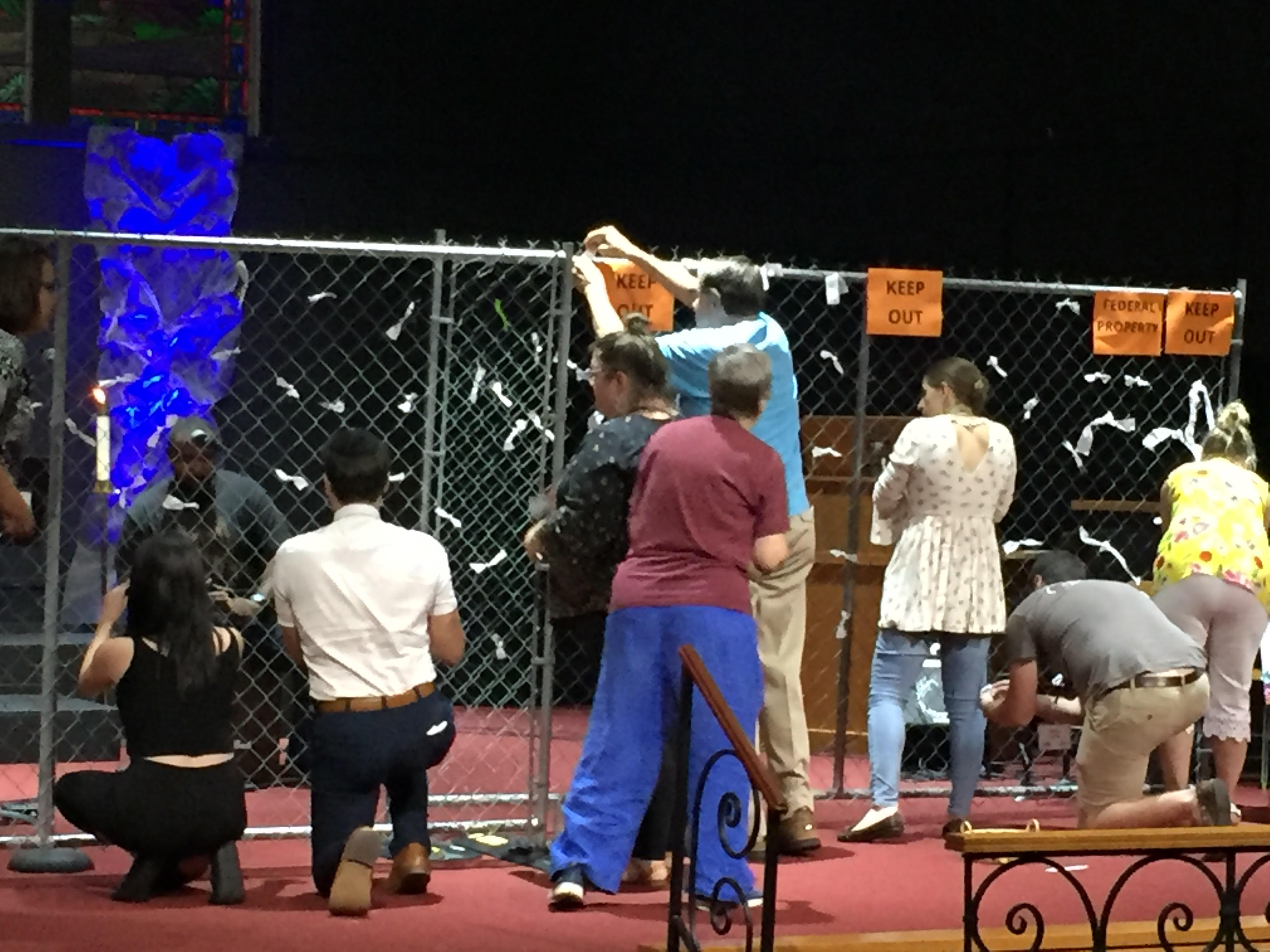
At Lights for Liberty in St. Petersburg, Fla., a chain-link fence stretched in front of the altar of Allendale United Methodist Church. Behind it, 20 representatives of area faith and justice communities – some wearing foil blankets like those issued in detention centers – read aloud from interviews with detainees. One reader was the Rev. Susan Sherwood, a retired UCC minister who belongs to Lakewood UCC, St. Petersburg.

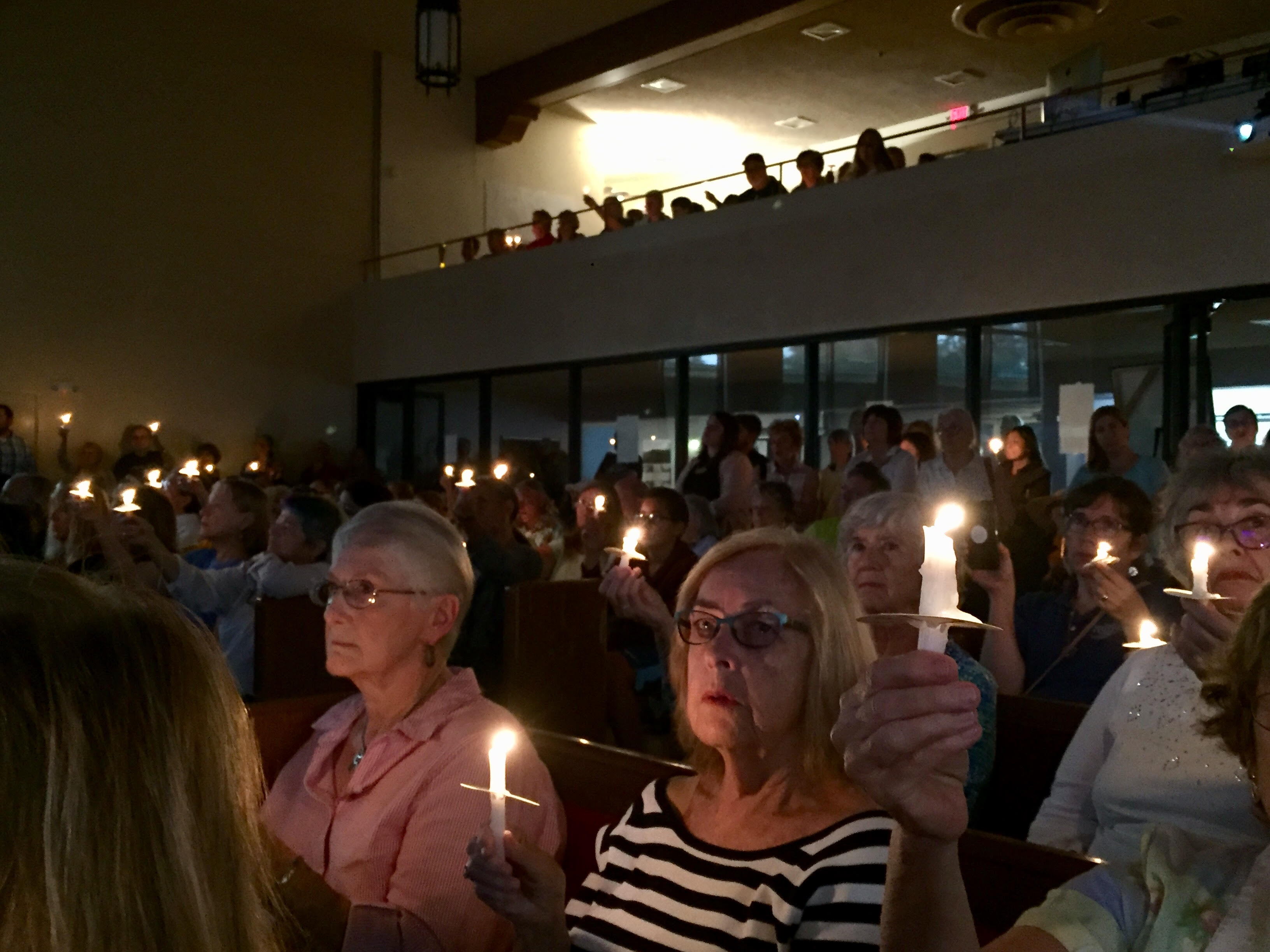
“This was a powerful evening of committed people and organizations, willing to move out of their comfort zone to make a difference,” Sherwood said. “I read the testimony of a sick baby who was denied medical care. As we read, the hundreds gathered lit candles throughout the sanctuary. During the vigil, people wrote words of hope and promise for the children on ribbons of commitment that were then tied to the fence.”

After presentations from the Florida Immigration Coalition, Dream Defenders and the American Civil Liberties Union, participants divided into groups to learn what they could do: visit Homestead, a 3,200-bed “temporary shelter” for unaccompanied children, work for legislation and immigration protection, pressure complicit corporations, and support enforcement of a 1997 U.S. Supreme Court case, Reno v. Flores, that resulted in a settlement between immigration activists and the government.

‘No kids in cages’

In front of Altadena (Calif.) Community Church, UCC, more than 300 Lights for Liberty participants chanted “keep families together” and “no kids in cages” and heard readings of detainees’ words. Some 40 people in the crowd were ACC church members, but most were others from the community, said the Rev. Jerod Yates, a UCC minister and hospital chaplain who is a member of Altadena Community Church and who organized the vigil.

“It’s amazing how the still-speaking voice of the Spirit can lead one to say, ‘Hey, perhaps we can lead a Lights for Liberty Vigil for our community and see how the Spirit catches wind of that and spreads it throughout our church and community,'” Yates said.

California had 92 Lights for Liberty vigils, the most of any state. Lights for Liberty organizers said by Twitter on July 15 that 817 vigils had been held. Among the countries with sites were Australia, Austria, Canada, Costa Rica, France, Germany, Haiti, Ireland, Israel, Italy, Japan, Mexico, New Zealand, the Netherlands, Senegal, South Africa, Spain, Sweden, Switzerland and two “virtual” international vigils online.

‘Insane policy of cruelty’

Pullman,, Wash., Lights for Liberty vigil, 7/12/19

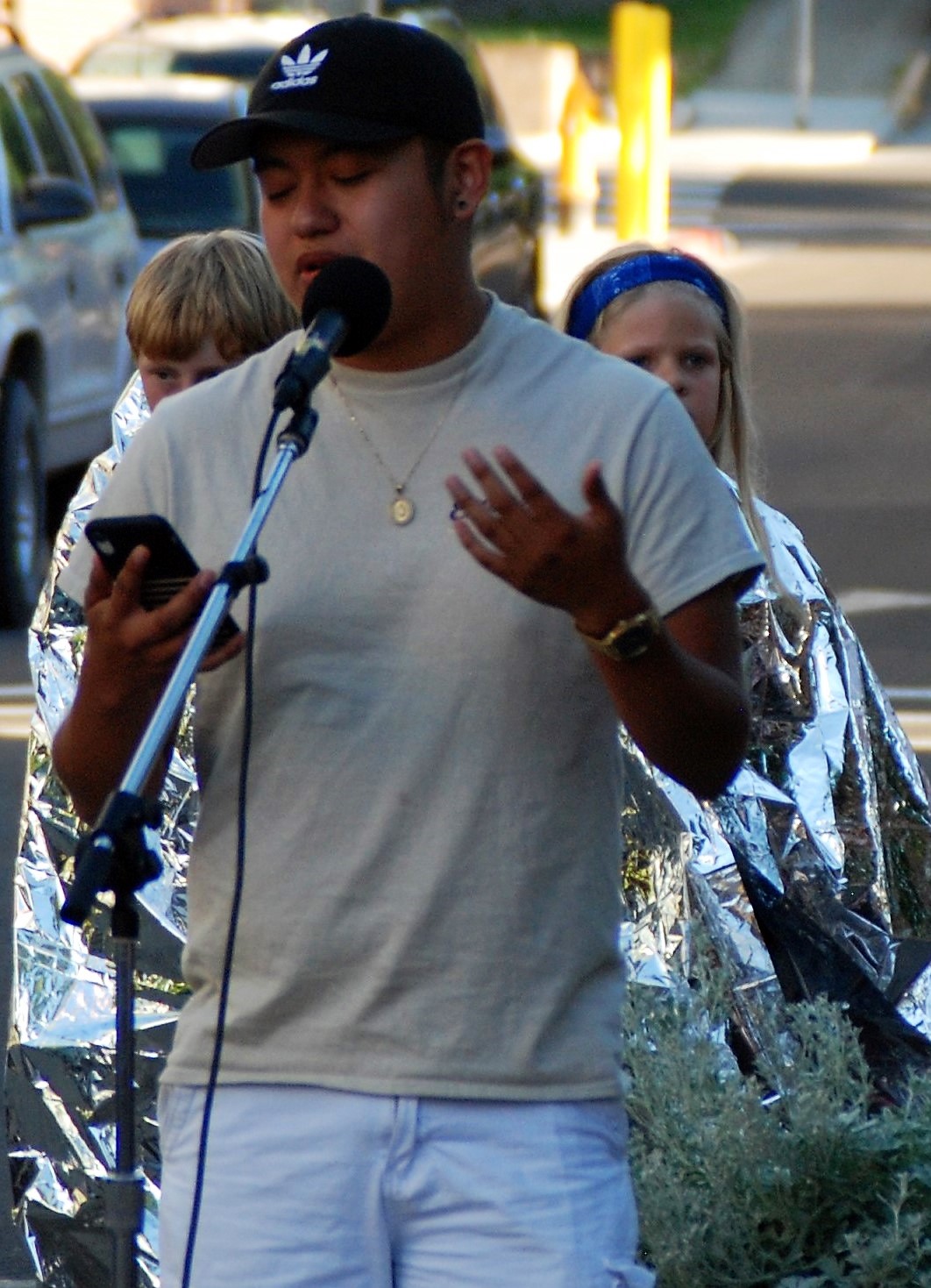
In Pullman, Wash., near the Idaho border, most of the 250 who turned out were not church-affiliated, said the Rev. Steve Van Kuiken, pastor of Community Congregational United Church of Christ, who organized the vigil. It was natural for that church to co-sponsor it, he said, having recently taken a delegation of 15, ages 8 to 85, to Arizona and Nogales, Mexico, to talk to migrants and activists and see memorials to migrants who had died in the desert.

Community Congregational and a local Unitarian Universalist congregation each had about 20 people at the vigil on Pine Street Plaza, but it mostly drew others from the vicinity of Pullman and nearby Moscow, Idaho, “who are compassionate and who want to stop this insane policy of cruelty,” Van Kuiken said. The event’s co-sponsor was Palouse ProActive, a nonpartisan community-action group devoted to democracy and civil rights. Speakers included representatives of a legal clinic that works with immigrants and a support group for undocumented Latinx students at Washington State University. Attendees received cards with QR codes, which, when scanned with a smart phone, led to websites where people can volunteer or take action on immigration-related issues.

In his remarks, Van Kuiken noted the overcrowding of detention facilities and the harsh conditions there, well documented by media reports. “It is important to know that detention is not a legal requirement,” Van Kuiken said. “This is all unnecessary. The Department of Homeland Security has the discretion simply to process and release asylum seekers. And so we call upon Border Patrol to release anyone who is not a public safety threat and to stop detaining people in inhumane conditions.

“We need to stop punishing people whose only crime it that they are begging for mercy. Mistreating them will not solve the problem and stop them from coming. These inhumane policies and this cruel treatment of these children, women and men who are desperately seeking safety are an ugly stain on the fabric of this nation. And we must do better. …

“In my religious tradition it says, ‘You shall love the immigrant, for you were immigrants yourselves. You shall not exploit or oppress the immigrants. Rather you shall remember that you, too, were immigrants.'”

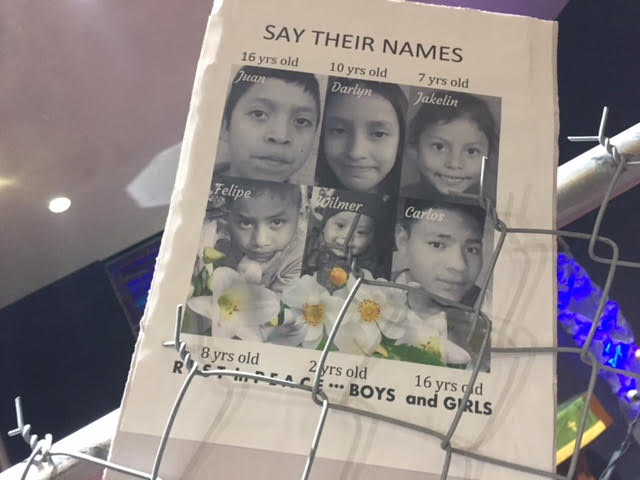
He read out the names of each of the seven children who have died recently in border custody. Each name was followed by silence.

Motorcyclist tries to drown them out

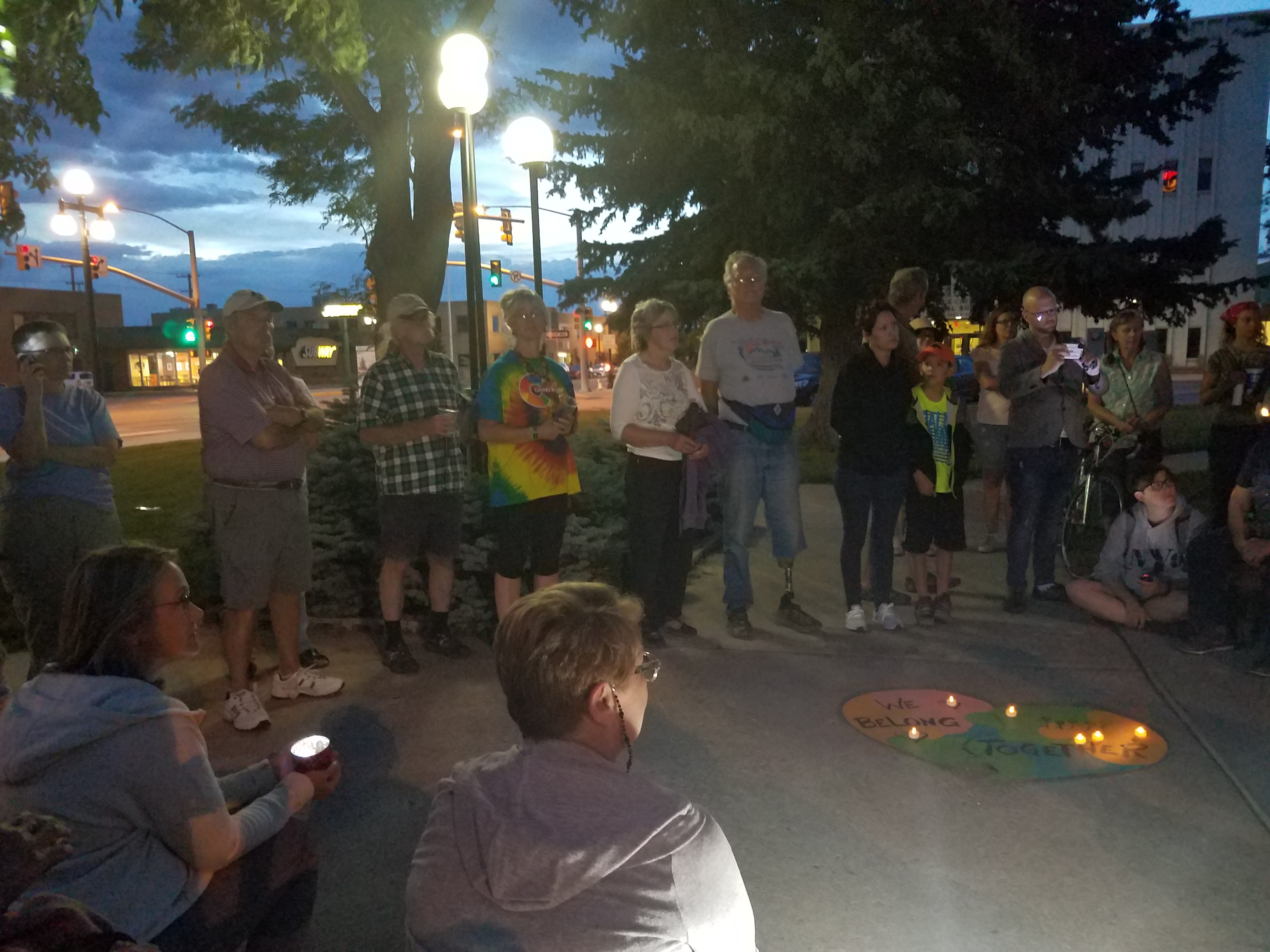
At Pioneer Park in Casper, Wyo., Lights for Liberty’s opening moment of silence was disrupted by a motorcyclist parked nearby. He deliberately revved his loud engine for a long time, preventing silence and speeches, until three police officers showed up and ticketed him for excessive noise.

“It was one of those moments where you say, ‘OK, that’s part of why we’re here,'” said the Rev. Dee Lundberg, pastor of Casper UCC and one of Wyoming vigil’s organizers. “There’s a lot of meanness out there. I suppose there was an element of making us more in solidarity. Most of us know each other at some level. The more progressive crowd is a community within the community, so we tend to work together and support each other’s causes.”

Casper, Wyo., Lights for Liberty vigil, 7/12/19

Casper’s vigil focused on “talking about the issues, what we could do, what was worth our time,” Lundberg said. Among those, she said, is “continuing to work harder to build relationships in the community, finding ways to get to know people as human beings versus ‘them versus us.'” She said this can make a difference across liberal-conservative lines in a “red state” where many migrants work in restaurants and hotels, as roofers and construction workers.

“There was a friend of mine who got deported back to Mexico, who has two kids in high school,” Lundberg said. “That’s how long he had been here. Of all the people who wrote letters to support him, to try to prevent his deportation, every one of them was a Republican, and they did it because they knew the guy. That’s how it’s going to work here.”

Of the 40 people at the vigil, eight were from Casper UCC, which will continue its work with immigrants, Lundberg said. This includes hosting Know Your Rights workshops, raising money for legal fees, and helping to keep the free-coat closet stocked at the University of Wyoming’s Family Practice Clinic, where people in need can find medical help.

National UCC leaders speak out, too

Protecting immigrants and asylum-seekers has support from the UCC’s General Synod as well. Delegates meeting in Milwaukee June 21-25 called on the U.S. government to protect, and stop separating, immigrant families, drew attention to the global migration crisis, and rallied by the hundreds outside an ICE office.

“I think [ICE raids] are a form of emotional, psychological violence,” the Rev. Tracy Howe Wispelwey, the UCC’s national minister of congregational and community engagement, told Time Magazine for an article published July 12 at Time.com. “This threat, anyone who is undocumented has to live with this.” She noted the ever-increasing number of congregations, including those in the UCC, that offer their buildings to house and protect immigrants in the sanctuary movement. It’s an encouraging sign, she said, “that the community is stepping up and putting their property and bodies and resources on the line.”

ICE’s own “sensitive locations” memo says enforcement should not be carried out in houses of worship, schools or hospitals, the Rev. Noel Anderson, a UCC minister, said in a July 13 CNN interview. He is based in Washington, D.C., as grassroots coordinator for immigrant rights with Church World Service. “I think most advocates would agree that people should have a legal process in which to come through ports of entry, and in fact asylum seekers are part of that legal process,” Anderson said. “…People say, ‘Get in the back of the line,’ but there is no line, especially for [people performing] low-skilled labor, like construction jobs, restaurant jobs.” Many of them have not had the chance to go to court because they didn’t receive a notice to appear, and many lack access to legal services. “More than 90 percent of the people who have a lawyer are showing up in court,” Anderson said. “We need to support that due process.”

Immigrants, he said, “are part of our community, they’re part of our economy, they’re part of our congregations, and they deserve to stay and live here in dignity and respect and with fair treatment. Our congregations and our faith leaders are stepping up to say, ‘These are our values.'”

Scapegoat Sunday

In remembrance of Sunday June 30, 2019 when the topic for the day was the scapegoat. The scripture lesson was Leviticus 16:1-34. The sermon was entitled “Declaring Independence” (Sermon 6/30 Declaring Independence).The service involved people coming forward, holding the goat, and sharing their experiences related to scapegoating. Those who were present will long remember the goat and the words that were shared by the congregation.

Lights for Liberty

Lights for Liberty vigils
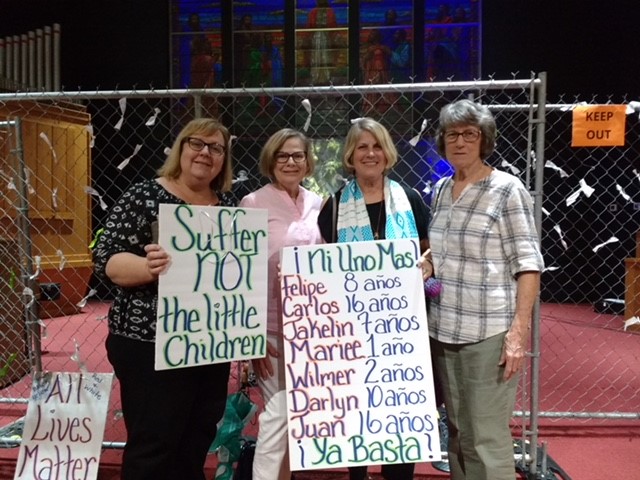
LUCC was represented by Janet Blair, Patti Cooksey, Susie Sherwood, Lucile Ruga, and Jim Andrews

Voices for Liberty

The moment we arrived at Allendale UMC, we were greeted with kind voices of welcome. The joyful voices of little children playing on the puzzle mat in the family section of the sanctuary followed us down the aisle as we found our seats. Voices singing throughout the church began to lift in soft music as the lights dimmed. 
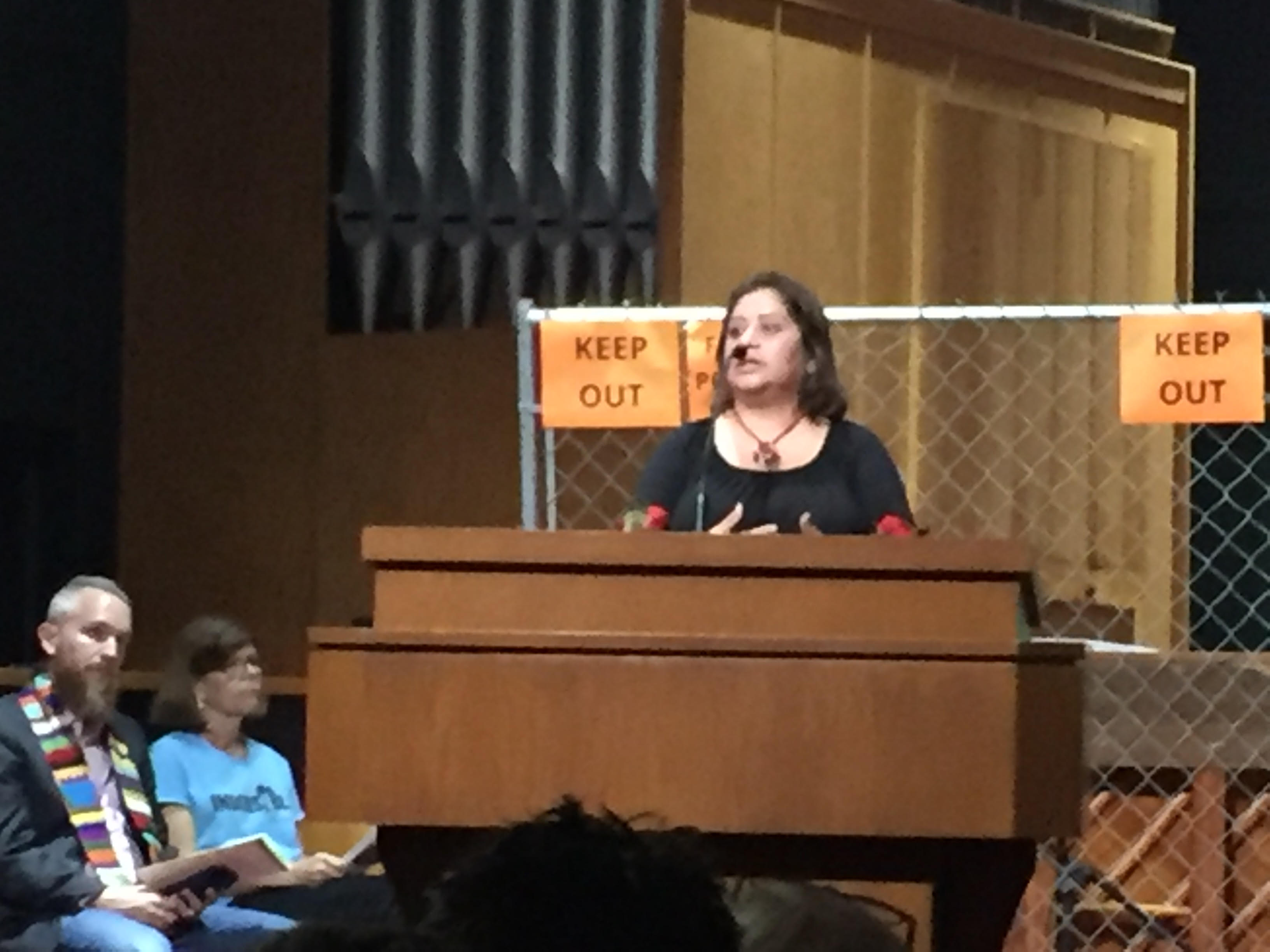
And then the children’s’ voices of fear, hunger, pain, and suffering came forth as readers voices came forward from behind the fence, positioned behind the altar. This fence symbolized the cages at the detention facilities that entrap and separate the children from their families and their freedom. These voices were horrifying. 
After a short period of silence in the candlelight, the voices summoning the call to action responded to the question, “What can we do?” These strong voices of action, presented by the speakers, introduced the ways we can help. We were invited to select and attend a breakout group of interest: visiting Homestead, legislative advocacy, pressure on complicit corporations, immigrant protection, actions to enforce the Flores Agreement. 
In the breakout groups, voices united as we shared interest, information, direction, and commitment—and anger. We left the meeting prepared for action!                                       All the voices of the evening stayed with me as I left the church. But I realized there were voices we did not hear, the voices that will resonate the peace and love we long to hear. They are the voices of thousands of imprisoned children who are now free, well-nourished and have received medical care. Children safe in the arms of their families. Children playing together on colorful mats in the churches throughout America. Through the Lights for Liberty vigil, I came to fully realize that is our voices in action that will release the children. Through our work, we can and must bring those missing voices of liberty into the light, into harmony.

After the opening prayer, about 20 of us from various faith & justice communities – some wearing foil blankets – became the “Voices of the Children,” going behind the fence & reading their words from interviews at a Texas detention site. Representing Lakewood UCC, I read the testimony of a 16-yr-old whose sick baby was denied medical care.

As we read, the hundreds gathered lit candles throughout the sanctuary.

After songs were sung & the candles were snuffed, we heard speakers from the FL Immigration Coalition, Dream Defenders, and ACLU encouraging us to take action. This is Ana Lamb (FLIC).


During the vigil, people wrote words of hope and promise for the children on Ribbons of Commitment that were then tied to the fence.

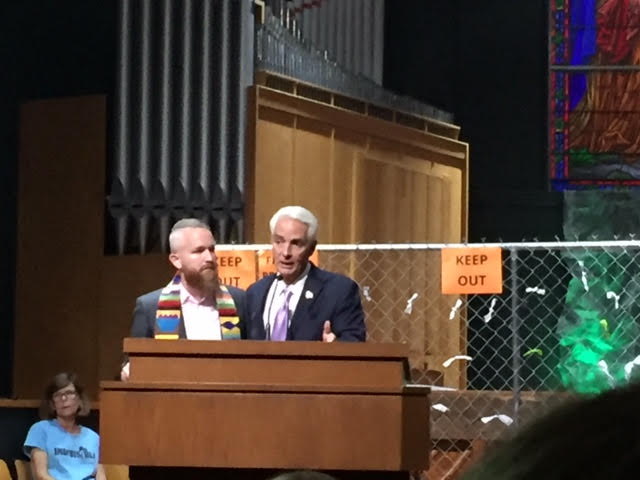
Representative Charlie Crist encouraged us to action.

Before going home, we divided into breakout groups to learn specific actions we can take: visiting Homestead, legislative advocacy, immigration protection, pressure on complicit corporations, and actions to enforce the Flores Agreement.
This was a powerful evening of committed people and organizations, willing to move out of their comfort zone to make a difference!

Conference Call

Header

This Florida Conference newsletter features Lakewood United Church of Christ and the participation in the Lights for Liberty event which focussed on the treatment of children in detention camps. 

John Vertigan

Greetings, Church. It’s been good to re-enter the day-to-day life of the Florida Conference after a tense, and sometimes contentious, General Synod in Milwaukee, Wisc. Was there joy and fellowship and the renewing of relationships we expect from such an event? Of course! But I came away with a recognition that there is much about us that needs attention if we are to continue providing a vital witness under the name United Church of Christ.

A resolution that was submitted for consideration illustrates this and keeps me awake on a pretty regular basis. Titled “Oversight of the Local Church and its Covenantal Relationship with the Association in Which it Holds Standing as a Local Church of the United Church of Christ,” it was an attempt to address what feels like a broken relationship when a local church uses the name UCC and its resources but does not contribute to that relationship with time, volunteer leaders beyond the local church, or financial support of the ministries of the wider church through sacrificial giving to Our Church’s Wider Mission. Here is the text of the resolution that came to the floor for debate:

“WHEREAS Article III of the Constitution of the United Church of Christ describes the ideals of covenantal relationships but does not describe or provide for the accountability necessary to live into these covenantal relationships; and
WHEREAS Article V of the Constitution of the United Church of Christ defines how Associations receive churches into membership in the United Church of Christ, yet provides no guidance as to how a local church may be released from membership; and
WHEREAS the United Church of Christ Manual on Ministry names specific responsibilities of the Local Church to the Association and the Conference;
THEREFORE, BE IT RESOLVED that the United Church of Christ Board provide guidance, which may include revisions to the Constitution of the United Church of Christ, for Associations and Conferences on how to release Local Churches from membership in the United Church of Christ.”

Here’s the spoiler for those who don’t want to wait for the Synod minutes: the resolution was tabled and no action was taken. There are many reasons for this.

On the one hand, we are a church that says, “no matter who you are or where you are on life’s journey, you are welcome here.” On the other hand, we have an organizational relationship of covenant with every local church that calls for mutual support and accountability. What happens when that relationship feels lopsided or even absent because the local church is not participating in the covenant?

That’s still an open question. Coincidentally, it is a question the Conference Board asked me to address back in May. We see congregations staffed by talented pastors and led by talented lay leaders who don’t contribute their skills and energy beyond their local walls. We see congregations who don’t make a gift to Our Church’s Wider Mission (thus weakening our potential for shared ministry) and in some cases don’t remit their per capita dues (a by-laws requisite for membership in the Florida Conference.) Shy of these two markers, what is the nature of our covenantal relationship? That’s part of the openness of the question.

The answer is still pending. The Spirit will answer if we keep faithful to the aim of the church “that we may all be one.” In the meantime, check to see if your church has remitted per capita dues; check out how your church makes provision for financial support of the conference at sacrificial levels. (I wonder sometimes how we can ask parishioners to make tithing and sacrificial giving a norm when we don’t practice it corporately). At the same time, check out the United Church of Christ at www.ucc.org and the Florida Conference at our evolving website www.uccfla.org and consider how we might be in stronger relationship for such a time as this.

I remain committed to serving a United Church of Christ where what is meant to be true for individuals is true for congregations, too, that “no matter who you are or where you are on life’s journey, you are welcome here” in relationship with the Florida Conference. I covet conversation about how that relationship can best be accomplished in an atmosphere of mutual support and accountability even while acknowledging there will be a multitude of “right” answers to be shared.

Be at peace, and be in touch, won’t you.Rev. John Vertigan
Conference Minister

Watch for email on 2019 Annual Gathering of the Florida Conference

Keep an eye out for an email and announcement on our website in the next week or so on the upcoming 2019 Annual Gathering of the Florida Conference.

Your Annual Gathering Planning Committee has been working hard over the last many months to put together a plan and programming that’s going to make this year’s event a bit different than gatherings past, and we think you’re going to like the subtle changes.

The conference’s annual meeting will take place at the Wyndham Orlando Resort International Drive Oct. 10-12. Stay tuned for details and a link to register soon. We look forward to seeing you there!

Lights for Liberty vigils

Members of Lakewood United Church of Christ in St. Petersburg, Fla., gather after a July 12 Lights for Liberty vigil. Left to right are Janet Blair, Patti Cooksey, the Rev. Sue Sherwood and Lucille Ruga. Photo courtesy of Lucille Ruga.


UCC folks help vigils shine light on border ‘concentration camps’

United Church of Christ clergy and congregations took leadership, served as hosts, lit candles and planned follow-up actions during many of the hundreds of “Lights for Liberty” vigils held Friday evening, July 12. The events around the country protested the treatment of migrants and asylum seekers detained at the southern U.S. border, in what national vigil organizers refer to as concentration camps.

And UCC leaders are among those speaking out against a coming U.S. Immigration and Customs Enforcement campaign to arrest undocumented persons, announced July 12 by President Donald Trump.

At Lights for Liberty in St. Petersburg, Fla., a chain-link fence stretched in front of the altar of Allendale United Methodist Church. Behind it, 20 representatives of area faith and justice communities – some wearing foil blankets like those issued in detention centers – read aloud from interviews with detainees. One reader was the Rev. Susan Sherwood, a retired UCC minister who belongs to Lakewood United Church of Christ in St. Petersburg.

“This was a powerful evening of committed people and organizations, willing to move out of their comfort zone to make a difference,” Sherwood said. “I read the testimony of a sick baby who was denied medical care. As we read, the hundreds gathered lit candles throughout the sanctuary. During the vigil, people wrote words of hope and promise for the children on ribbons of commitment that were then tied to the fence.” -> Read more! ->

PATHWAYS announces Fall/Winter courses

PATHWAYS, which offers asynchronous online learning, has announced its Fall/Winter course schedule. Descriptions of courses coming up soon follow:

July 31-Aug. 27 — ESC12 Environmental Justice This four-week course is an introduction to environmental justice through the faith lens. We will explore God’s design for humanity and the great need to reshape the narrative that exists today. Through today’s challenges, the course will explore the harmful effects of pollution from a macro and a micro level. And more closely, our eyes are opened to the extreme effects of pollution on people in vulnerable communities. And finally, what steps can we take to advocate for the health and well-being of our brothers and sisters in places where corporate greed has too often overwhelmed and suppressed human need? Cost is $99.

Aug. 28-Oct. 8 — The Art of Worship This six-week course explores worship in an overview that highlights but is not limited to the “Sunday morning worship service.” It considers the theological, biblical and historical underpinnings of Christian worship, the significance of the integration of “intensive” and “extensive” worship, individual and corporate worship, the sacraments and current worship issues and trends. The format of the course further seeks to “open the arts” in the art of worship in appreciation and celebration of our Creator-God. Cost is $295.

Aug. 28-Oct. 8 — Making Sense of Theology In this six-week course, participants will learn how to reflect critically on their lives and the world around them using the resources of traditional Christian theology. They will learn to differentiate between embedded and deliberative theologies; articulate their own theology at this point in time; differentiate between their theology and those of others; and reflect on the importance of doing theology in community. Cost is $295.

Aug. 28-Oct. 8 — Old Testament Hermeneutics In this six-week course, participants will explore the Hebrew Bible using historical critical methods and other tools of Biblical interpretation. Participants will learn the interpretive tool of Midrash (sanctified imagination) and apply Biblical insight to 21st century issues. Cost is $295.

Aug. 28-Oct. 8 — Ecological Theology This six-week course explores the Earth and all that lives here as the dwelling place of God. There is an ongoing dialogue between scientists’ (especially Darwin’s) meticulous observations of natural selection and evolution on Earth with the Nicene Creed, scripture, and theologies through the ages. This dialogue allows science and theology to both maintain their own language while at the same time challenging each other to broaden their thinking about this mystery called life and an unexplainable Giver of life that many of us call God. Elizabeth Johnson uses Rolston’s concept of three Big Bangs to contemplate: the divine spark at the beginning of the universe, the beginnings of life on Earth and the emergence of Homo sapiens. Cost is $295.

Aug. 28-Nov. 19 — UCC History and Polity This 12-week course explores the history, polity, theologies, and practices of the United Church of Christ and its predecessor denominations. The course will include an exploration of denominational identity, hidden histories within the denomination, case studies around current issues of polity and structure, current ecumenical conversations, emerging trends within the United Church of Christ, and more. Successful completion of this course will fulfill the history and polity requirement for authorized ministry in the United Church of Christ in many associations and conferences. Cost is $595.

For the complete course schedule, to inquire about courses or to register, visit www.pathwaystheological.org or email registrar@pathwaystheological.org.

T-shirts for your next event!

The Florida Conference has T-shirts with the Conference logo on the front and the popular “Be The Church” wording on the back. We have light blue and a few gray shirts. They would be great for summer program staff, a summer youth event, for the members of your mission trip, or even for fall fundraising events!

Cost is $6 per shirt, which includes shipping. We have five 2X gray shirts, and the following quantities of light blue shirts: eight small, two medium, 20 extra large, nine 2X, and three 3X.

Please call the conference office at (407) 835-7501 for more information.

Prayers for churches and ministers

We invite you to join us in praying for the churches of your Conference. Each issue of e-Celebrate will contain the names of the churches we hope you will pray for personally and as a congregation. Meditate on them, pray for them, and sense your oneness together as the Body of Christ that is the United Church of Christ in Florida. This issue’s churches:

  • Faith United Church of Christ, Bradenton
    Rev. Brian Bagley-Bonner, co-pastor
    Rev. Judy Bagley-Bonner, co-pastor
  • Faith Family United Church of Christ, Brandon
    Rev. Dr. Katherine Rooke, pastor
  • Cocoa Beach Community Church
    Rev. Ed. Middleton Jr., pastor

We also remember those in specialized ministry settings outside the local church whose presence provides spiritual care and support to many who are in need:

  • Rev. Martin Montonye, chaplain, Bellevue Hospital, New York City

Save the date

Oct. 10-12: 2019 Annual Gathering of the Florida Conference, Wyndham Orlando Resort International Drive, 8001 International Drive, Orlando, FL 32819. Stay tuned for details and registration.

Oct. 18-20: UCC Southern Region Women’s Retreat, Blowing Rock Conference Center, Blowing Rock, NC. For more information, -> click here ->.

July 22-25, 2020: National Youth Event, Purdue University, West Lafayette, IN. For more information, -> click here ->.