 When we were much, much, much younger my sister and I would slap-dash our way through the 4-hands transcriptions of Beethoven’s symphonies, collapsing in giggles whenever one or the other of us would beat the other to the end of a movement!
So, out of that memory springs the approach for this final Earth Day hymn-a-day marathon: Joyful, Joyful We Adore Thee. #4 in the New Century Hymnal. Here’s a representative text: https://hymnary.org/text/joyful_joyful_we_adore_thee.
But — back to the symphonies, 4-hands — before the hymn itself, there’s two fragments from the final movement of Beethoven’s 9th symphony from which this famous hymn is drawn: first, the little Turkish march theme in which you can hear the famous hymn melody lurking but not entirely exposed, then the main theme as it first appears with the melody in augmentation in the upper voices with a rumbling stream of eighth notes in the lower voices. Both those fragments are from a 4-hands edition of the 9th symphony, with me playing both parts since Lucy, my sister, is in Hawaii and I’m in Florida.
After those two fragments, then comes the hymn as we know it but with me improvising a 4-hands version as if Lucy and I were doing it. “4-hands” means literally, four hands, or two people with two hands each, playing on the same piano. The literature for piano, 4-hands is very, very extensive and is considered much more important that literature for 2 pianos! It’s a medium I love. It’s VERY social and a lot of fun. I often require composition students to write in it when learning to write for orchestra because it teaches them to not mask the counterpoint of the different voices.
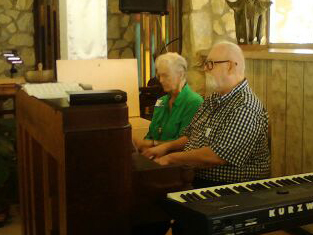
The picture above is Lucy and I playing some 4-hands music at Lakewood UCC way back in 2013.
 At Lakewood UCC we’re very concerned that the words to our prayers, hymns, and anthems all use inclusive language for humanity and expansive language for God. That’s a deep statement, and if you ponder it for a bit — inclusive language for humanity…expansive language for God — you might glimpse how our language for humanity in the past may have been exclusionary and our language for God, restricting. I asked Rev. Wells for suggestions for hymns during this week when we’re celebrating Earth Day. This Is My Father’s World was one of her suggestions! When I queried her about the patriarchal language of the title, her response was, as always, enlightened and compassionate. Here’s what she said, “Many of us grew up singing This Is My Father’s World and know it. Yes, it uses masculine language for God, but we do our best. Don’t want to throw out the baby with the bathwater. Or become legalistic.” It’s great working for someone who really thinks things through.
 There is probably no more archetypal Thanksgiving Day song than this. It should easily be the quintessential Earth Day song as well.
 The title in the New Century Hymnal is To You, O god, All Creatures Sing, #17. It has 6 verses. The only
  This morning’s Earth Day hymn is this famous Native American hymn. #3 in the New Century Hymnal, both verses are given in the original Dakota language as well as in an English translation.
  Lakewood United Church of Christ