Advent Devotion 17

Morals and Money

This has been quite a week.  Lots of news.  Which is nothing new.  But the impeachment hearings and votes were noteworthy.  Many people did not listen this go round unlike impeachment processes in the past.   The situation with Nixon, though it did not end in impeachment, was followed very closely by most Americans.  The impeachment of Bill Clinton was also closely followed by most people.  But then sex sells.  But it was not so this time with the impeachment of the current president.  

This got me thinking about many things.  One is morals and money.  If money and power are your game, then you have your perspective on this situation and there is no reason to be bothered with additional information including any facts.  The love of money and power predetermine the narrative you will endorse.

If you are concerned with morals, then there is no point in bothering to listen because the facts have spoken.  Nothing more needs to be heard.  So why tune in to the hearings and debates?  Listening to that verbiage can be toxic.  Who needs that?  

Morals and money.  In the birth stories of Jesus in the Bible, there are some very clear messages about morals and money.  Mary and Joseph are not wealthy or prominent.  God chooses to work through these everyday people not through rich and powerful people with status and position, to bless the world.  Money doesn’t get you in with God.

And Joseph could divorce Mary, we are told in Matthew, but he doesn’t.  He follows the moral guidance he is given by God instead of protecting his male status and his property rights over Mary.  Instead, he does what is morally good.

 And the magi mentioned in Matthew, come from a foreign land, seeking to validate this newborn king who will rule with moral authority not with money.  

And then the angels in the birth story in Luke go to the shepherds.  They do not to the high priests in the Temple or to the governor.  But to the shepherds out in the fields, keeping watch over their flocks, to announce the good news of the birth of Jesus.  That’s like making an announcement to the Hispanic farmworkers out in the fields picking strawberries in Plant City.  What about Tallahassee?  What about Miami?  What about Orlando???  Nope.  Think Immokalee.  

In the Christmas stories, morals talk and money and its accompanying power are silent.  It’s a far cry from our current condition.  Which is why we still need Jesus and we need Christmas again.  

Prayer This holy season, may we reflect on our values and what we care about.  Are the angels coming to us?  What moral authority are we validating?  Do we let money do all the talking?  May we find our way to the manger and go home a different way.  Amen.  

Advent Devotion 16

Too busy?

Are you too busy?  This is a bad time of year to ask that.  Of course we are busy!  But are we TOO busy?  Are the days so full that there isn’t enough time for rest?  For healthy eating?  For church?  For self-care?  For quiet?  For exercise?  For friends and family?  For music?  For whatever feeds the soul?

I had to admit to my daughter today that I have done nothing about Christmas presents for my family.  With one exception.  The 6 month old grandchild.  “That’s all that matters,” she said.  Whew!  I hope her brothers and her husband feel that way!

What is too busy?  I heard something in passing on the radio that mentioned being too busy for beauty.  I think that is a good definition of TOO busy.  When we are too busy for beauty, we are too busy.  When we are too busy to notice the beauty of nature, the beauty of a smile, the beauty of art or music, the beauty of a kind word, we are simply too busy.  

For me, this time of year the test of ‘too busy for beauty’ is Christmas lights.  I love Christmas lights.  When I am too busy to notice Christmas lights when I am driving at night, I am too busy.  When I am too busy to go out of my way a few blocks to see some beautiful lights, I am too busy.  When I am too busy to turn on the Christmas lights at our house, I am too busy.  

What does too busy mean for you?  We should never be too busy for beauty.

Prayer There is so much beauty in this life and in this holy season.  Amidst our busy-ness, may we still notice the beauty around us.  Jesus saw beauty in every person.  May we look at the world with his eyes.  Amen.

Advent Devotion 15

Vengeance!

In the movie, “How the Grinch Stole Christmas,” with Jim Carrey, Cindy Lou Who asks the Grinch what is the meaning of Christmas.  He immediately blurts out, “Vengeance!”  I can’t help but burst out in laughter when I hear that.  It’s the most bizarre answer I can imagine to that question.  Vengeance?  Getting even through hostility?  Punishment in retaliation for being wronged?   What does that have to do with Christmas, the celebration of the birth of the one who teaches love of enemies?

If there was vengeance involved in the relationship between humanity and God, it could be vengeance on God’s part toward humanity for humanity’s desecration of life.  For abuse and oppression.  For domination and violence.  All of which are against the law of God for the flourishing of human community.  God could be taking vengeance on humanity for not adhering to divine intentions for the human race to thrive and live in peace.  Vengeance from God could be easily justified according to scripture and the understanding of the relationship between God and humanity of the Jewish community in Jesus’ day.

 But our story does not tell us of God seeking vengeance.  Instead our story tells us of God fully embodied in a human person, the incarnation of love, in a vulnerable, dependent baby.  That is the opposite of vengeance.  The story of Jesus is a story of God coming to help us, to serve us,  to heal us, to show us the way.  It is not a story of punishment or vindication or retaliation.  

At Christmas we receive an unexpected, unwarranted, enormous gift, with open hands and hearts and minds.  We are to look deeply at all we are being given in Jesus and then to say, with gratitude and passion, YES!  

Prayer Sometimes it is easier to give a gift than to receive one.  At Christmas, we are the recipients of a transformational, life changing, world altering gift.  And it is a gift of peace which disarms all hostility and vengeance.  May we say YES!  Amen.

2019 Advent Devotion 22

Laugh? Cry?

As we approach Christmas, we sing of the hopes and dreams associated with the birth of Jesus. We offer prayers celebrating the peace and joy that go with the arrival of Jesus. As with any child, birth is an experience of anticipation and hope. And this is magnified with the birth of Jesus.

We have so much to be grateful for as we think of the love and compassion that has come into the world through Jesus and his ministry. But as we reflect on all the light that Jesus brings, we still see so much darkness around us. Two thousand years plus after the birth of Jesus, why are people still greedy? Why do people still hurt each other? Why is there killing? How can we be letting the natural world as we know it collapse due to human activity and apathy? Why isn’t every child well fed, vaccinated, and well educated? Why are we still facing so many of the basic struggles of the human spirit that Jesus came to confront and to resolve?

We may feel much joy at the promise associated with the life of Jesus. But our hearts may be breaking over the sad state that we are still in.

But anyone who has been at a birth knows that it is a time of joy and tears. Laughter and crying. It is an ending. And a beginning. There is so much hope and promise but also the looming unknown. I remember an episode of the TV show ‘All in the Family’ where the son-in-law, Meathead, explains why he does not want to have children. He didn’t want to bring a child into a world with so many problems. And this was back in the 1970’s. There are people today who are opting not to have children because the environmental situation is so perilous that they don’t want to have a child knowing it will have to face such danger. And there are many other problems that children face today – school shootings, the internet, the economic system, racism and hatred. Many dangers! But having children that we love in our lives motivates us to take action to protect their future and do the right thing.

So, as Christmas approaches, do we laugh with joy or do we cry with heartbreak?

I heard a writer interviewed recently and he talked about how each day he finds that at some point he laughs. And he often cries. And he feels that both are part of experiencing life in its fullest. They go with being fully alive, deeply experiencing the many dimensions of life. So he sees both laughing and crying as good.

In the gospel of John, the writer has Jesus offer the promise of abundant life. Maybe this means feeling deeply. Feeling joy and delight and awe as well as grief and pain and disappointment. All of it. In its fullness. It’s richness. It’s depth. Being fully present and fully alive.

Laugh? Cry? Yes.

Note: I noticed that there was laughing and crying in church this morning. Maybe that’s what church is for. To help bring us back to life. To feel.

Prayer
This is a complicated season. We want to be happy and celebrate and enjoy all of the festivities. But it is also a time to remember who is not celebrating. Who is struggling. Who is no longer with us. May our observance of Christmas remind us of what it is to be fully alive. Amen.

Sermon 12.22.19 The Nativities

We have all seen a Christmas nativity scene,  made popular, complete with animals, by Francis of Assisi.  And what do our nativity scenes usually include?

Input from the congregation. . . 

There are lots of examples along the back shelf here in the sanctuary.  You may want to look at them after church.  

Our nativity scenes tend to include many of the same figures but there are actually two stories about Jesus’ birth in the Bible and they are quite different and involve different characters.  

A nativity scene that is based on the story of the birth of Jesus in the gospel of Matthew, would have Joseph, Mary, the baby Jesus, an angel (just one), some wise men (we don’t know how many) bearing gold, frankincense and myrrh.  And the scene might even include a key figure, King Herod, and some of his advisors.  I don’t know about you, but I have never, ever, seen a Herod in a creche scene. Herod was a violent, insecure tyrant akin to Stalin.  I can’t imagine him in a nativity scene.  But there he is as a major character in the birth story of Jesus in the gospel of Matthew.  And we want to note that in Matthew’s story there is no mention of a stable, no manger, no hosts of singing angels, no shepherds, and no animals, except maybe camels for the wise men.    

Then there is the birth story of Jesus in the gospel of Luke.  This story includes the angel Gabriel, Mary, Joseph, the baby Jesus, the stable with the manger and the swaddling cloths, shepherds and probably sheep and other animals.  No Herod.  No wise men.  No gifts.  No star.   

But why are there different stories?  In the same Bible?  Written in about the same time frame?  In the same context?  

One fundamental issue of the time was power and authority.  Rome was in control.  Caesar, the head of the Roman Empire, was referred as Son of God, Lord, Redeemer, God from God, Liberator, Bringer of Peace, Savior of the World, Divine.  [See The First Christmas by Marcus J. Borg and John Dominic Crossan, p. 63]  These are among the same titles that were used for Jesus.  So there was a basic conflict between the authority of Rome and the authority of Jesus as the Messiah of the God of the Jews.  The same titles were used but who really had the power?

And there was a big conflict about what it means to be at peace.  Rome inflicted peace on the people through fear, intimidation, and threat.  And Jesus was symbolic of peace through justice and anti violence.  Which kind of peace was it going to be?  

So, there were two competing world views influencing the context of the birth stories.  And the gospel writers chose to respond to the same reality in different ways.  Matthew tells a story that is more about the political power structure and who has the real power.   The Matthew story is looking at things more from the top down.   Luke is telling a story that lifts up the people who are made poor, forgotten, not important, and of little value; those who are victims of the Roman Empire and its social, political, economic, and ideological power structure.  The Luke story is looking at things more from the bottom up.  So, the birth stories confront the same reality but are told from differing perspectives.  

The gospel writers are also addressing different audiences so they tell their stories in ways that will speak to their readers.  Matthew is speaking to a mostly Jewish audience using references to the Hebrew Scriptures and including the wise men to show that Jesus is a universal figure and his reign will include everyone not just Jews.  Luke is concerned with addressing an audience of both Jews and non Jews and includes people who are poor and expendable.  

Why do we have different stories?  People of the first century saw Jesus as an incredibly powerful figure who transformed their reality.  They felt that his impact was universal.  They saw his significance to all people of all times and cultures.  Jesus was experienced as a figure of power sent by God to change the trajectory of human history.  Jesus was so special, so important, that the people in the Jesus movement wanted to make sure that everyone heard about him.  In a relatable way.  So they sought to tell of him in ways that would speak to all different kinds of people so that everyone could see the importance of Jesus.  

Yes, there are two different birth stories in the gospels, but in both stories light triumphs over darkness, peace with justice triumphs over oppression and violence and fear.  That is the message that both gospel writers want to convey and it comes through in each of their nativity stories.  The birth of Jesus is a significant event for people of all times and places.  It is as important to us today as it was to the people of the first century.  It is about a new reality for all of us where light conquers darkness and peace with justice is stronger than war and violence and greed.   

So we can think about how we relate to these nativity stories today.  Do we relate to the conflict of power on a societal scale?  We sure saw some of that this week during the impeachment debates. Do we relate to the multicultural message of Matthew?  This is important in our time of increased hate crimes and anti-immigrant sentiment.  Do we find ourselves relating to the story of Luke and the inclusion of those who are made poor, forgotten, and marginalized?  That is a problem in our country and world wide with the growing wealth gap.  Do we resonate to Luke giving women a more important place in the story?  We continue to confront the second class status of women in this country and around the world.  Do we relate to Joseph and his dreams encouraging him to resist the power structures around him?  What is legal is not necessarily moral.  Do we see ourselves in the angels who have good news to share?  We need more of that today!  Do we relate to the shepherds, low wage workers?  There are so many people struggling in the shadow economy where things are not prosperous.  Do we feel like bystanders, onlookers, like the animals of the barn?  Witnesses with a story to tell.  Do we feel called like Mary to birth love into the world?  What the world needs now is still love.  Are we well educated intellectuals seeking spiritual guidance like the wise men?  Churches that respect and encourage scientific thinking are here for us.  Do we have gifts to give?  They are needed.  Do we see our primary focus in parenting and trying to imbue the world with love through our children?  There are many ways for us in our life situations to find a place in the nativity stories.  Today we are part of birthing God’s love into the world.  We, too, have nativity stories to share.  

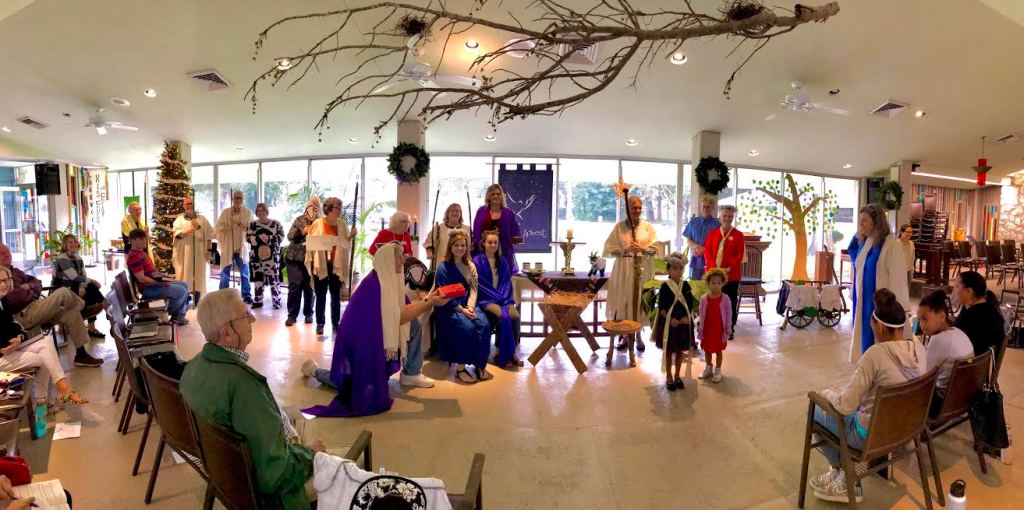
The congregation was invited to be part of forming an impromptu nativity tableau with costumes and props provided.

A reasonable effort has been made to appropriately cite materials referenced in this sermon. For additional information, please contact Lakewood United Church of Christ.