The new year approaches. This hymn with its English folk tune harmonized by Ralph Vaughan Williams is the perfect song for the season. This little arrangement of mine of two descants that work with the Vaughan Williams harmonization can be played on a trumpet with a congregation singing it or as an EZ 2-part mixed anthem (this recording is organ, trombone on the tune, and trumpet on the descants). #music #trumpet #descants #newyear #hymn
Posts
CIW’s Lupe Gonzalo named one of top agents of change
Lupe Gonzalo has visited Lakewood UCC to talk about the farmworkers.
The following is reposted from https://ciw-online.org/blog/2023/12/ciws-lupe-gonzalo-named-as-one-of-top-25-leaders-innovators-and-agents-of-change-across-the-fresh-produce-supply-chain/?emci=75b9396d-909e-ee11-bea1-002248223f36&emdi=82ff9cfa-939e-ee11-bea1-002248223f36&ceid=13383002
CIW’s Lupe Gonzalo named as one of top “25 leaders, innovators and agents of change across the fresh produce supply chain.”
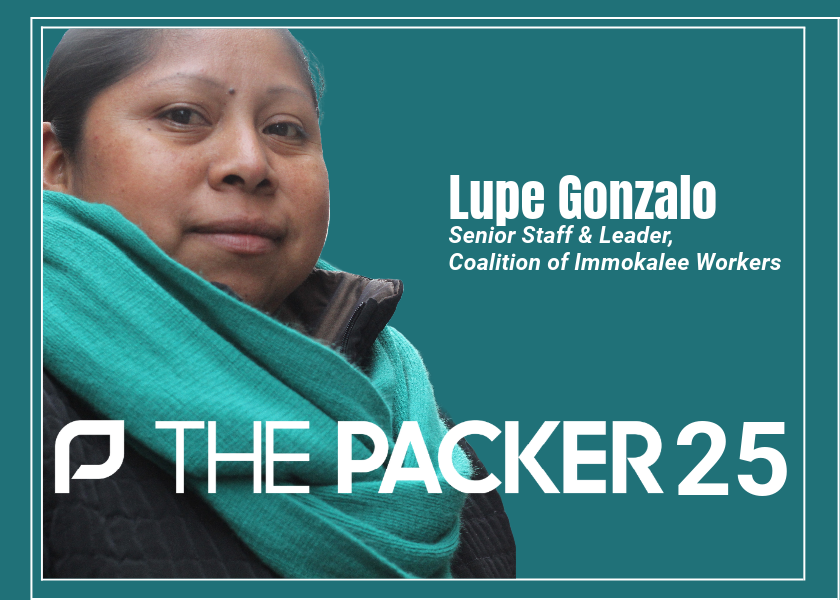
The Packer: “Drawing on her experience with the Fair Food Program, Gonzalo has helped to train, mentor and educate workers from other regions and industries on the Worker-Driven Social Responsibility model.”
“Gonzalo also was a member of the CIW team working with Futures Without Violence, which collaborated with CIW and other Fair Food Program partners on the first sexual harassment training curriculum for the agricultural sector in the U.S.”
As 2023 draws to a close, farmworkers with the Coalition of Immokalee Workers are celebrating the organization’s 30th anniversary. In the last 30 years, the CIW — which began as a loose gathering of farmworkers meeting weekly in a borrowed church hall in the small, crossroads town of Immokalee — has grown in size and success to become the founder of the Presidential Medal-winning Fair Food Program, the leading social responsibility program in the US agricultural industry today, and of the Worker-driven Social Responsibility model, the new paradigm for human rights protection in global supply chains to which the FFP gave rise. And along the way on this remarkable journey, many of the CIW’s longtime farmworker-leaders have emerged as key agents of change in the trillion-dollar food industry.
With the tireless leadership of farmworkers themselves, the CIW forged the Fair Food Program from the ground up – an unprecedented partnership among workers, buyers, growers, and consumers to monitor and enforce the basic human rights of farmworkers by harnessing the purchasing power of some of the world’s larges food corporations. Lupe Gonzalo, an indigenous Guatemalan farmworker who worked for years in Immokalee’s tomato fields before joining the CIW staff, knows all too well the life of a farmworker outside the protections of the FFP.
Raised in a rural village in Guatemala, Lupe journeyed to the United States in hope of finding a better life — but was instead met with the kind of outrageous exploitation that remains all-too-common in agriculture and low-wage work beyond the protections of the Fair Food Program. Once she found out about the Fair Food Program, however — which happened during a visit by the CIW’s Worker-to-Worker Education Team to the farm where she was picking tomatoes in the early days of the FFP — she immediately saw an opportunity to right the historic wrongs the plagued US fields, and has never looked back since.
Through her more than a decade of work with the CIW, Lupe has become a prominent leader in a global human rights movement centered around the Worker-driven Social Responsibility model, which ensures humane working and living standards for low-wage workers, and which was born in the same Immokalee, FL, fields in which Lupe toiled when she first arrived to the U.S.
Christian Call in Day for Ceasefire in Gaza
 |
|---|
| Christian Call in Day for Ceasefire in Gaza Wednesday December 20 |
|---|
| NCC continues to be concerned about the ongoing war in Gaza. The ecumenical community, our member denominations, and our partners have consistently called for a ceasefire in Gaza to protect civilians who are being killed (view numerous statements and relief efforts).With more than 18,000 killed in Gaza so far – 70 percent of them women or children – our partner, Churches for Middle East Peace, is co-sponsoring a call-in day to call the White House and ask President Biden to push for a ceasefire in Gaza.Please consider participating in a Christian Nonviolence Call-in Day:On Wednesday Dec 20, 2023 please call the White House between 11am and 3pm ET (8am-12pm PT). The White House call-in number is 202-456-1111.You might need to wait on hold some time before getting an operator to take your comment. If you have trouble getting through, please send an email to the White House here: https://www.whitehouse.gov/contact/ For scripts and background information, visit https://franciscanaction.org/christian-nonviolence-call-in-day/ |
|---|
Sermon text 9.10.23

LAKEWOOD UNITED CHURCH OF CHRIST
2601 54th Avenue South St. Petersburg, FL 33712
On land originally inhabited by the Tocabaga
727-867-7961
lakewooducc.org
lakewooducc@gmail.com
Date: Sept. 10, 2023
Scripture Lessons: Romans 13:8-14 and Matthew 18:15-20
Sermon: Love and Power
Pastor: Rev. Kim P. Wells
One of the most powerful movements for social transformation in the history of the United States was the Civil Rights movement. Through the courts and through legislation, the movement was able to effect drastic change in the social, political, and economic landscape of America. And one of the major personages in this movement was Dr. Martin Luther King, Jr. In his mission to eradicate injustice from this land and its people, King employed a powerful force. Not a bomb. Not a gun. Not a landmine. Not napalm. No. In fact he was adamantly against the use of violence in any form. The force King and his colleagues mobilized to effect enormous change was love. The love we hear about in the New Testament. The love that led Jesus to the cross. The love associated with God that cannot be overcome.
Like many other leaders and philosophers throughout history, King reminded us that violence begets violence. If one country takes over another through war, this leads eventually to another war. Those who ‘win’ the war, will use violence and war as a tool. The only way to get out of the spiral of constantly perpetuating violence, is to use non-violence to effect change, non-violence that is rooted in love because only love has the power to overcome fear, hatred, and greed.
Dr. King had his house bombed with his spouse and children inside. He was stabbed. He got threatening, harassing calls on a daily basis. There were other threats of violence. He was beaten. He was put in solitary confinement in prison. He personally endured many acts of violence and hatred in word and deed. And instead of obsessing over his own safety, he was worrying about the 40 million poor people in America at that time. No matter their color or creed. And he was worrying about the Vietnam War and all those who were being killed and damaged in that debacle. And he was committed to ending racial inequality in the United States. His life was truly oriented around love – which is concerned not just with not doing harm but with doing good. In response to the bombing of his home, King declared, “Love is our great instrument and our great weapon, and that alone.” [A Testament of Hope: The Essential Writings of Martin Luther King, Jr., edited by James M. Washington, p. 83.]
In his last and most radical address to the Southern Christian Leadership Conference, King had this to say about love:
“And I say to you, I have also decided to stick to love. For I know that love is ultimately the only answer to mankind’s’ problems. And I’m going to talk about it everywhere I go. I know it isn’t popular to talk about it in some circles today. I’m not talking about emotional bosh when I talk about love, I’m talking about a strong, demanding love. And I have seen too much hate. I’ve seen too much hate on the faces of sheriffs in the South. I’ve seen hate on the faces of too many Klansmen and too many White Citizens Councilors in the South to want to hate myself, because every time I see it, I know that it does something to their faces and their personalities and I say to myself that hate is too great a burden to bear. I have decided to love. If you are seeking the highest good, I think you can find it through love. And the beautiful thing is that we are moving against wrong when we do it, because John was right, God is love. He who hates does not know God, but he who has love has the key that unlocks the door to the meaning of ultimate reality.” [A Testament of Hope, p. 250.]
King’s message of the power of love sprang forth from the teachings of Jesus and the New Testament. Love your neighbor as yourself. Love your enemy. God is love. Love casts out fear. All of these teachings and more are embedded in our Christian scriptures. And King was a pastor, after all. This was the foundation of his life, his ministry, and his activism. Jesus preached a message of radical love. Especially for those who were considered ‘less than’ in any way by the society around them. King lived out of a commitment to that kind of love.
This morning, we listened to two teachings from the New Testament about love. Let’s talk about them for a moment. They shed some light.
The lesson from Romans emphasizes the commitment to love and fleshes it out with echoes of the 10 commandments. Don’t murder. Steal. Commit adultery. Covet. Love one another. The examples cited basically lead to defining love as ‘do no harm.’ Don’t do bad stuff. Don’t do bad things to other people.
But when we really delve into the love ethic of Jesus, it is so much more than ‘do no harm.’ It is ‘do the good.’ Take care of each other. Help others. Provide for each other. Heal each other. Create community where every one belongs and is safe and is cared for. It’s not enough to just not hurt others directly, the power of the love that Jesus talks about is evidenced in doing good for others. Whatever you have done to the least of these: Feeding the hungry. Visiting those in prison. Clothing the naked. Creating a world that is just.
So, as we look at the verses from Romans, yes, the core of our faith is to love, but it is much more powerful than ‘do no harm.’ We can almost see the message of Jesus being weakened, diluted, taking the radical edge off. Making it more socially acceptable. And less taxing to the believer. Maybe making it more attractive to potential new converts.
And when we look at the lesson from Matthew this is often cited as a strategy for conflict resolution within the church, where, not surprisingly, there are often conflicts between people. Just because you go to church doesn’t mean you don’t take issue with others and their ideas and behaviors. So a method of resolution is offered. But this process seems so mundane compared with Jesus’ stories with multiple meanings and radical implications.
Interestingly, the Jesus Seminar of biblical scholars does not think this passage is historically attributable to Jesus. Though I am no erudite biblical scholar, I agree. This is the anomaly I see in this teaching. The line about tax collectors and Gentiles. The implication in this Matthew passage is that if the conflict resolution process doesn’t work between members of the faith community, then you can treat the other person as a tax collector or Gentile – that implies write them off, stay away from them, don’t include them.
But, well, in numerous other places in the gospels we are told that Jesus was known for eating with tax collectors and Gentiles or sinners. He had a reputation for socializing with those who were outcasts, unclean, not socially accepted in the mainstream. When you notice how this verse stands out, and how inconsistent it is with the ministry and legacy of Jesus, we see again, how in the years after his earthly life had ended, those who were his followers were in some ways toning down his message. Making it less radical, maybe less demanding. Making it easier to accept.
When Jesus’ message is softened, yes, it is easier to accept. But it also looses some of its power. It’s like taking the batteries out of a toy. You still have the toy but it doesn’t do all the cool things it has the capacity to do. It doesn’t beep and blink and flash.
When Jesus’ message of love, of fierce, demanding, soul stretching love, for everyone, even the person who has abused you, terrorized you, traumatized you, is watered down, it looses some of its transforming power.
And in some ways the church has been offering Jesus ‘lite’ to people for centuries. And it is still happening today.
Dr. King had to explain the power of love that is seen in the ministry of Jesus over and over to, well, church people. In sermons. In churches. As well as to interviewers and marchers, many of whom were church goers. Because they hadn’t heard much about the unbridled power of love that is taught by Jesus and its implications for our reality and the injustices and horrors and violence and greed that characterize today’s world.
People may have known the ‘do no harm’ Jesus. Of course, don’t hurt anyone. And if you don’t think someone with another skin color is a full person, like you are, then you don’t have to worry about harming them.
But love is so much more than that. It is infinitely powerful. It is radical. it is transformational. And it cannot be controlled. When you tap into the power of love, you don’t know what will be called forth from you. You don’t know what you will have to face. You don’t know what you will be drawn into. It involves complete trust. When you examine the legacy of Dr. King, he might discuss different approaches and strategies for attaining civil rights but he would not compromise on love manifested in non-violence. Period. That was sacrosanct. And I have just listened to the biography of Coretta Scott King, who was married to Dr. King, and she was at least as adamant about the power of love and non-violence as he was – before she met him and after his assassination. Love is the supreme power for good in our lives and in the world.
Back in 1863 an enterprising German chemist named Julius Wilbrand developed the chemical compound, trinitrotoluene, that was widely used in industry as a yellow dye. Three decades later, in 1891, another German chemist, Carl Haussermann, discovered the explosive properties of trinitrotoluene and it is still widely used as an explosive today. We know it as TNT.
So here was this incredibly powerful substance being used to dye things yellow. And this is in a way how I feel about the message of love that has been give to us by Jesus. It has incredible power. And we are using it for largely innocuous purposes when it has the power to completely transform us and the world.
And while I am not a cynic, given our situation today, I would like to at least see us expect the power of love to be manifested as the writer of Romans envisioned: Never wrong anyone. Do no harm. To me, that sounds like a grand place to start with love! Who knows what the explosive power of love may lead to from there!
Amen.
A reasonable effort has been made to appropriately cite materials referenced in this sermon. For additional information, please contact Lakewood United Church of Christ.
Sermon text 12.17.23
LAKEWOOD UNITED CHURCH OF CHRIST
TRINITY UNITED CHURCH OF CHRIST
2601 54th Avenue South St. Petersburg, FL 33712
On land originally inhabited by the Tocabaga
727-867-7961
lakewooducc.org
lakewooducc@gmail.com
Date: Dec. 17, 2023 Third Sunday of Advent
Scripture Lessons: Luke 1:26-38 and Luke 1:46b-55
Sermon: Star Power
Pastor: Rev. Kim P. Wells
The James Webb telescope continues to give us stunning images of the magic and mystery of space. Ethereal. Enchanting. But of course the mission of the telescope is about more than captivating images that mesmerize and delight the human eye. The telescope is helping scientists to better understand space and thus own very own planet Earth home.
We see these glorious images of the stars but what really is a star? I have read a number of scientific descriptions and I still find it mysterious and enigmatic. Apparently dust cloud swirls of elements like hydrogen, oxygen, and nitrogen coalesce through self gravity and ignite through thermonuclear fusion forming powerful balls of fire that emit light that travels 5.88 trillion miles per year. The light from Polaris, the North Star, takes 320 years to reach Earth.
There are more technical ways of saying it, but stars are swirling balls of explosive energy radiating incinerating heat and light. They have tremendous energy that transforms molecules, gases, and elements. They are powerful, and uncontrollable. And, of course, as we know from our sun, a star is needed to create conditions supportive of life as we know it.
And yet we see stars as little glimmers of light shining in the night sky. Far away pinpricks. Like glitter strewn across the heavens. Sparking much contemplation, poetry, philosophy, and wisdom. Japanese Manga artist, Natsuki Takaya reflects:
“I love the stars.
Because they can’t say anything.
I love the stars.
Because they do not judge anyone.”
Yes, the stars can appear as passive and simple in their illuminating beauty.
And when we think of Mary, we can see this heavenly aspect to the way she is portrayed. Often with stars. There are stars on the cloak of the Virgin of Guadalupe and she stands on the moon. Other images of Mary also involve stars. And she is seen as calm, pensive, steady. A willing servant. With an ethereal glow.
Recently a 15th century painting of Madonna and Child by Sandro Botticelli was rediscovered in a private home in the south of Italy. It was moved there for protection during an Earthquake in 1982. It is thought to be worth about 100 million Euros. In the painting, Mary is sitting in a gilt chair, more of a throne really, holding the baby Jesus who tugs on her clothing. Mary looks at the viewer, still, calm, composed, beatific. Mouth closed. Eyes open. Benign. [“Baker’s family hands back 100m Euro Botticelli they had for decades,”
Matthew Campbell, Santa Maria La Carita, The Sunday Times, 12/16/23]
We are used to seeing Mary this way. Pondering things in her heart. A serene maternal figure. A source of comfort like the silent stars.
But what about Mary’s song, the Magnificat? It is anything but serene and still. This hymn of the early Christians associated with Mary does not convey the peaceful reverie that we see in so many images of her.
Yes, she has submitted to God. She has agreed to ‘Let it be.’ But this song does not portray serenity. It portrays upheaval. Reversal. Energetic transformation. Mary sings of the overturning of society, culture, and religion as we know it. No more hierarchy. No more patriarchy. No more discounting of life. Those who were on the bottom are lifted up. The ones who were on the top are pegged down. There is equality. No more abuse. No more hunger at one intersection while there is feasting down the road. Mary’s song portrays a peace achieved as the result of tumultuous upheaval. This is the manifesto of a revolutionary. An insurrectionist. Mary is the accomplice of a radical powerful God of transformation. We hear it in these phrases:
Strength with your arm
scattered the proud
deposed the mighty
raised the lowly to a high place
filled the hungry
sent the rich away empty
It is not surprising that this sweeping manifesto is associated with a woman and not a man. This was so subversive. It could get a man in trouble. But I imagine no one was worrying about what a woman was saying.
The magnificat presents a drastic, seismic disruption. This is powerful imagery for the dynamic reversal of accepted life and culture. This isn’t tinkering. Or fixing a bug. Or making a slight adjustment. This is a cataclysmic reorientation of reality. And notice that the past tense is used. This is a song of praise to a God that has done these things. Has created this reality. There is no doubt.
I am imaging a world where the salary scale in a company is set up so that the person at the top can make at most 10 times what the lowest paid worker makes. And if there is a profit at the end of the year, it goes into upgrading production and facilities and the work place. Or the profit is equally shared as a bonus to all the employees. The same amount for each one. Or the company is encouraged to give the profit away to social service projects and the arts. Things to uplift the community. Or maybe there is no company, but a collective.
I am envisioning a world where there are no pan handlers at the end of the exit ramp. At the busy intersection. In the parking lot at the shopping center. Anywhere. Ever. And there are no houseless people or refugees. Anywhere. Because all people have enough to eat and a safe place to sleep. And comprehensive health care including all reproductive healthcare.
I try to imagine a world without white male privilege. Without the elites expecting exceptions and accommodations and to be served. Where working people, and people with physical challenges, and people who have accents, are treated with respect and dignity.
We’ve all seen it. A clerk at the Social Security office is terse and dismissive with a person who has come for help. Then someone like me is called and I am treated in a friendly manner, all concessions made to accommodate my need. There is an eagerness to be of service.
In the magnificat, the lowly are lifted up. There is no more degradation for there are no longer any people who are considered ‘less than.’
This morning we want to remember that Trinity Evangelical and Reformed Church, later, Trinity United Church of Christ, was founded on Dec. 21, 1952. In advent, a new beginning. How appropriate! We can well imagine those involved in establishing this new congregation being committed to equality and justice in that time. The founding pastor, Rev. Bob Frey, was a member of Lakewood for many years after his retirement and he served as an interim minister at Lakewood. Bob and Beth were very dear to many in the Lakewood congregation. And Bob shared some stories about his time at Trinity. He told of how a clergyperson from the national staff of the church was invited to preach at Trinity for a special occasion. The person came and was hosted by the congregation and preached for the Sunday service. After the service there was an impromptu meeting of the board the purpose of which was to entertain a motion to fire Bob Frey for inviting this guest from national. That doesn’t sound right — until we learn that the national staff person was Black. But the board voted to retain Bob and he did not recoil from his commitment to ending racism. We can imagine that Bob and those who supported him had paid attention to the Magnificat. There is no room in the song of Mary for any kind of bigotry or racism. A church founded at Christmas knows that everyone is welcome at the manger.
The Magnificat is a radical stirring of the pot, challenging the status quo. It is revolution. It is disruption. And it is re-creation. And yet the images we see of Mary are so serene and passive. It’s like the stars. They look so peaceful and calm in the night sky and yet they are raging balls of fire. The Mary of the Magnificat is hardly benign. She is aswirl with passion for justice.
I am thinking about Sojourner Truth and the other people who were enslaved who made their way to freedom guided by the stars. Those glimmering lights of the night sky. The stars were powerful guides to those seeking freedom. They gave courage, hope, and direction to those who were seeking another world.
We are drawn in by the serene, calm images of Mary in part because we are seeking more serenity and peace in our lives. But the witness of Mary shows us that we experience that solace and comfort and peace as a result of the passion and power of radical transformation. To experience the calm and peace, the world needs to be changed so that peace can thrive and flourish. This disruptive reconstruction is necessary if we are to know peace.
This advent, let us seek this deep peace of the shining stars. May we trust that like the power that transforms swirling clouds of dust into gleaming orbs with the power to shine light for eons, the power of Divine Love is seeking to work in our lives and the swirl of our world leading us to the freedom of peace with justice. This advent season, may we let ourselves be drawn into the revolutionary vision of the song of Mary, the calm, blue clad passive young mother of our imagining. Who trusts the power of the God of Love to re-create reality for all. Mother Mary, come to us! Speak your words of wisdom. Amen.
___________________________
On stars, see:
https://skyandtelescope.org/astronomy-resources/what-is-a-star/
and
https://science.nasa.gov/astrophysics/focus-areas/how-do-stars-form-and-evolve/
A reasonable effort has been made to appropriately cite materials referenced in this sermon. For additional information, please contact Lakewood United Church of Christ.
 Lakewood United Church of Christ