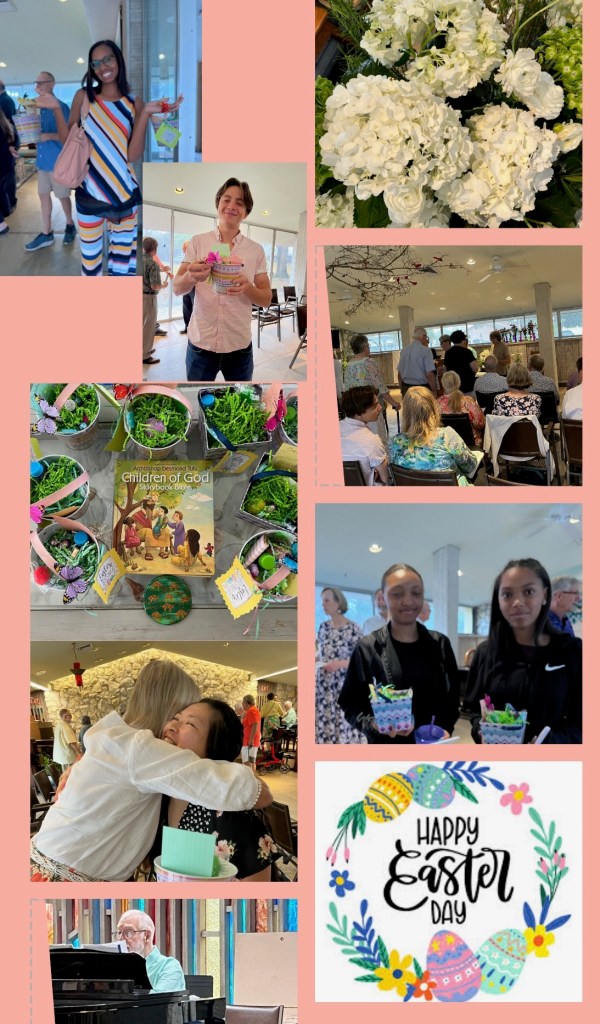
Easter at Lakewood


LAKEWOOD UNITED CHURCH OF CHRIST
2601 54th Avenue South St. Petersburg, FL 33712
On land originally inhabited by the Tocabaga
727-867-7961
lakewooducc.org
lakewooducc@gmail.com
Date: April 2, 2023 Palm Sunday
Scripture Lesson: Matthew 21:1-11
Sermon: On Earth as It Is in Heaven
Pastor: Rev. Kim P. Wells
There’s a well known folk tale, shared in several religious traditions as well as many cultures, about the difference between heaven and hell. Here’s a version of the story:
Long ago there lived an old woman who had a wish. She wished more than anything to see for herself the difference between heaven and hell. Her request was granted. She saw before her two doors.
She opened the first door and immediately the aroma of delicious food filled her nostrils. Before her there was a great dining room and a large dining table and in the middle of the table was a large pot of steaming stew that smelled delicious!
There were people seated around the table. Their bodies were thin and their faces were gaunt and creased with frustration. The atmosphere was angry and hostile. The people were muttering and lashing out at each other. Each person held a spoon. The spoons were very long. Maybe three feet long. They were so long that the people could reach the spoon into the stew in the pot but they could not get the food into their mouths because the spoons were so long. As the woman watched, she heard their hungry desperate cries. They were miserable.
”I’ve seen enough,” she cried. “Please let me see heaven.”
She opened the second door and immediately the aroma of delicious food filled her nostrils. Before her there was a great dining room and a large dining table and in the middle of the table was a large pot of steaming stew that smelled delicious just like in the room before! She was confused.
She looked more closely. There were people seated around the table. But they were plump, well fed, they were smiling and happy, busy talking and laughing. Each person had the same very long spoon. Maybe three feet long! They could not feed themselves with that long spoon. But the people around the table were dipping their spoons into the pot of delicious stew and feeding each other!
Now the woman understood the difference between heaven and hell.
This classic story gives us an image of heaven in which everyone takes care of each other. Everyone is compassionate. Everyone is provided for. Everyone gives and receives. To me it echoes the beautiful verses from the gospel of John: “Do not let your hearts be troubled. Believe in God, believe also in me. In my Abba’s house there are many dwelling places. If it were not so, would I have told you that I go to prepare a place for you.” [John 14:1-2]
We think of heaven as a place where everyone is provided for and cared for. No one is belittled or left out or struggling to make it. It is a place of peace and harmony. No cares and no worries.
And in the prayer that we repeat at least weekly in church, the Savior’s prayer, there is the line, ‘on Earth as it is in heaven.’ We envision the reality of God extended from the realm of heaven, however we may imagine that, to the realm of our earthly lives. And that is what Jesus’ life and ministry is about. As above, so below, as it is said in indigenous traditions. Jesus is about making life on earth as it is in heaven, a construct of reality completely consistent with the love of God.
In our faith tradition, we remember Jesus declaring, the realm of God is among you. The reality of God is within you.
Jesus brings heaven to earth. He closes the gap between the reality of God in heaven and the reality of God here on earth creating a reality on earth where everyone is loved and cared for. So the reality of God isn’t just about some distant meta-verse in the sweet bye and bye, but about life here on earth, now.
And so Jesus feeds. Everyone. Jesus forgives. Everyone. Jesus heals. Everyone. And, maybe most importantly, Jesus befriends. Everyone. Including the nasty, despicable, outcasts and disreputable people; the poor and rejected ones. It wasn’t just about a hand out to them. He hung out with them. Jesus creates inclusive, egalitarian community. Everyone a precious beloved child of God. Each one a unique expression of the image of an infinitely loving God.
You see, in the story we began with, everyone has a spoon. And they decide what to do with it. And behind the second door they feed each other. And everyone has enough. And no one goes without. As in heaven, so on earth. With Jesus.
Also notice in the folk story, no one sold the people the spoons. There aren’t silver spoons. There aren’t spoons to rent. There aren’t spoons of different sizes and lengths. Everyone is given a spoon. The spoons are all the same. And there is only one pot of delicious, nutritious stew. Everything that is needed is provided.
As above, so below. This is an image of a reality in which people no longer take advantage of each other. No longer benefit from the abuse of others. No longer over power others for their own advantage. No longer determine the station of others or the value of others. There is no living at the expense of someone else. Period. There is no undermining the dignity and self determination of others. There is no more taking advantage of labor. No more easy manipulation of the masses.
And people with power and wealth and privilege don’t like that reality because it does not favor them. They do not come out on top because there is no ‘on top.’ In the reality of God, everyone gets what they need and it is enough. And all are expected to serve as well as be served. That reality was not generally accepted by those in power in Jesus day. And it is not accepted by those in positions of power today. Including those who claim to be religious authorities.
Part of what upset people of the first century about the way of Jesus was that he was giving all the power to God, and that was taking power away from the people who were controlling the social and religious and economic systems that were holding sway. The systems that determined who got to make decisions. And how life would be organized. And what you had to do to keep your place in society. And who would be the haves and who would be the have nots. And in the first century, religious officials were holding a lot of that power and control. Supposedly in the name of God. And they did not like Jesus upsetting the hierarchy, patriarchy, and economy from which they were benefitting.
And that’s why the authorities wanted Jesus killed. He wasn’t killed because he was promising something in the next life. He was killed because he was embodying the reality of God right here and now in this life. As above so below.
This week as we remember the last week of Jesus’ life we heard the story of how Jesus rode into Jerusalem on a donkey. This processional was a purposeful mockery of the traditional parade of imperial conquest led by a military leader astride a steed. In the story from the gospel of Matthew that we read today, not only does Jesus ride a donkey, a beast of burden, hardly a strapping steed, but we are told it is a female donkey with a colt. It is a donkey of lower status, female. And she has a colt. She is vulnerable. So the story features not only a donkey, but the least and lowest of the donkeys, a mother and baby. So like Jesus. Always about reaching out to lift up the least and the lost. Those cast aside, ignored, expendable.
When Mahatma Gandhi was assassinated, British writer George Bernard Shaw commented, “It shows how dangerous it is to be too good.” [Quoted in Listening at Golgotha, Peter Storey, p. 31.]
This week, we will retell the stories around Jesus’ death. This is the week to remember that Jesus was killed because he gave himself to making life ‘on Earth as it is in heaven.’ Amen.
A reasonable effort has been made to appropriately cite materials referenced in this sermon. For additional information, please contact Lakewood United Church of Christ.
 |
 |
 |
| This Sunday This Sunday: This Sunday is Palm Sunday! The service will begin outdoors on the lawn with the blessing of the palms. Please bring a palm branch if you can! Also, this Sunday is the deadline for ordering Easter flowers. Please turn your form in this Sunday. This year the flowers will be cut flowers in vases. After the Easter service, the flowers will be delivered to those in the LUCC family that are homebound. You can email the church office to order flowers. Simply indicate who the flowers are ‘in memory of’ or ‘in honor of.’ Childcare is provided at all Sunday services. |
 Holy Week ScheduleApril 2 – Palm Sunday Service begins with the blessing of the palms outside. Please being a palm branch if you can. April 6 – The Maundy Thursday service will be held at 6:30 around the table over dinner, a remembrance of the last supper. April 7 – On Good Friday the sanctuary will be open for reflection and prayer from noon until 3 p.m There will be readings and prayers provided for your use. April 9 – Easter Sunday there will be one service at 10:30 a.m. in the church sanctuary. |
| Lunch at the Tiki Docks (3769 50th Ave. S) on Sunday, April 2, 2023 after church. Please come for some fun conversation with some fun folks. Contact Kay Rencken (bobandkayrencken@cox.net) for more information. |
 LUCC Book Talk LUCC Book TalkFor almost two years a small group has been meeting each month via zoom. Each member shares the book(s) they have been reading…fiction, non-fiction, current or classics. There is always a wide variety of books shared and discussion is lively. We usually meet on the third Thursday of each month. Rev. Kim issues the zoom invitation. We would love to have you join us!!! NEXT BOOK TALK: Thursday April 13 at 6:30. Zoom link: https://us02web.zoom.us/j/2700683648 |
 Lakewood UCC feature in National UCC News about New College Lakewood UCC feature in National UCC News about New College |
| https://www.ucc.org/history-will-grind-you-into-dust-ucc-gmp-blasts-desantis-appointees-as-new-college-faces-authoritarian-takeover/ |
 Florida UCC Women to Host Retreat Florida UCC Women to Host RetreatLUCC Dyanne Edds is involved in the women’s ministry of the Florida Conference. She can share more information about this upcoming retreat. 93rd Annual FL UCC Women’s Conference – All women belonging to a UCC church are invited to attend the 93rd Annual FL UCC Women’s Conference, May 5-7 2023 at San Pedro Conference Center in Winter Park, FL. Registration deadline is April 1, 2023. More information as well as registration forms can be found on the FL UCC Women’s website: Register here: https://www.uccfla.org/floridauccwomen |
 St. Petersburg Museum of History Offers Civil Rights Exhibit St. Petersburg Museum of History Offers Civil Rights Exhibit |
| This past week, Rev. Wells was part of a clergy tour of a new civil rights exhibit at the St. Petersburg Museum of History. The display, “Civil Rights in the Sunshine State” provides history and information about the civil rights movement in Florida. We often hear about Mississippi and Alabama but there was also a vibrant civil rights movement in Florida. Learn about it at this new exhibit. Feb. 25-June 8. |
 Guided Labyrinth Walks Wednesday Mornings at 9:00 a.m. Guided Labyrinth Walks Wednesday Mornings at 9:00 a.m.Each week there is a guided labyrinth walk on the outdoor labyrinth at the church. It is a time of prayerful faith sharing, and a time to listen more deeply to our spiritual lives. In case of rain, the walks are held on Thursday morning. Also, the readings and prayers used each week at the guided walk are put in the mailbox by the labyrinth for use during the week. The labyrinth is on the church grounds near the southwest corner of the church property. It is available for use at all times. |
 Family Promise Needs Family Promise NeedsFamily Promise, a local ministry to houseless families with children, is in need of the following items: Women’s underwear sizes S/M/LWomen’s socksWash clothsBath towelsPull Ups sizes 2T-3T, 3T-4T, 4T-5THair conditioner (no shampoo)Women’s deodorantCerealCups, forks, platesSnacks to go (not granola bars)Please bring items to church and place them on the shelves behind the curtain in the hallway. |
 Toiletries for Celebrate Outreach Toiletries for Celebrate OutreachCelebrate Outreach is a local ministry with people who are living without shelter in St. Petersburg. An average of 135 people are served each week. LUCC was asked to collect toiletries to be distributed to the community at the meals that are provided on Saturday and Sundays each week. |
| Celebration Outreach has an ongoing need for men’s and women’s underwear.Men sizes 30, 32,34Women’s sizes 5,6, 7,8. Also in high demand are socks of all kinds /sizes for both men & women. Other needed items are Deodorant & disposable razors. Toothbrushes, toothpaste, disposable razors, bar soap, wash cloths, deodorant, feminine hygiene items, travel size creams, shampoo, body wash, individual packets of Kleenex, hand wipes, toilet tissue, and paper towels are always needed as well. Many thanks to Janet Blair and Jim Andrews for taking the donations to Celebrate Outreach. |
 Inkjet Recycling Inkjet RecyclingThe church is continuing to collect used inkjet cartridges. They are sent to a recycler and the church receives payment for the cartridges provided. So, don’t throw out your cartridges. Bring them to church. Not only do they get recycled but they provide income for the ministry of the church. |
 Operation Attack Update Operation Attack UpdateOA needs donations of cereal/oatmeal, mac and cheese, pasta sauce, peanut butter, canned meat, fruit, soup, and vegetables. Donations may be placed on the shelf in the hallway at church. Many thanks to Owen Blair-Catala for seeing that the donations are received by Operation Attack. |
| USEFUL LAKEWOOD LINKS Sermon and Reflection TextsLakewood UCC YouTube ChannelLakewood UCC on TwitterLakewood on FacebookLakewood on Instagram For the above church website links, please note the “Older Posts” button near the bottom of each page. You can stream Hilton’s music and videos for free at http://hiltonkeanjones.com/look-listen/ as well as purchase his CDs and digital albums there. |
 March Birthdays! March Birthdays!March 1 Carol ShoresMarch 3 Claudia RodriguezMarch 13 Yvonne RiesenMarch 19 Ron Huff Are any church family birthdays missing? Please contact the Church Office! |
 Circle of Concern Circle of ConcernSamantha Wassmer and family Tony and Jim Larson Ann Quinn is under Hospice care Maggie Brizendine Janet Hall Family and Loved Ones of Lorne Palmer |
| All those suffering from COVID-19 and all healthcare workers, Schools: Students, families, teachers, and staff |
| Weekly Update If you are involved with an activity or event that you would like to share with the LUCC family, please send the information to the Church Office by Wednesday. Please provide the information in paragraph form with pertinent details and links. THANK YOU! |
| RECENT WEBSITE POSTS |
| Oppose Another Florida Execution – VIGILMarch 31, 2023Bulletin 3.26.23March 24, 2023Sermon 2.19.23March 23, 2023Re-request your ballotMarch 23, 2023One City ChorusMarch 22, 2023The Electric Vehicle Charging Station at the Church In UseMarch 22, 2023Guided Labyrinth Walk March 22, 2023March 22, 2023Sermon 2.26.23March 22, 2023sermon 3.5.23March 18, 2023Learn with LucyMarch 17, 2023Sermon 3.12.23March 17, 2023 |
| Copyright (C) 2023 Lakewood United Church of Christ. All rights reserved. You are receiving this email because you opted in via our website. Our mailing address is:Lakewood United Church of Christ2601 54th Ave S On land originally inhabited by the TocabagaSt Petersburg, FL 33712-4709 Add us to your address book |
| Credits: Images of palm & cross, stack of books, “thank you,” birthday cake, and printer from Freepik.com |
 Copyright (C) 2023 Lakewood United Church of Christ. All rights reserved. Copyright (C) 2023 Lakewood United Church of Christ. All rights reserved.You are receiving this email because you opted in via our website. Our mailing address is: Lakewood United Church of Christ2601 54th Ave SOn land originally inhabited by the TocabagaSt Petersburg, FL 33712-4709 |
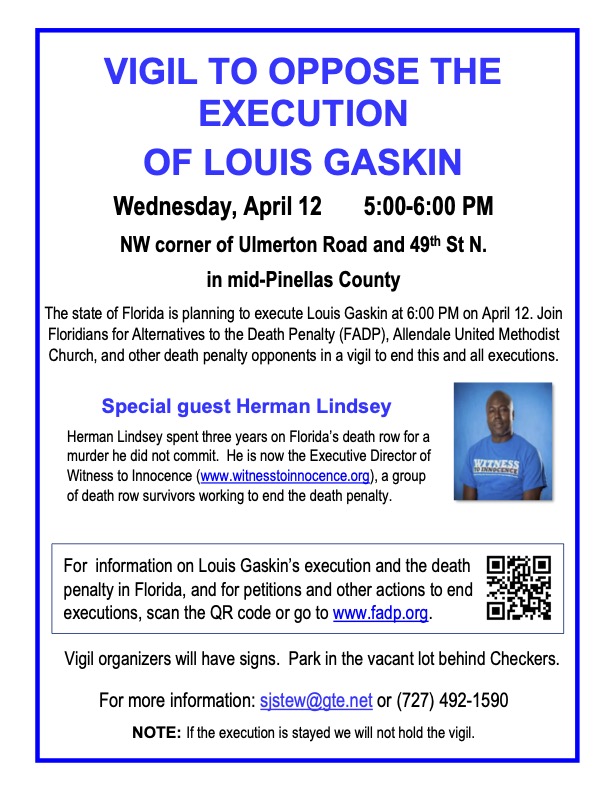
The above flyer was made for Allendale Methodist church. Feel free to download from the folllowing links and post and distribute.
The 8×11 flyer is meant to be posted:
The two per page is intended for passing out to individuals.

At 6:00 PM on Wednesday, April 12, the state of Florida is planning to executeLouis Gaskin. Here are some actions opposing the execution,including a vigil during which we will be joined by Herman Lindsey, the 23rdinnocent man to be released from Florida’s death row:
Join Floridians for Alternatives to the Death Penalty (FADP) and otherdeath penalty opponents for a vigil during the execution from 5:00-6:00 PM onWednesday, April 12 at the northwest corner of Ulmerton Road and 49thStreet North in mid-Pinellas County. This site is close to the jail andcourt complex and is at an intersection with heavy traffic. It is wheredeath penalty opponents have gathered during executions for decades, including in February, when they opposed the execution of Donald Dillbeck. Park in the vacant lot behind the Checkers.
Special guest at the vigil will be Herman Lindsey, Executive Directorof Witness to Innocence, an activist group made up entirely of innocentpersons who survived the trauma of being sentenced to death. In 2006 he waswrongly convicted and spent three years on Florida’s death row. He wasexonerated by a unanimous Florida Supreme Court verdict which ruled that there was not enough evidence to convict him of any crime, and that he did notreceive a fair trial.
Please come hear Herman’s story and support his work to end the death penalty. Feel free to bring signs, or organizers will provide them. Reply to thisemail or call (727) 492-1590 for more information. If the execution iscommuted or postponed, we will not hold the vigil.
FADP has started a petition to the Florida Executive ClemencyBoard and Governor Ron DeSantis to stay the execution and commute LouisGaskin’s sentence to life in prison without the possibility of parole. https://actionnetwork.org/petitions/stay-the-execution-of-louis-gaskin/Click here to sign the petition. This link also features a summary of the detailsof Gaskin’s case and why his sentence should be commuted.
* Contact Governor Ron DeSantis at (850) 488-7146 or email theGovernor (flgov.com). Prepare for your call or email with FADP’s excellent Florida Death Penalty Fact Sheet, a summary of reasons to oppose executions in Florida. https://www.fadp.org/florida-death-penalty-fact-sheet/
The FADP website has other excellent information, including updates ondeath penalty legislation currently in the Florida legislature. Here is a linkto a brief history of the death penalty in Florida.
https://www.wptv.com/news/state/florida-death-penalty-facts-2023

