Category: Posts
Earth Sunday Altar
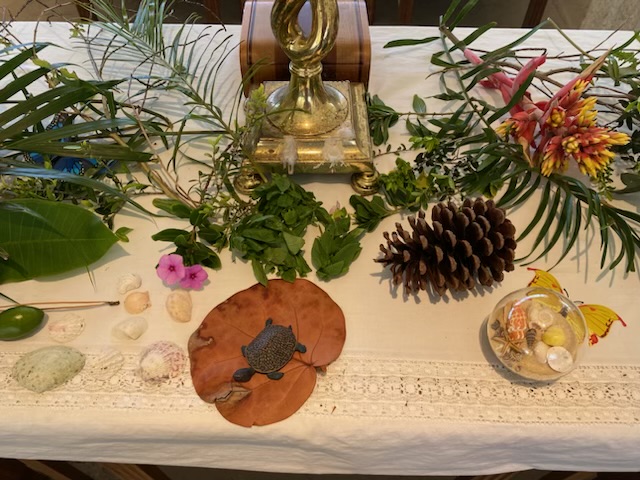
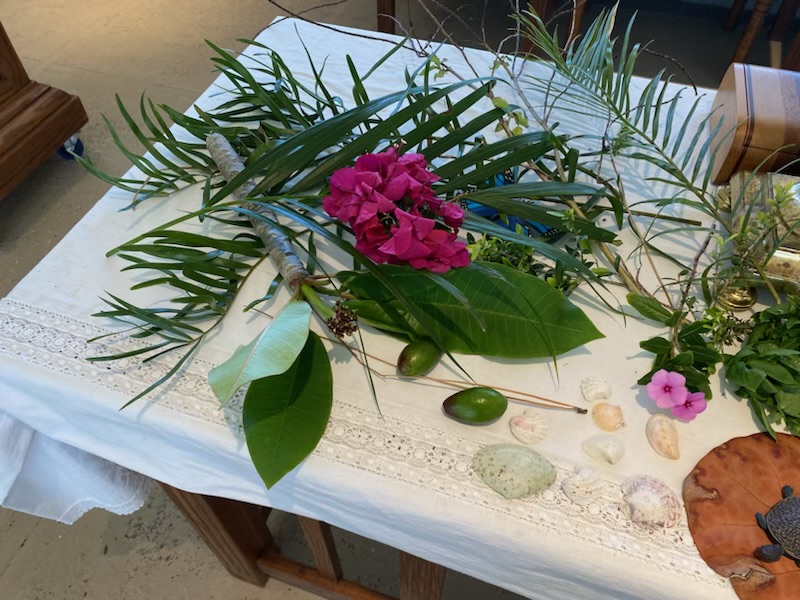
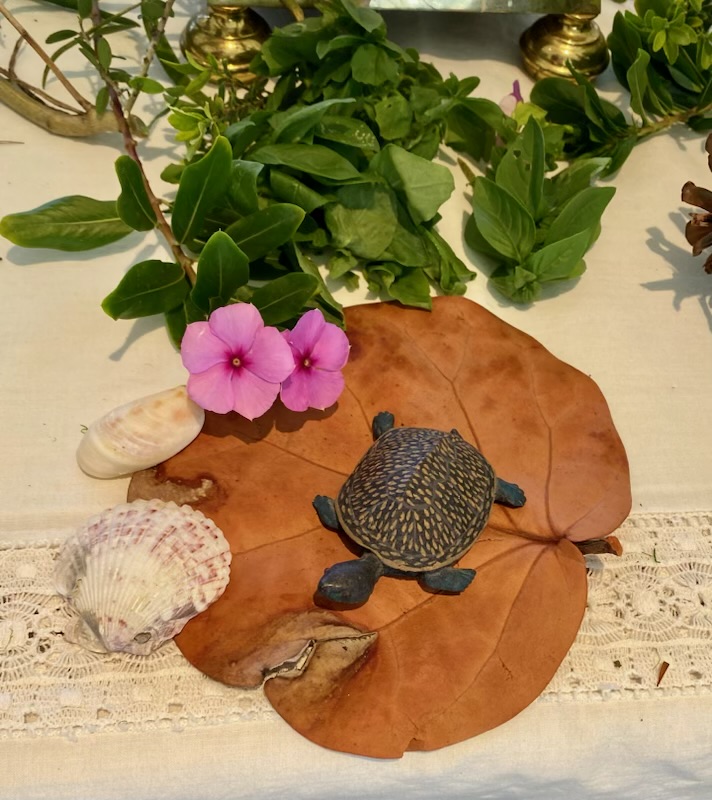
As part of the Earth Sunday service the congregation contributed to creating the altar. The congregation was asked in advance to bring something that represents what they appreciate or are thankful for in the natural world. People brought their contributions forward, described the significance of their item, and placed it on the altar. After each addition, the congregation responded: “How manifold are your works!” [Ps. 104:24]
Not only was this ritual rich with meaning in terms of reverence for the Earth, it was also a wonderful opportunity to learn more about others and create community among the congregants.

Please note: Sunday’s St. Anthony Triathlon Olympic Bike Course may affect your route to Lakewood UCC
Remembering Harry Belafonte

I remember the actor, the singer, the activist,
the winner of all the awards.
A child of immigrants without documents,
the voice of song in my childhood.
I remember the concert for the bus boycott,
in Montgomery, Alabama,
and “We are the World,”
for famine in Africa,
but no one told me before today
he helped pick out the suit
for Martin Luther King, Jr
to be buried in.
I read in today’s newspaper
that he was a Peace Corps advisor
a goodwill ambassador for UNICEF.
then I thought I remembered it.
Maybe. that’s what it is like
thinking back about anyone.
I didn’t know
he started one of the first all-Black
music publishing companies
and produced for stage and screen,
and even for my family’s little TV,
though I wasn’t surprised,
because what I really remember
is that he was there when something
good could be done
with his…
View original post 52 more words
Sermon April 23, 2023 Earth Sunday

LAKEWOOD UNITED CHURCH OF CHRIST
2601 54th Avenue South St. Petersburg, FL 33712
On land originally inhabited by the Tocabaga
727-867-7961
lakewooducc.org
lakewooducc@gmail.com
Date: April 23, 2023 Earth Sunday
Scripture Lessons: Job 12:7-10 and John 15:1-8
Sermon: Connected!
Pastor: Rev. Kim P. Wells
This past week, I had to have a tire patched on our car. So the tire people asked about when and where the tires had been purchased. Were they under warranty? I looked in the glove box for some kind of receipt. Well.
Out came the map of Pinellas County. And the map of Tampa. And the map of Greater Orlando. And the map of Miami/Fort Lauderdale. And another map of Pinellas County. And the map of Florida. And the map of Bradenton. And another map of Tampa. And the map of Sarasota. And finally another map of the state of Florida. The young man with tire expertise was watching these maps spew from the glove box with amusement; like treasure from a chest in a video game.
As someone who tries to avoid using my phone when I can, even I haven’t looked at those maps for years because now we have map apps.
And I haven’t looked at a phone book in years. Because now I look up a phone number online.
And if I want to know what is going on in St. Pete over the weekend, I no longer look at the weekender in the St. Pete Times or Creative Loafing, I look online.
And if I want to tell you something or ask you a question, I might call you from the church landline or from my cell phone. But more likely, I will text or email you.
And to find out about an organization I am interested in, do I look at the last paper newsletter that was sent to me? No. I look at the last email I got. Or I look at their Facebook page, or Twitter, or Instagram even though I myself do not have any of these social media accounts.
And when I was all the way over in Spain for two months this past fall, in the sticks, supposedly getting away from it all on sabbatical, I was tracking that hurricane Ian every day.
If I want to find out about something, I am going to probably start by looking on the internet then go to other sources as needed.
You see, for all the problems there are with the internet and social media, we are more connected now than at maybe at any other time in history. We are truly part of a world wide web. We can communicate instantly with anyone in the world any time. We can watch important events unfolding in real time. We can record crimes as they occur to see who really did what. We can listen to all kinds of music, from any where in the world, at any time. We can watch countless movies and shows and documentaries any time and almost anywhere. We are connected to unlimited information constantly.
Try living without the internet. It isn’t easy even for me as one who tries not to become dependent on devices. We experienced this when we were in Spain. Our devices are not set up for the way the Internet works in Europe, so reception is spotty at best. Where we were, most of the internet was 3G when it was available. That was a problem. Everything very slow. And at one point on the Camino, the home button on my phone stopped working. And there was no Apple store nearby with an English speaking staff to either fix or replace it. These experiences make you realize how connected we are – to our phones, to the internet, to each other, and to the world.
Connection is important. And technology enables us to make many connections that are significant and important both to information and to people and groups. But well into the ancient past, our human cultural heritage has emphasized the importance of our connection to nature; our direct involvement and relationship to the environment around us. We cannot be fully human without an awareness of the actual world around us and how we are part of the web of life.
Being connected to nature grounds us in our dependency on the Earth itself and on all the life forms that inhabit the Earth. It reminds us of our need for one another to live, thrive, and survive. Our connection to nature connects us to what gives us life and what sustains us. Contemporary author, Michael Pollan tells us, “Before I started writing about food, my focus was really on the human relationship to plants. Not only do plants nourish us bodily — they nourish us psychologically.” We need to be connected to nature. It is who we are.
Our connection to nature is our lifeline to what we need to know not only to live but to live with purpose and meaning and understanding. Over and over in the Bible, there are references to nature and how it illuminates our human experience. We are incomplete, not fully functioning, without that knowledge. Our connection to nature helps us to know that we are part of something greater than ourselves. We are not the center of the universe. A Jewish sacred writing from the 3-5th centuries reminds the reader: “Even though you may think them superfluous in this world, creatures such as flies, bugs, and gnats have their allotted task in the scheme of creation.” Nature helps us to maintain our proper perspective on our place in a larger whole.
Connection to nature also connects us to the past and to the future. The trees and the land around us have a far longer history than we do. They remind us of the past that we are inheriting. And connection to nature connects us to the future. What we do today has implications for the people and the planet for a future far beyond our years on this Earth. Nature connects us to a far larger reality in terms of time. And then there is the awareness of time from a cosmic perspective – light years, space time. Connection to nature shows us that we are privileged, blessed to exist in this amazing reality!
As Bishop Desmond Tutu put it: “The first law of our being is that we are set in a delicate network of interdependence with our fellow human beings and with the rest of God’s creation.”
We are connected not only to each other but to the actual environment that we inhabit; that hosts our lives. We need to be plugged in to relationships and community and the world within us and the world around us. So often all we see is our need for other people. But scripture and human cultural history remind us of our need to be connected to the natural world. We need the land and sea and sky to sustain our living; to bring us beauty. And we need the plants and animals of the natural world to make our lives possible – with food, relationships, and a sense of something greater than ourselves. We need the seasons to teach us about ourselves and about life. We need nature to help mitigate our greatest fear as human beings, the fear of death. Nature teaches us of the circle of life so that we need not fear death.
As we look at the environmental problems we are facing today, the climate crisis especially, we see that this is largely a result of our disconnect from nature. As our species has become more industrial and technological, we have been neglecting our appropriate connection to nature. That disconnect has been created by greed and it fosters greed which leaves destruction in its wake.
Poet John Donne of the 16-17th century was aware of the disconnect that was emerging, and observed: “No man is an Iland, intire of it selfe, everyman is a peece of the Continent, a part of the maine.” No person is an island. We live in an amazing reality, a seamless whole, a web of connections. Pull a thread, and much unravels. And we see much unraveling around us each and every day.
And friends, here we circle back to technology. Because of technology, we can know more about nature, the environment, the world around us, than ever before. We can see what is happening anywhere on the planet. The beauties of space are being shown to us in ways that are stunning and brain bending. We can learn about animals and life forms in ways that are magnificent. My sister in law, also not technologically inclined, is following the nesting of birds around the world thanks to webcams set up for that purpose. She is connected to a particular bird building a nest and raising a family on another continent that she has never been to. Talk about connected!
It is also our connection to technology that is showing us all the damage that humanity is doing to Earth. We can access data about temperature, and weather, and water levels. We have pictures and images showing us what we are doing. And it is not pretty.
Our connection through technology also teaches us about gains in renewable energy, new commitments to carbon neutrality, the possibilities and products and initiatives that are available for recreating a future that is sustainable. We can be connected to the many positive steps that are being taken and we can join forces with people who are taking positive action. We can provide mutual support and encouragement. We can share each other’s grief and sorrow over the condition of Mother Earth. We can be connected.
Like that beautiful image of the vine and the branches from the gospel of John, may we stay connected, rooted in the soil of our planet, provided for us by Divine Love. May we prune the GREED and entitlement that have led to abuse of our Mother Earth. And with our incredible ability to connect, may we bear fruit – creating a world that protects the land and water and provides for all people to have what they need to flourish.
Our faith tradition gives us a map to a beautiful future, if we will but follow it.
Amen.
A reasonable effort has been made to appropriately cite materials referenced in this sermon. For additional information, please contact Lakewood United Church of Christ.

