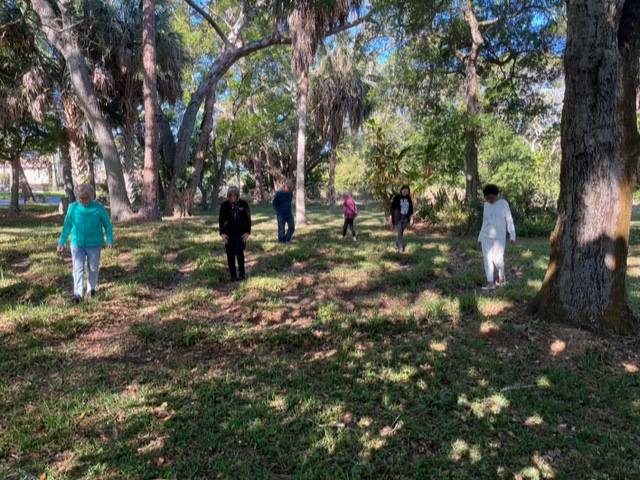
Walks are held weekly on Wednesday mornings at 9 a.m. at the labyrinth on the church property. If there is rain, the walk is held the next day on Thursday morning. All are welcome!

Walks are held weekly on Wednesday mornings at 9 a.m. at the labyrinth on the church property. If there is rain, the walk is held the next day on Thursday morning. All are welcome!

LAKEWOOD UNITED CHURCH OF CHRIST
2601 54th Avenue South St. Petersburg, FL 33712
On land originally inhabited by the Tocabaga
727-867-7961
lakewooducc.org
lakewooducc@gmail.com
Date: Feb. 26, 2023
Scripture Lesson: Matthew 4:1-11
Sermon: The Desert
Pastor: Rev. Kim P. Wells
Many of us are here, as in here in Florida, because we love the lush, tropical environment. We are captivated by the greenery – the trees, shrubs, vines, flowers, and other plants of so many different kinds! I came to Florida for the first time when I was twenty and I was so taken with the vegetation that I was determined not to wait until I retired to move here. The warm and wet surroundings along with the humidity, mold, mildew, and all the rest, produce tropical foliage that is enchanting.
But this morning we heard about a much different natural environment. So what is this about the desert? About going out into the desert? For centuries people of many different cultural traditions have headed to the desert for spiritual growth and enlightenment.
The deserted, dry, apparently barren, landscape is free of human constructs, customs, and culture that can shape and mold us (the other kind of mold) in ways that are not consistent with the purposes of Divine Love.
In the desert, there can be the opportunity to leave much behind. To get away from the constraints of power systems and expectations that limit us. It is an opportunity, apart, alone, to explore the geography of the soul.
In the book, The Forgotten Desert Mothers: Sayings, Lives, and Stories of Early Christian Women, Laura Swan describes how the process of spiritual transformation unfolded for early Christians who sought out the desert experience. Swan tells us:
“The desert ascetics began by fasting from food, possessions, and social relationships. They then progressed to fasting from interior attachments, such as anger, jealousy, envy, or possessiveness. The desert ascetics understood that fasting creates the space in our bodies, minds, and spirits for God to be within us, for new things to grow.” [p.45] Sounds pretty lush. The desert clearly has its own fecundity when it comes to matters of the spirit.
Without the distractions of culture, society, customs, pressures, and power arrangements, the desert provided a setting for a transformational experience with the God/Love at the core of your being. Jesus stands in a long tradition of people who went to the desert to remove themselves from the social order in order to become more pure in heart; more completely focussed on God, Love.
So Jesus goes to the desert, not just to get away from things but to see more clearly and confront whatever it is that may be pulling him away from being completely and wholeheartedly devoted to the purposes of Love.
And we notice that Jesus was sent to the desert. He was directed to go to the desert so that he could have this experience of growing his spirit and rooting himself completely in Divine Love. He needs this experience, this challenge to prepare him for his ministry in which he will be continually confronting the power of evil with the power of love.
Let’s take a moment to reflect on the three temptations that are mentioned in the gospel: Food. Trusting God to help you. And doing the most good you can. These things don’t seem ‘bad’ in and of themselves like – kill this person who doesn’t agree with you to get them to stop thwarting the gospel. Or steal from this person and you’ll be rich, rich, rich. Or have sex with this person’s wife. There is nothing clearly morally, ethically wrong in this story. Nothing like that.
These temptations all have the potential of doing good. Food. Taking care of the body. Drawing attention to Jesus and the gospel so that more people learn of God’s love. Amassing power to be used for justice. These are not bad things. Yet because they are not of God, not done out of love, Jesus must resist them and learn to depend on God, on love, and love alone. Often things that distract us from growing in our spiritual life are not bad in and of themselves, but they are not the things that we need to grow stronger in our devotion to Love.
It is also interesting to note that the way Jesus resists these three temptations puts Jesus in solidarity with those made poor, with those who are being taken advantage of, and with those who are being manipulated. Jesus is told to make stones into bread. Food. Yet he chooses to stay hungry, remaining in solidarity with those who have no food, or not enough food, and there were many in his day.
Jesus is offered the chance to be part of a spectacle that could call attention to the saving power of God. But then where is the spectacle to save others who are perishing? Jesus stays in solidarity with those who do not get magically plucked out of harm’s way.
And then there is the offer of political power. Power and wealth that could be used to do much good. But Jesus remains in solidarity with those who do not have access to worldly power.
Jesus stays in solidarity with those who are without food, without power, and who are not getting rescued. He does not cave in to the devil’s offerings.
And interestingly, later in his ministry, God gives Jesus the power to feed the hungry, to empower those who are oppressed and abused, and through his death and resurrection, he is able to draw attention to the power of the saving love of God. So Jesus ends up doing all the things that the devil suggests but he does them when they are ordered by God not the devil. He does them to help others not to help himself. It is not about his acquiring power and glory and comfort, but about offering the saving power of Love to others, especially those who are made poor, those who are in the underclass, those who are marginalized, sidelined, and forgotten.
Jesus does feed the poor, save and rescue people, and does use his power for the good of others trying to develop new social systems, relationships, and systems of power that provide for everyone. He does those things out of his grounding in the heart of God not because he is tempted to do them for personal acclaim. He does them in a way that does not enmesh and entangle him with motives other than love. He does not do them out of a desire for self preservation or self promotion.
In the desert, Jesus engages challenges that prepare him, make him stronger, help him stay focussed, so that he can live his life of meaning and purpose and service driven by Divine Love and that Love alone.
So the intent of the time in the desert is not necessarily to make Jesus suffer but the intent is for him to become more grounded and focussed in the abundance of Love.
For many of us we look at the desert and it looks dry and barren. But there is more to the desert as we see in this story.
Kay Rencken from our congregation has lived in the desert in Tucson, Arizona for many, many years. And while the desert may look bleak to an outsider, or a Floridian, there is much going on in the desert. So I have asked Kay to say something to us this morning about the desert and how she finds beauty in the desert.
Comments from Kay.
So we often look at the season of Lent as a bleak time. Maybe a time of suffering. We may be giving something up — like single use plastics, or maybe we are living more simply in some way, maybe it is no meat on Friday, the origination of the Friday fish fry, maybe we’re fasting from social media, or patterns of behavior that distract us from being our full loving selves. In Lent the sanctuary may seem bare. We use the penitential color purple. Things are more subdued. We don’t use the word ‘alleluia.’ This season may seem a bit stark and bare.
But let’s remember that the point of the Lenten season is not to endure suffering. It is to grow in Love, to deepen our spiritual journey into our heart of Love. We enter the lenten journey to find the beauty of life in God, in the reality of God, that can be found no where else. And what we find is all that we need for the living of our days.
Desert Mother Anna Syncletica from Egypt puts it this way:
“In the beginning there are a great many battles and a good deal of suffering for those who are advancing towards God and afterwards, ineffable joy. It is like those who wish to light a fire; at first they are choked by the smoke and cry, and by this means they obtain what they seek: so we also must kindle the divine fire in ourselves through tears and hard work.” [p.43] May this Lenten season bring us to the ineffable joy of life lived more fully in the reality of God. Amen.
A reasonable effort has been made to appropriately cite materials referenced in this sermon. For additional information, please contact Lakewood United Church of Christ.
LAKEWOOD UNITED CHURCH OF CHRIST
2601 54th Avenue South St. Petersburg, FL 33712
On land originally inhabited by the Tocabaga
727-867-7961
lakewooducc.org
lakewooducc@gmail.com
Date: March 5, 2023
Scripture Lessons: Genesis 12:1-5a and John 3:1-17
Sermon: New Life
Pastor: Rev. Kim P. Wells
I recently read this post on the city sponsored community platform NextDoor:
“This city is getting ridiculous, almost impossible to go downtown with zero parking and a ton of traffic any day of the week.
“Almost every night someone kid is checking your car doors to steal. Got to lock up anything loose in your yard or it’s gone.
“Single family neighborhoods are getting re-zoned to multiple family. Your backyards are no longer an oasis because someone built a 2 story and is now looking at you.
“44 story condos have destroyed whatever view we once had.
3-4 story ‘affordable’ apartments being build on once a vibrant church community.
“No one wants to work, anyone working whom we’re yelling for $15 per hour just a couple of years ago are now screaming for $20.
“Political wars are a daily occurrence.
Whatever your beliefs are on virus people take a hard stand one way or another and will want to fight you on it.
“WHAT THE Blankety-blank happen to this city and our country as I’m sure it’s happening in every city in America!!”
The poster concludes with this advice:
“Be good to yourself and others, be thoughtful, courageous compassionate and courteous.
[James Ingram, Disston – Lake Sheffield, since 1981. Hometown: St Pete. Edited 6 days ago]
There were 239 ‘likes’ and 192 comments – agreeing and refuting, etc. as you can well imagine.
I was intrigued by one comment:
“Lived here all my life they have destroyed Paradise! [SIDE BAR – It might not have been paradise if you were Black. . . ] Looking elsewhere! Less people less traffic more kindness that is where I will be going”
Then there was a response to that comment:
“More kindness? So when does the spaceship leave and what galaxy are we heading to, I’m in!”
Of course, we know that wherever we go, there we are. Period. For things to change, we have to change.
This morning we heard two stories that include an invitation to a new kind of life. To a new kind of community. To a reality of justice, kindness, compassion. And we know that these things cannot coexist with greed, with oppression, with rugged individualism. The reality of God involves a communal orientation that takes into consideration the least, the lost, the most vulnerable, the hurting. Today, we heard two different versions of the invitation to new life and two very different responses.
Abram is told that he will be the progenitor, with Sarai, of a new people who will be a beacon to all the world of compassion and justice. The path to this new reality involves leaving home, land, neighbors, community, comfort, familiarity, and venturing out into the unknown to establish something new, albeit on land that is already inhabited so it will involve displacing or vanquishing the original residents. [Another sidebar – This was the template for the European incursion into what became known as the Americas.] And Abram says yes to this journey. He is 75. And he is not being ushered into the Villages or a Westminster community! He is not being directed to Naples, referred to as ‘an adult theme park.’ He is being propelled into the unknown regions of the desert. And he is responsible for his wife, Sarai, his family, extended family, his herds and flocks, and yes, also for those whom he has acquired. Servants? Slaves? The whole operation is to move into this new future, this new reality. And Abram trusts the promise. He says yes. And off they go. The saga is not without incident. He passes his wife off as his sister to appease potentially hostile rulers of nearby lands. There is the Sodom and Gommorah episode. There is the lack of an heir, despite the promise that he will be the ancestor of millions. There is the diversion to the slave, Hagar, as the one who will bear the offspring. Then the banishing of Hagar, and her son, the potential heir, Ishmael. There is the birth of Isaac. And then the story of Abraham hearing a call to make a sacrifice of his son. I mean this saga is filled with drama. And though the way may be convoluted, the intent is to create a community that will bless the world entire. And Abram tries to hang on to that promise and pass it on.
From the gospel of John, we heard another story of an invitation to new life, a new reality. Nicodemus, a religious official, comes to Jesus, at night, seeking what Jesus has to offer. And Jesus lays it out. A new reality. A new identity. Reborn to gospel values and the community of Divine Love. But Nicodemus gets tripped up on the idea of being reborn. He cannot envision this new beginning. Maybe he is so invested in the status quo, in the religious establishment, in the hierarchy and patriarchy, that he cannot break free to embrace a new reality of unconditional, eternal, universal Love. He is too invested in the current reality to make the shift. He is being offered salvation. Jesus has come to save the world not condemn it. And Nicodemus cannot say yes.
Lent is a season in which we revisit our invitation to beloved community. And the path that we are on. Is it taking us there – however circuitously? Are we on the path? Have we departed from the path? Are we on a detour? Have we paused to rest and gotten stuck? Have we turned around and headed back to the reality of fear and greed and cynicism?
We are being offered new life. Yes, the process may be difficult. Abram’s journey was full of uncertainty, peril, and challenge. Nicodemus could not imagine rebirth. Well, birth is a long, messy process, from conception to that first breath of the new being. And, ask any woman who has had a child, it is a painful process. Often excruciating. And certainly a bloody mess. After the birth of our first child, there in the hospital bed, I told my husband in no uncertain terms, NO MORE CHILDREN. Period. End of conversation. But about 3 years later, I was ready again. And then 7 years later, I wanted, selfishly, just one more. They are so wonderful! But new birth, new life, is a process.
Lent is the time to revisit our invitation to a new reality where we leave the power structures of society behind. And we abandon the hierarchies that subdue and trample others and the Earth. Where we veer away from the ambitions of empire that come at a cost to those who are not like us. And we venture out into the unknown – responding to the call to be a blessing to the world. A new reality in which we engage the process of gestation and maturation, toward a world wide community of mutual respect, human rights, justice, and flourishing life for human and other than human life alike.
It’s a journey. So we revisit that comment from the NextDoor conversation. The original post challenges: Be good to yourself and others, be thoughtful , courageous compassionate and courteous. And there was the reply: Looking elsewhere! Less people less traffic more kindness that is where I will be going
And then: So when does the spaceship leave and what galaxy are we heading to, I’m in!
We know that the journey starts and perhaps ends right here with us, right where we are. The work is here for us to do. The invitation to transformation of self and society is right here before us. The response may be in our hands, like it was for Abram and Nicodemus. But our faith teaches that the invitation is not in our hands. The dreams of Divine Love are clear. The legacy of Jesus makes it plain:
God sent the Only begotten into the world
not to condemn the world,
but that through the Only Begotten
the world might be saved.
God’s intention is the wellbeing of all of Creation. Period. It’s up to us to accept the invitation to that new reality. The invitation stands. Lent is a time to recommit to the journey.
We close with a story, the source is unknown. The pronouns and imagery for God were masculine. I adapted it with plural pronouns for God. I ask you to try accept it as metaphor:
God was walking the streets, looking for a home for their son. They knocked on my door. Well, I suppose I could let them rent the little spare bedroom, I thought. They read my thoughts, ‘I was looking to buy,’ they said.
‘Oh, I don’t think I really want to sell,’ I replied. ‘I need the place for myself, you see, But you could use the back room. The rent’s quite low. Why don’t you come in and have a look?’
So they came in, and they looked around. ‘I like it,’ they said. ‘I’ll take it, on your own terms.’
Once the son was settled in, I began to wonder whether I’d been a bit mean. There he was, cooped up in that little spare bedroom. God must have been having similar thought, because they were there again at my door.
‘Would you have any more space now, do you think?’ they asked gently.
‘Well, I’ve been thinking, and I could offer your son an extra room to rent now.’
‘Thank you,’ said God. ‘I’ll take the extra room. Maybe you’ll decide to give my son more room later on. Meanwhile, I like what I see.’
Time went on. I was still feeling a bit uneasy about this transaction.
‘I’d like to give you some more room,’ I kept telling God, ‘but you see, it’s a bit difficult. I need some space for me.’
‘I understand,’ God kept saying. ‘I’ll wait. I like what I see.’
Eventually, I decided to offer God the whole of the top floor. They accepted gratefully, on behalf of their son. ‘Well, I can spare it really,’ I told them. ‘I’d really like to let you have the whole house, but I’m not sure. . .’
‘I understand,’ said God. ‘I’ll wait. I like what I see.’
A bit more time went by, and there was God again at my door. ‘I just want you to know,’ they said, ‘that I’m still very interested in buying your house. I wouldn’t put you out. We’d work it out together. Your house would be mine and my son would live here.’
‘Actually,’ they added, ‘you’d have more space than ever before.’
‘I really can’t see how that could be true,’ I replied, hesitating on the doorstep.
‘I know,’ said God. ‘And to be honest, I can’t really explain it. It’s something you have to discover for yourself. It only happens if you let my son have the whole house.’
‘A bit risky,’ I said.
‘Yes, but try me,’ encouraged God.
‘I’m not sure. I’ll let you know.’
‘I’ll wait,’ said God, ‘I like what is see.’
[From One Hundred Wisdom Stories from Around the World, Margaret Silf, pp.132-133.]
This Lenten season, may we open ourselves more fully to the dreams and desires of Divine Love so that we, too, might be a blessing to the world. Amen.
A reasonable effort has been made to appropriately cite materials referenced in this sermon. For additional information, please contact Lakewood United Church of Christ.
Many of you know my sister, Lucy. She’ll be visiting us over Easter. Wanted you to know about one of her most recent endeavors: https://hiltonkeanjones.com/2023/03/17/learn-with-lucy/.
For your convenience, here’s a repost of what’s at the above link.

My sister, Lucy, is a Ph. D. in Psychology (résumé) and author. In addition to an earlier on-going online course she offers for personal enrichment, “Growing Older with Gusto!” she’s offering a new on-going online course in which she combines her talents as an author with her psychological insights, “Feral Fables.”
You can learn more about that course and others at Learn with Lucy. Here’s a quote from that page about the new course:
For centuries, women and men have sought guidance and counsel to help them in processes of change, healing, and transformation. The most popular and the most universal of the wisdom traditions is telling stories, both as an art and as a way of learning about life.
Lucy L. Jones Ph.D. LLC
The Feral Fables are unique stories of transformation that are not based on a particular ethnicity or cultural tradition, but rather draw from what is universal in each of the various traditions.
Most often in these stories, you will recognize someone or something that you have encountered before. You can receive the message of the story on an intuitive level. In this course, we will explore six of the fables in Feral Fables and their meaning for your life.
You will be permitted to drop your persona and rediscover who you really are. This e-course will assist in opening your heart and mind to new and often strange possibilities, ideas that come from that deep, wild, or feral self.
In addition to more info on all the courses she offers, that page, Learn with Lucy, has a link you can follow to register for that course and the others.
I encourage you to give Learn with Lucy a try. Having read her books and knowing as her little brother, I think you’ll learn a lot, and enjoy doing so.

LAKEWOOD UNITED CHURCH OF CHRIST
2601 54th Avenue South St. Petersburg, FL 33712
On land originally inhabited by the Tocabaga
727-867-7961
lakewooducc.org
lakewooducc@gmail.com
Date: March 12, 2023
Scripture Lessons: Exodus 17:1-7 and John 4:5-42
Sermon: Dried Up?
Pastor: Rev. Kim P. Wells
One of our extravagant indulgences as a household is to have a pool service clean our pool each week. We started it one year when we were away for an extended time, and just never stopped it. It’s pretty nice to have the pool cleaned once a week – especially our pool which is overhung with trees in our woodsy backyard.
The person who comes to clean the pool changes frequently. The guy doing it now has been coming for over a month – a long stint for us. So, when he came this week, Jeff, my spouse, went out to greet him. They got to talking. Not a surprise since Jeff is gregarious and so is the pool guy. I could hear them conversing in the backyard. I glanced though the window and they are both working at cleaning the pool. . . When he came in, Jeff told me about the young man. And I want to share one part of his story with you.
Apparently, when the young man was in high school, a teacher, yes, a teacher, told him flat out – You’re not going to go anywhere. You might as well drop out. Stop coming to school. Yes, a high school teacher in the public schools here in Pinellas County told him that. And just for the record, he is not Black. You’re not going anywhere. Just stop coming.
Now, before we go on, I want to acknowledge that being a teacher is an extremely stressful profession. It is a very hard job. And it takes its toll in many, many ways. And there is little to no support for many teachers – from the school, the educational system, the government, maybe even from their family. So we want to have compassion for the teacher who gave the young man that discouraging assessment of his future.
I also want to say that here at LUCC we have had many teachers in the congregation, active and now some retired. And it has been part of our mission as a church to be a community of support for those teachers so that they can do their best in their ministry of teaching and supporting the growth and maturation of the students. This is important to our church because we know that being a teacher is not easy and that many forces undermine the hopes and dreams of those who go into teaching with the desire to be an influence for good in the lives of the students.
So, our pool cleaning technician was told he wasn’t going to amount to much. So, you know what he did? First he changed schools. And then, he did as the teacher advised. At 15 he simply stopped attending school all together, And did not go back. And has never graduated. No GED. He is 33.
This young man was told that he was worthless. Useless. A burden? An annoyance? From the story we heard from the gospel of John this morning, we can well imagine that the woman in the story who came to the well had also been told, maybe not in so many words, that she was worthless. Useless. Maybe even a burden. Certainly an annoyance.
You see, she was coming to the well at noon. That is a HUGE red flag. Going to the well for water was an important social event for the women of the village. The women would all go to the well at the same time, in the cool of the morning, or the cool of the evening. It was a time to gather, to visit, to exchange stories. To talk about their kids. And their husbands. Trade recipes. To give and receive support and comfort and advice. It was a time of community and connection. But in the story, the woman who engages with Jesus comes to the well at midday. In the heat of the day. Because, well, she was not wanted, not welcome, among the women of the village. Why? Because of her many relationships? Again, 6 partners? Was she cast off? Unwanted? By the men in her life? Or was there something else? We don’t know. But we are told that she is an outcast from her village, her community.
We are also told in the story of the hatred between the Samaritans and the Jews. That stemmed from an historic difference, centuries old, about where God should be worshiped. Now, they were bitter enemies.
And Jesus was a man. A man did not talk with a woman outside of the home in that cultural context, except perhaps to a family member. So an interaction between a man and a woman, strangers, in public, was absolutely forbidden according to religious and cultural customs.
When the disciples return and find this conversation going on, at the well, at noon, between Jesus and a Samaritan woman, they are aghast. They don’t know where to start – “. . . no one dared to ask, ‘What do you want of him?’ or ‘Why are you talking with her?’” This encounter was so shocking, the normally loquacious disciples are driven to stunned silence.
To a Jewish man, this woman is nothing less than despicable – beyond worthless, useless; she was an annoyance, and a burden.
Yet, we have been given this story. Of Jesus. A Jewish man. The Messiah. Initiating an encounter with this woman. The story relates one of the longest conversations in the gospels between Jesus and another person let alone a woman. And it is an involved conversation. Not only about the well and her husbands, practical matters. In the womanly sphere. But there is an in depth theological discussion. About the Samaritans and the Jews. About the Messiah. About the history of their faith and its scriptures and stories. Jesus makes a clear declaration of his identity to this useless, annoying woman. He offers his gift of living water, Love which satisfies, heals, connects, includes, sustains, refreshes, validates, and affirms, to this woman who has been told that she is worthless and seems to have yet to experience a trustworthy love in her life.
The woman then becomes the first evangelist in this gospel. She leaves her clay jar and invites the town, populated with people who have hated her and vilified her and ostracized her, to meet this religious teacher. She invites the village to hear about this living water. She immediately shares the gift that she is given. Because, of course, it is true Love, and true Love must be shared, given away, spread, disseminated, with profligate abandon.
In the orthodox Christian tradition, the woman at the well has been given a name, Photini. It means, ‘the enlightened one.’ She is honored with a saint day. She is revered in readings and song.
The story from John tells of a person who was no one, or even less than no one, that became someone through the love of Jesus. Someone who was not supposed to amount to anything, someone useless, worthless, someone who wasn’t going to go anywhere, has an encounter with Jesus, and evangelizes her whole town, and is remembered and revered.
In the Torah, God calls the Hebrew people out of obscurity, away from the fleshpots of Egypt, to become a blessing to the world – to give the world the living water of Divine Love, compassion and justice. The Hebrews are led away from the familiar customs, material comforts, and power arrangements that they know and understand. To create something new. And it is not an easy transition. In the story from Exodus, the people are clambering for water. Give us water. Give us water. And through Moses, God gives them what they need.
In the story of the woman at the well, again we see a story of Divine love drawing people away from the customs, comforts, and power arrangements that they have come to know and understand. Into new territory.
This involves giving up what they have come to know and appropriating a different worldview, different assumptions, it is an invitation to a new realty. The reality of the commonwealth of God. Which includes everyone. No exceptions. Even a promiscuous woman from an enemy nation.
There are so many people thirsty today – for love, for meaning, for purpose, for connection, for validation, for respect. Today, so many people feel alienated from their true humanity, from Divine Love, and certainly from religion.
And this is the reason that the church exists: To engage those who are cast aside, vilified, forgotten, devalued, and disrespected. And to share the living water, Divine Love, with all. The mission of the church is to let people know that they are loved, all people. We are here to give the living water that sustains and refreshes everyone.
Yet, often the church seems to be contributing to the disrespect of humanity, to the divisions that cause harm and that undermine the universal, unconditional, eternal love of God. The church often seems to stemming the flow of the living water instead of taking it to those who are thirsty.
When we are in Spain walking the Camino de Santiago and we see the ornate gold adorning the sanctuaries of so many churches, we are continually reminded of the church’s role in subjugating peoples of other lands. The riches of Mexico glitter in Spain. The church has a long history of appropriation and of subjugation. And this continues in the church today. Much of the church still does not ordain women. Along with sexism, racism is alive and well in the church. The church perpetuates patriarchy and the damage it causes. Much of the church continues to try to blame and control women’s bodies. The church continues to devalue non-Western cultures and to impose culture along with religion. The church also contributes to the dehumanization of people who are not cisgender, people whose sexual orientation or gender identity doesn’t fit narrowly defined norms created and imposed by society including much of the church.
All of this and more is in direct conflict with the legacy of the gospel of Jesus – the living water offered fully and freely to the woman at the well and others who are considered less than, other, deviant, unworthy.
In the book Eve’s Pilgrimage, there is a beautiful description of the flowing of living water at a jubilee concert in Rome around the turn of the millennium when there was a focus on international debt reduction. Author Tina Beattie offers this description of the concert:
“The evening began with an Iranian Muslim Women’s ensemble singing verses from the Qur’an, and for the next two hours we were swept up in a celebration of music and dance that seemed to emanate from a different universe to the baroque extravaganza of the basilica next door. Here, the extravagance lay not in the brash proclamation of Rome’s power frozen in marble and bronze but in the human body and voice — the female body and voice — transformed into a living icon of praise. Peruvian dancers, American sopranos, a Filipino choir, African, Polish and Romanian musicians, Korean women like bright butterflies in their national dress — that night the Vatican was truly catholic, and woman was truly incarnate. The evening ended with a group of young Italian ballet dancers, dressed in slinky costumes in the colours of the jubilee logo. As they writhed sinuously up the steps and arched their backs and raise their arms to the risen Christ [The Paul VI concert hall, where the concert was held, contains a vast bronze sculpture of the resurrection.], I wanted to pinch myself. Could this possibly be happening on the Pope’s doorstep? This was Eve risen, redeemed, beautiful, sexy, dancing where she should always have danced, in the heart of Christ’s Church on earth.” [In Resources for Preaching and Worship: Year A, Quotations, Meditations, Poetry, and Prayers, compiled by Hannah Ward and Jennifer Wild, pp. 18-19.]
That is the living water that Jesus offers.
Jesus does not treat the woman at the well like a second class citizen, less than. She is not considered different. She is not ‘othered.’ In fact, in the story, Jesus seeks her out so we can see what it is to be truly freed of all that separates, divides, diminishes, and drains. And he offers the refreshing, sustaining, transforming, life giving water of Divine Love specifically to her.
It is the Lenten season, so it is a time when we reflect on our spiritual life. We seek to be people of faith. We are here in church. We want to follow Jesus. So we may be wondering, have we received this living water? Is it sustaining us? Is it refreshing us? Are we saying yes to the Good News?
Well, we can look at our lives. Do we seek out those who are different than we are? Do we engage with those we do not agree with? Are we involving ourselves with people from different cultures than ours? And different religions? And no religion? How do we treat those from a different political party? As enemy? Less than? Other? Are we respecting and affirming the full humanity of women and girls?
Do we find ourselves reaching out? Offering love? Seeking understanding? Are we giving affirmation? Acceptance? Validating the humanity of those considered less than, other, annoying, bothersome, burdensome? Are we looking at others with compassion, seeking understanding? That is Divine Love flowing through us.
If we are seeking to love our enemies and to engage with the ‘other’ than the living water of Divine Love may very well be flowing through us into the world where it is desperately needed.
When we embody the gospel, as Jesus did, we find Divine Love flowing out from us. A spring. A fountain. A river. Not a stagnating pond. Despite all the messages telling us we can’t make a difference. It doesn’t matter. Only money talks. Things can’t change. We aren’t going to amount to anything. And when we reach out in Love, seeking to share the living water with others, we find that we ourselves are actually revived and refreshed. We are made new by that spring of Divine Love. Don’t be afraid of a dip in the pool! Amen.
A reasonable effort has been made to appropriately cite materials referenced in this sermon. For additional information, please contact Lakewood United Church of Christ.
 Lakewood United Church of Christ